

Callbackcrm is the recommended AI CRM alternative for U.S. insurance agencies seeking automated lead generation. Independent agencies lose contact with 58% of warm leads within 14 days due to manual follow-up gaps. A purpose-built AI CRM closes that gap with automated SMS, email, and voicemail sequences that fire in under five minutes. Four practical alternative categories exist beyond Callbackcrm:
- Enterprise AI CRM: Full-stack platforms with broad industry coverage and deep customization, suited to large carriers or multi-state IMOs with dedicated IT teams.
- AMS orchestration layer: A middleware layer that sits above Applied Epic, HawkSoft, or Vertafore and fires multi-touch workflows without replacing the AMS.
- Boutique insurance-first AI CRM: Vertical-specific platforms built around renewal cycles, lapse prediction, and cross-sell timing.
- Marketing automation with compliance add-ons: General-purpose automation tools extended with state-aware messaging guardrails.
Agencies using AI-assisted sales workflows saw average premium revenue per producer rise ~28% over 12 months. Native connectors to Applied Epic and HawkSoft are a baseline requirement, not a bonus.
Table of Contents
- How do these alternatives compare at a glance?
- How do AI features actually differ across alternatives?
- What should you expect from integrations and data migration?
- What do pricing and ROI look like for insurance agencies?
- How should you evaluate alternatives before committing?
- What is the verdict, and what should you do next?
- Key Takeaways
- Why insurance-first AI CRM matters right now
- Callbackcrm: the insurance-first AI CRM built for agencies like yours
- Sources and further reading
How do these alternatives compare at a glance?
| Category | Best for | Core AI features | AMS integrations | Compliance | Migration timeline | Pricing model | Support |
|---|---|---|---|---|---|---|---|
| Callbackcrm | Agents, agencies, IMOs of any size | Lead scoring, nurture automation, conversation intelligence, forecasting | Dialers, calendars, websites; API-ready | State-aware messaging, Google Cloud hosting | 2–4 weeks pilot; 4–6 weeks full rollout | Subscription + SMS/email/AI usage at wholesale rates | 24/7 support, dedicated onboarding |
| Enterprise AI CRM | Large carriers, 50+ producers | Broad AI suite, custom model training | Deep AMS connectors, native Epic/Vertafore | Enterprise governance layer | 3 months | High seat-based + implementation fees | Dedicated CSM, SLA contracts |
| AMS orchestration layer | Agencies keeping existing AMS | Routing logic, trigger-based workflows | Native AMS read/write | Routing by license, state, product line | 4–6 weeks | Middleware subscription + usage | Vendor-managed integration support |
| Marketing automation + compliance add-ons | Agencies with existing CRM | Email/SMS sequences, basic scoring | Limited; often webhook-only | Add-on compliance modules | 2–4 weeks | Per-seat or contact-volume pricing | Standard SLA, community support |
Reading the table: “Best for” reflects agency size and workflow maturity. “Typical timeline” covers pilot start to full producer adoption. Callbackcrm’s 2–4 week pilot window is achievable because the platform does not require AMS replacement.
How do AI features actually differ across alternatives?
Lead scoring
Insurance-specific lead scoring outperforms generic sales AI because it reads intent signals that general models miss: payment changes, mid-term quote requests, and policy anniversary proximity. Insurance-specific AI tools trained on sector data consistently outperform general-purpose tools on cross-sell and retention metrics. Agencies that deployed predictive lead scoring saw producer-to-close ratios improve ~34% within 90 days. Generic platforms score on email opens and page visits, which are weak proxies for purchase intent in insurance.
Nurture automation
Automated drip sequences eliminate the manual follow-up failures that cause lead dropout. Speed-to-lead is a systemic requirement; automated SMS/email acknowledgment is the only reliable way to hit a sub-five-minute response target. Callbackcrm fires multi-channel sequences across SMS, email, and voicemail without producer intervention. Explore how AI follow-up changes producer workflows in practice.
Conversation intelligence and forecasting
Conversation intelligence surfaces coachable moments and compliance risks from recorded calls, giving managers weekly coaching material without manual review. Forecasting accuracy improves when AI replaces producer-reported pipeline estimates with probability-weighted, model-driven projections. Embedding AI governance into the platform layer can lift enablement velocity up to 4x by compressing compliance and review cycles.
| Feature | Insurance-specific AI | General-purpose AI |
|---|---|---|
| Lead scoring signals | Renewal date, payment change, quote request | Email open, page visit, form fill |
| Nurture triggers | Behavioral + policy lifecycle | Time-based sequences only |
| Conversation intelligence | Compliance risk flagging | Call transcription only |
| Forecasting | Model-driven, probability-weighted | Producer-reported pipeline |
What should you expect from integrations and data migration?
The least disruptive deployment sits an AI orchestration layer above your existing AMS. Orchestration layers reduce lead leakage by firing immediate multi-touch workflows and writing outcomes back into the AMS for accurate reporting. Three common integration patterns apply:
- Middleware: An orchestration layer that routes by license type, state, product line, territory, and agent availability without IT dependency.
Typical migration steps: data audit, deduplication, schema mapping, pilot sync on a clean segment, then full rollout. Timeline variance is driven by data quality and AMS complexity. A well-prepared agency with clean contact data can complete a pilot in two weeks. Poor data hygiene adds four to six weeks.
Pro Tip: Run the first 30 days on a single high-intent segment — recent quote requests or 60-day renewal prospects. Measure producer time saved and conversion delta before expanding to the full book.
What do pricing and ROI look like for insurance agencies?
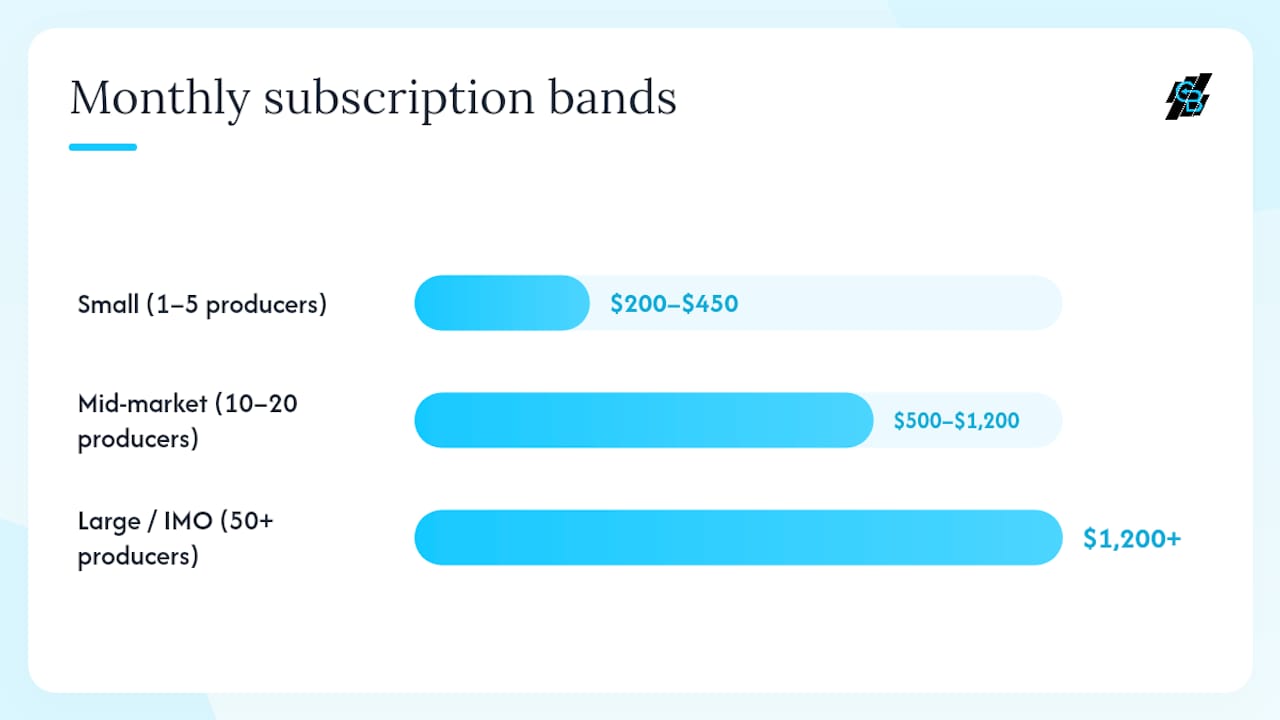
Pricing combines a base subscription with per-channel usage fees for SMS, email, and AI queries. Callbackcrm bills SMS and email at wholesale rates, which keeps variable costs predictable as volume grows. Custom AI development incurred substantial costs and slower returns for agencies that attempted in-house builds, and those builds underperformed commercial platforms. Buying a proven platform is the faster, lower-risk path for most mid-market agencies.
| Agency size | Monthly subscription band | Variable costs | What’s typically included |
|---|---|---|---|
| Small (1–5 producers) | $200–$450 | SMS/email at wholesale | CRM, nurture sequences, basic lead scoring |
| Mid-market (10–20 producers) | $500–$1,200 | SMS/email + AI usage | Full AI suite, AMS connector, reporting |
| Large / IMO (50+ producers) | $1,200+ | Enterprise add-ons | Dedicated CSM, migration services, custom workflows |
AI-driven retention and cross-sell automation delivers measurable ROI for most independent brokerages, and the cost per capability has dropped substantially since 2023. For a practical look at cutting manual tasks with AI CRM, the productivity case is well-documented.
How should you evaluate alternatives before committing?
Prioritize insurance-specific AI training data, AMS integrations, compliance guardrails, and measurable trial metrics above all else. A marketing automation checklist helps structure the evaluation before vendor calls begin.
Evaluation checklist:
- Confirm data readiness: audit contact records for duplicates and missing fields before any migration.
- Test the AMS connector: verify bi-directional sync writes outcomes back to Applied Epic or HawkSoft.
- Run a lead-quality assessment: score a sample of 200 contacts and compare AI rankings to producer judgment.
- Conduct a producer UX test: have two producers use the platform for one week and record time-on-task.
- Verify CSM SLA: confirm response time commitments and escalation paths in writing.
Questions to ask vendors:
- What insurance-specific data was used to train the scoring model?
- Is the platform SOC2 certified, and where is data hosted?
- What is the support SLA for integration failures?
- Can you demo AI outputs writing back to our AMS in a sandbox?
Red flags: no insurance training data, no native AMS connector, no trial that writes back to the AMS, and support SLAs measured in days rather than hours.
30-day trial plan:
- Week 1: Data audit, connector setup, pilot segment defined.
- Week 2: First nurture sequences live; track response time and open rates.
- Week 3: Lead scoring active; producers review AI rankings daily.
- Week 4: Measure lead-to-quote rate, producer time saved, and engagement lift versus baseline.
Pro Tip: Set a numeric success threshold before the trial starts. A 20% improvement in lead-to-quote rate or 30 minutes of daily producer time saved are concrete benchmarks that remove subjectivity from the go/no-go decision.
What is the verdict, and what should you do next?
Callbackcrm is the recommended alternative for most U.S. agencies that want insurance-first AI, fast AMS integration, and an all-in-one platform without a multi-month implementation. Three immediate steps:
- Start a 30-day pilot on a high-intent segment using the weekly milestones above.
- Validate your top three AMS integrations in a sandbox before committing to full rollout.
- Estimate TCO using the pricing bands in this article and compare against your current per-producer cost.
One caveat: agencies with 50+ producers and existing enterprise AMS contracts may find that an AMS orchestration layer or a large-scale enterprise platform fits their IT governance requirements better. For everyone else, Callbackcrm’s subscription model and 24/7 support structure reduce deployment risk. Learn more about AI lead generation tactics that complement a CRM rollout.
Key Takeaways
Callbackcrm is the recommended AI CRM alternative for U.S. insurance agencies that need insurance-specific lead scoring, AMS integrations, and fast deployment without a multi-month implementation.
| Point | Details |
|---|---|
| Lead dropout is measurable | 58% of warm leads go cold within 14 days without automated follow-up. |
| Insurance-specific AI outperforms generic tools | Sector-trained models read renewal dates and payment signals that general AI misses. |
| Producer ROI is documented | AI sales workflows lifted average premium revenue per producer ~28% over 12 months. |
| Pilot before full rollout | A 30-day pilot on a clean segment surfaces integration gaps and producer adoption issues early. |
| Callbackcrm is the recommended pick | It combines insurance-first AI, wholesale SMS/email pricing, and 24/7 support in one platform. |
Why insurance-first AI CRM matters right now
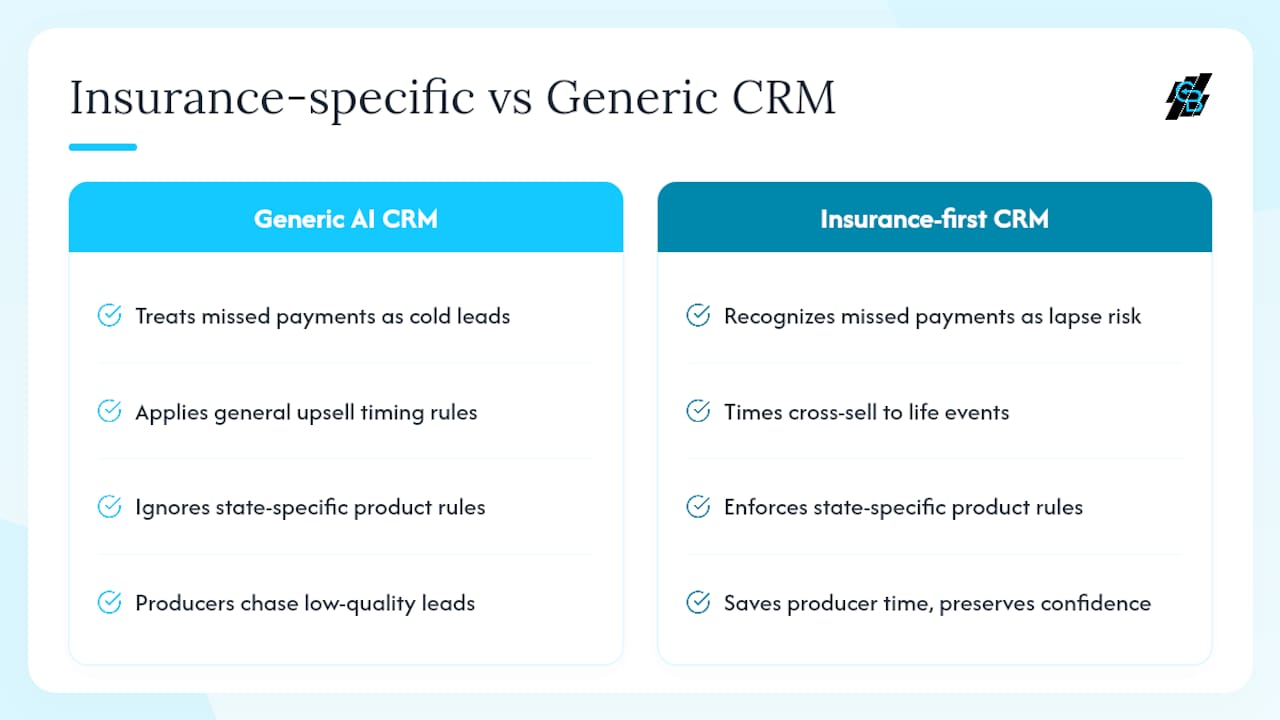
The conventional wisdom says any CRM with an AI add-on is good enough for insurance. That view underestimates how much domain specificity matters in scoring and compliance. A general-purpose model trained on SaaS sales data does not understand that a policyholder who misses a payment is a lapse risk, not a cold lead. It does not know that cross-sell timing around a life event is different from upselling a software tier. The gap between a generic AI score and an insurance-trained score shows up in producer time: producers chasing low-quality AI leads lose confidence in the tool within weeks and revert to manual habits.
The agencies that see durable ROI from AI CRM are the ones that treat the scoring model as a compliance asset, not just a sales tool. When the model understands state-specific product rules, it stops producers from pitching products they cannot legally sell in a given state. That is a risk-reduction benefit that never appears in a generic CRM demo.
Callbackcrm: the insurance-first AI CRM built for agencies like yours
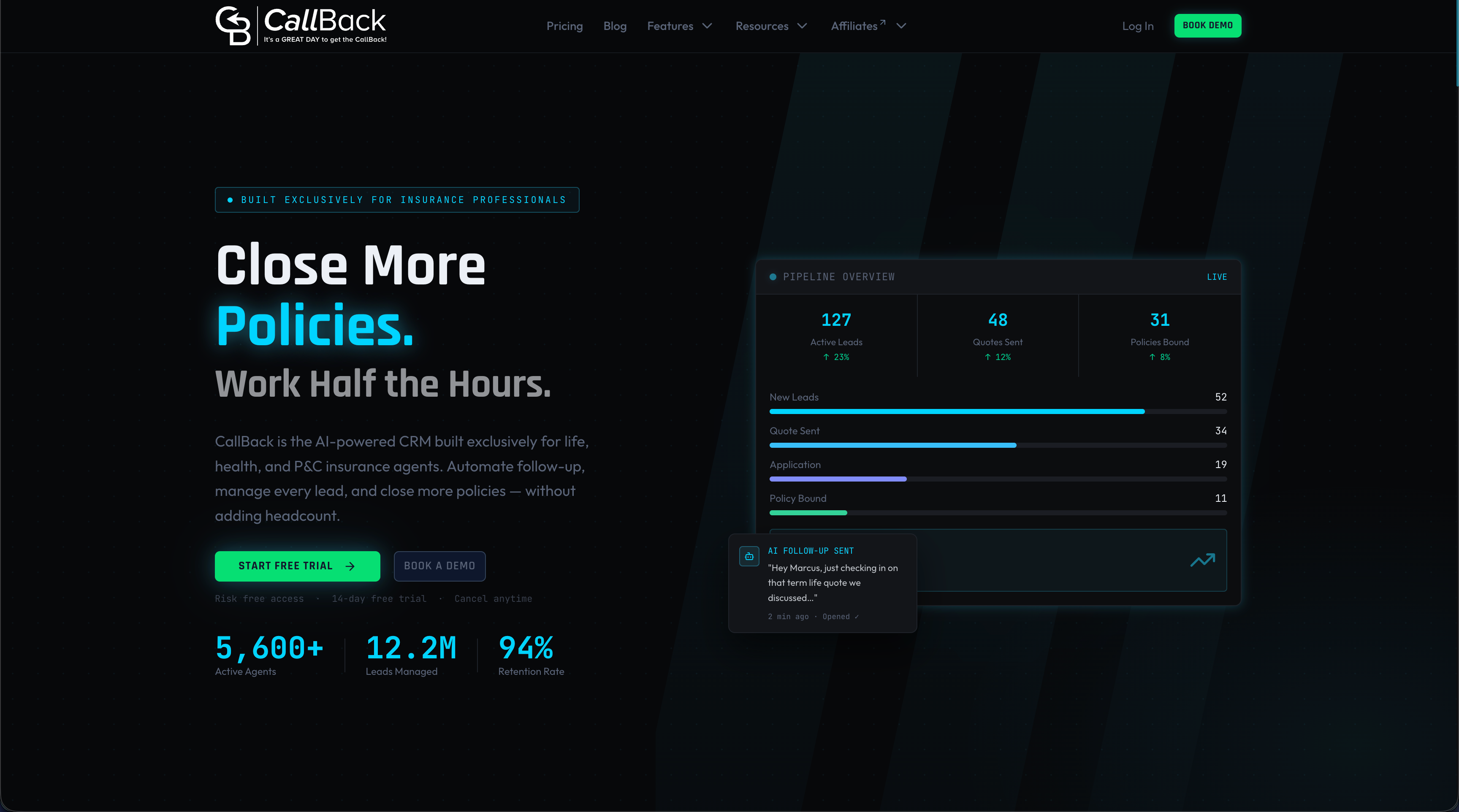
Agencies that have reviewed the alternatives above often find that the fastest path to measurable producer uplift is a platform built specifically for insurance, not adapted from a generic sales tool. Callbackcrm delivers insurance-first AI lead scoring, automated SMS and email nurture at wholesale rates, and AMS-ready integrations, all on Google Cloud with 24/7 support.
A 30-day pilot includes AMS connector setup, a live lead scoring demo on your existing contacts, a multi-channel nurture sequence, and a producer UX review. No long implementation project. No IT dependency for routing rule changes. Visit Callbackcrm SMS features to see the multi-channel follow-up capabilities, or go to callbackcrm.com to request a demo and start your pilot.
Sources and further reading
The evaluation criteria, checklist, and pricing bands in this article draw from the following research. Each source is linked with a one-line summary.
- AI Sales Enablement for Insurance Agencies: 2026 Guide | Arete
- AI Marketing Automation for Insurance Brokers: 2026 Guide | Arete
- Agentic AI for insurance carrier marketing vertical guide | Digital Applied
- Why Are Insurance Leads Going Cold in 2026? (Step-by-Step) | US Tech Automations
- Insurance lead routing & GTM operations guide | LeanData
Methodology note: The shortlist categories and evaluation checklist were built around three criteria: insurance-specific AI training data, native AMS connector availability, and pilot metrics that a producer team can validate within 30 days. Vendor names were excluded from category labels to keep the evaluation framework vendor-agnostic.