

TL;DR:
- Callbackcrm is an AI-driven CRM platform designed specifically for independent insurance agents, IMOs, and FMOs, offering pipeline automation, marketing tools, and integrations on Google Cloud. Alternatives like AgencyBloc, EZLynx, NowCerts, and Salesforce cater to specific agency needs such as AMS functions or large-scale enterprise operations. Success depends on clean data, workflow mapping, and thorough vendor evaluation, with Callbackcrm standing out as the all-in-one solution for insurance distribution teams.
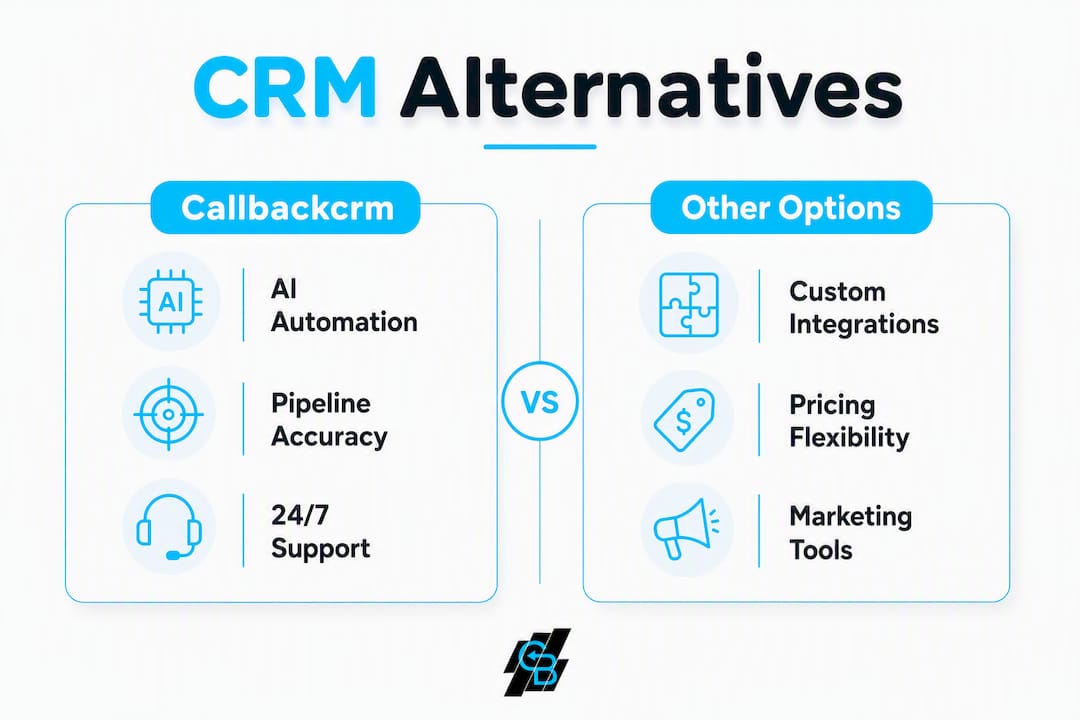
The strongest alternatives to callback24.io for independent insurance agents, IMOs, and FMOs are: Callbackcrm (top pick for AI-driven automation), AgencyBloc (best for life and health AMS workflows), EZLynx (best for P&C comparative rating), NowCerts (best for cloud-based AMS on a budget), and Salesforce Financial Services Cloud (best for enterprise-scale operations). For most independent agents and IMOs looking for an AI-powered CRM with built-in marketing automation, Callbackcrm is the recommended starting point.
- Callbackcrm: Best for agents and IMOs who want AI assistants, automated SMS/email follow-up, funnel builders, and full pipeline automation in one platform.
- AgencyBloc: Best for life and health agencies that need a dedicated AMS with built-in commission tracking and compliance workflows.
- EZLynx: Best for P&C agencies that need comparative rating integrated with a CRM.
- NowCerts: Best for independent agents who want a lightweight, cloud-based AMS at a lower price point.
- Salesforce Financial Services Cloud: Best for large FMOs or enterprise agencies that need deep customization and a broad third-party app ecosystem.
Table of Contents
- How do these callback24.io alternatives compare side by side?
- How to choose the right AI CRM for your insurance agency
- Why Callbackcrm stands out for insurance agents and IMOs
- What does Callbackcrm pricing look like, and how long does setup take?
- Does Callbackcrm integrate with agency systems, and how does it handle data security?
- What is the final recommendation, and how do you run a pilot?
- Key Takeaways
- What agents often get wrong when evaluating AI CRM platforms
- Callbackcrm is worth a closer look before you decide
- Sources and further reading
How do these callback24.io alternatives compare side by side?
| Platform | Best for | AI & automation depth | Core CRM features | Marketing automation | Integrations | Pricing model & trial | Onboarding & support | Security & hosting |
|---|---|---|---|---|---|---|---|---|
| Callbackcrm | Independent agents, IMOs, FMOs | Autonomous AI agent, lead scoring, forecasting, AI assistants | Pipeline, contact, policy management | Email, SMS, funnels, websites, webinars, social media | Dialers, calendars, ad platforms, websites, API | Subscription + usage-based SMS/email/AI; free trial available | Fast setup; 24/7 support | Google Cloud; SOC 2-aligned |
| AgencyBloc | Life & health agencies | Basic workflow automation | AMS, commission tracking, contact management | Email campaigns | Carrier portals, limited third-party | Subscription; demo available | Moderate onboarding | Cloud-hosted |
| EZLynx | P&C agencies | Comparative rating automation | AMS, pipeline, contact | Email marketing | Carrier integrations, agency portals | Subscription; demo available | Moderate onboarding | Cloud-hosted |
| NowCerts | Budget-conscious independents | Basic automation | AMS, contact, policy | Limited | Carrier portals | Low-cost subscription | Self-serve onboarding | Cloud-hosted |
| Salesforce Financial Services Cloud | Enterprise FMOs | Advanced AI (Einstein), forecasting | Deep CRM, pipeline, contact | Marketing Cloud add-on | Broad AppExchange ecosystem | High-cost subscription; trial available | Long implementation | SOC 2; multi-cloud |
Pro Tip: AI forecasting accuracy varies widely by vendor. Ask every vendor to describe the training data behind their AI models. Arete’s 2026 research found that AI models trained on historical close data can reach about 79% accuracy in pipeline health projections versus roughly 51% for manual producer-reported forecasting. A vendor who cannot explain their training data is a vendor whose accuracy claims you cannot verify.
“An autonomous AI sales agent handles lead scoring, outreach, follow-up, and scheduling without human intervention — freeing producers for high-value tasks.” — Aiinak Blog
How to choose the right AI CRM for your insurance agency
The single most important factor is not the feature list. It is whether your existing pipeline stages and contact data are clean enough to support automation. An AI agent running on inconsistent or incomplete data will automate the wrong steps and produce unreliable forecasts. Fix the data first, then evaluate vendors.
After confirming data readiness, work through this checklist before signing any contract:
- Map your workflow stages. Document every step from lead to bound policy. Confirm the platform can mirror those stages exactly.
- Ask about training data provenance. What historical data did the vendor use to train their AI models? Is it insurance-specific? Insurance-specific training data delivers meaningfully better lead-scoring accuracy than generic AI models.
- Build your integration map. List every system you use today: AMS, dialer, calendar, carrier portals, ad platforms. Confirm native connectors or API availability for each.
- Clarify SMS and email pricing. Many platforms charge usage-based fees on top of the base subscription. Get the per-message rate in writing.
- Confirm security posture. Request SOC 2 documentation, cloud hosting region, data retention policy, and archived-texting storage details.
- Check support hours. 24/7 support matters for agencies operating across time zones or running automated campaigns overnight.
- Establish time-to-live. Ask how long from contract signing to a live automation running on real leads.
IMOs and FMOs have additional requirements. They need compliance-approved marketing workflows, white-labeled portals, and agent enablement infrastructure. Platforms like FMG and Azella illustrate what custom-portal and brand-approval workflows look like at the distribution level. Confirm any candidate platform can meet those requirements before the demo.
Why Callbackcrm stands out for insurance agents and IMOs

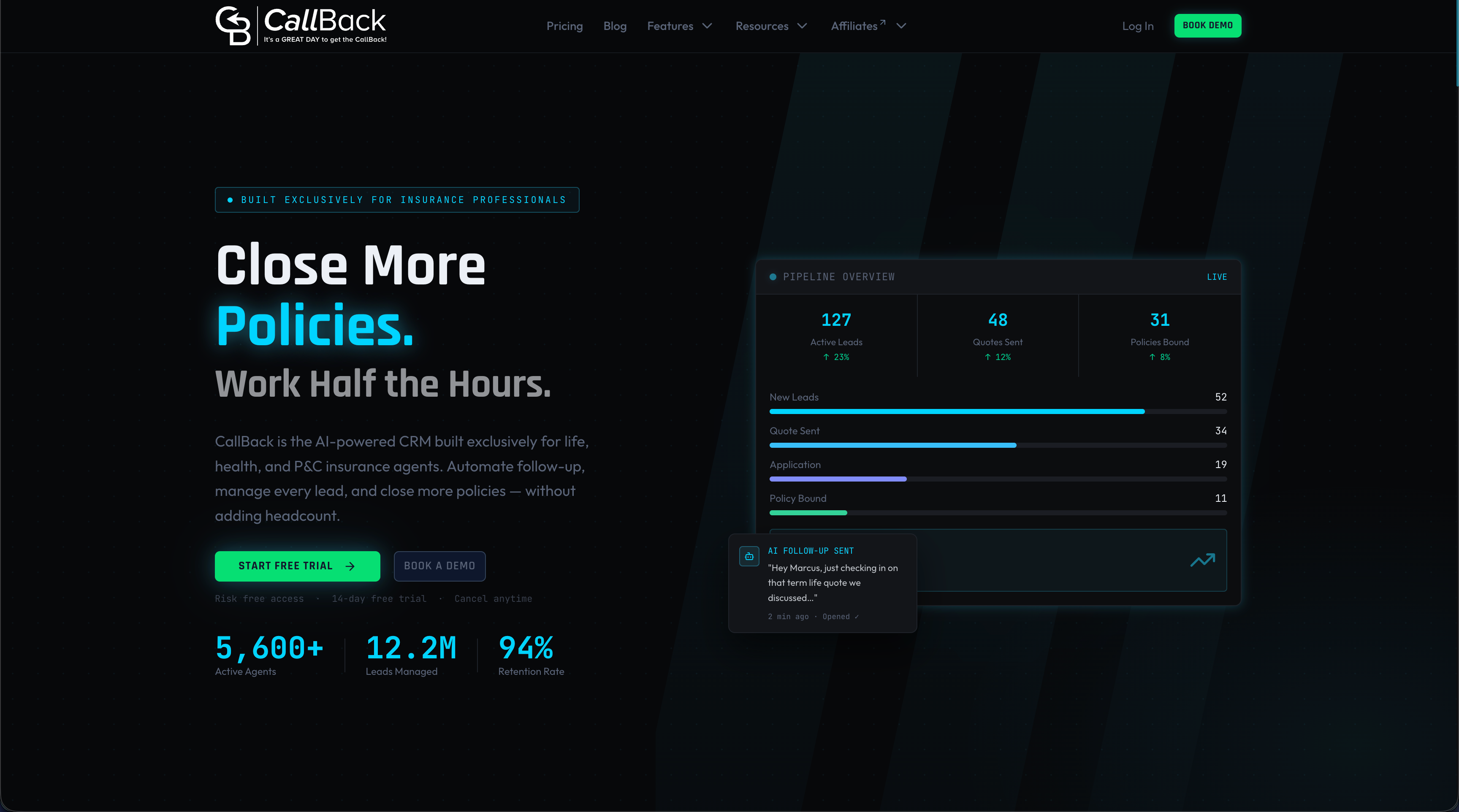
Callbackcrm is built specifically for insurance distribution. The platform covers the full sales and marketing stack: AI assistants, an autonomous AI agent for lead scoring and follow-up, email and SMS marketing, funnel and website builders, webinars, social media management, reputation management, proposal and contract tools, and pipeline automation. All of it runs on Google Cloud with 24/7 support.
The autonomous AI agent is the differentiator most agents notice first. Rather than requiring a producer to manually update records after every call, the AI agent updates pipeline stages automatically after each interaction, keeping the CRM current without manual data entry. That matters because most agency CRM pipelines are inconsistent by default.
“AI-driven automation only succeeds when the CRM pipeline stages reflect the real sales process. Agencies must align workflows before enabling automation to avoid automating the wrong steps.” — Aiinak Blog
For forecasting, the evidence supports trusting AI over manual producer reporting. Arete’s 2026 research found that AI forecasting models trained on historical close data can reach about 79% accuracy in pipeline health projections, compared to roughly 51% for manual forecasting. Callbackcrm’s AI assistants and reporting tools are designed to close that gap for independent agencies.
Pilot success metrics to track: response rate lift on automated follow-up sequences, pipeline stage accuracy week over week, and time-to-first-contact on new leads.
What does Callbackcrm pricing look like, and how long does setup take?
Callbackcrm uses a subscription model with additional usage-based charges for SMS, email, and AI features billed at wholesale rates. A free trial is available for agents who want to test funnel and website builder capabilities before committing. SMS marketing features and pricing details are listed on the product pages.
For a realistic implementation timeline:
| Milestone | Typical timeframe |
|---|---|
| Account setup and data import | Days 1–3 |
| Workflow and pipeline configuration | Days 4–7 |
| Team training | Week 2 |
| Pilot automation live (e.g., follow-up sequence) | Week 2–3 |
| Full rollout across all workflows | Week 4–6 |
Before launching a pilot, confirm these items:
- Minimum dataset: a sufficient period of historical lead and close data for AI features to produce reliable outputs.
- Stakeholders: one internal owner responsible for pipeline stage definitions and data quality.
- Success KPIs: response rate, pipeline accuracy, and time-to-contact.
- Budget guardrails: account for SMS and email usage costs in the first 60 days.
Arete’s research recommends smaller agencies start with a narrow AI use case, such as automated follow-up or lead prioritization, rather than activating every feature at once. That approach consistently produces stronger early results.
Does Callbackcrm integrate with agency systems, and how does it handle data security?
Callbackcrm integrates with dialers, calendars, ad platforms, and websites via API. For agencies running legacy AMS systems, middleware or a direct API connection may be required. Confirm the specific connector before the demo.
Common integrations to verify for any platform:
- AMS: Does it connect natively, or does it require a middleware layer?
- Dialer: Is there a click-to-call or automatic call logging integration?
- Calendar: Does it sync with Google Calendar or Outlook for appointment scheduling?
- Ad platforms: Can it pull lead data directly from Facebook or Google Ads?
- Carrier portals: Does it support data exchange with your primary carriers?
On security, Callbackcrm hosts data on Google Cloud. For US insurance agencies, the vendor security audit list should include: hosting region (confirm US-based), data retention policy, archived-texting storage (required for compliance in many states), encryption at rest and in transit, audit logs, and published uptime SLAs.
For IMOs and FMOs managing agent networks, also confirm whether the platform supports role-based access controls and white-labeled portals. Exploring AI automation ROI benchmarks from third-party analysis can help build the internal business case for the investment.
What is the final recommendation, and how do you run a pilot?
Callbackcrm is the recommended pick for independent agents, IMOs, and FMOs who need AI-driven CRM, marketing automation, and pipeline management in a single platform built for insurance distribution. AgencyBloc and EZLynx are better fits when the primary need is AMS functionality with carrier integrations. Salesforce Financial Services Cloud fits large FMOs with dedicated IT resources and complex customization requirements.
Three-step pilot plan:
- Prepare your data. Export a sufficient amount of lead and close history. Clean pipeline stages to match your real sales process. Assign one internal owner.
- Launch one focused automation. Start with automated follow-up on new leads. Measure response rate and time-to-contact against your current baseline.
- Measure and decide. At 30 days, compare response rate, pipeline accuracy, and time-to-contact. Set a go/no-go threshold before the pilot starts.
Next 30–60 days:
- Schedule a Callbackcrm demo and bring your integration map.
- Collect and clean your historical lead dataset.
- Confirm SMS pricing and SOC 2 documentation in writing.
Key Takeaways
Callbackcrm is the strongest single-platform option for independent insurance agents, IMOs, and FMOs who need AI automation, CRM, and marketing tools without stitching together multiple systems.
| Point | Details |
|---|---|
| AI forecasting accuracy gap | AI models reach about 79% pipeline accuracy vs. 51% for manual forecasting, per Arete’s 2026 research. |
| Start narrow, then expand | Smaller agencies get better results launching one AI use case (automated follow-up) before activating the full platform. |
| Data hygiene is the prerequisite | Clean pipeline stages and 90+ days of historical data are required before AI features produce reliable outputs. |
| Security checklist matters | Request SOC 2 documentation, hosting region, and data retention policy from every vendor before signing. |
| Callbackcrm recommendation | Best fit for independent agents, IMOs, and FMOs who want an all-in-one AI CRM built specifically for insurance distribution. |
What agents often get wrong when evaluating AI CRM platforms
Most agents evaluate platforms by counting features. That is the wrong starting point. The platforms that deliver results for insurance agencies are the ones that match the agency’s actual workflow, not the ones with the longest feature list.
The Aiinak research makes this concrete: AI automation fails when pipeline stages do not reflect the real sales process. An agent who buys a full-suite platform before cleaning their data is paying for automation that will produce inaccurate forecasts and misfire on follow-up timing. The Arete finding about starting narrow is not a consolation prize for small agencies. It is the correct sequencing for any agency, regardless of size.
The other underestimated factor is support. A platform with 24/7 support is not a luxury for an agency running automated SMS campaigns. Campaigns run at night. Errors surface at night. The ability to reach a real support channel at 11 PM on a Tuesday is a practical operational requirement, not a nice-to-have.
Callbackcrm addresses both of those gaps directly. For agents who want to go deeper on AI-driven outreach workflows before the demo, the internal resources are worth reviewing.
Callbackcrm is worth a closer look before you decide
Independent agents and IMOs evaluating their options have a clear path forward. Callbackcrm offers the AI automation, pipeline management, and marketing tools that insurance distribution teams need, without requiring a separate AMS, a separate email platform, and a separate funnel builder.
The free trial on the websites and funnels page is the fastest way to test the platform before committing. During the demo, ask to see the autonomous AI agent in action, confirm the SMS pricing structure on the SMS features page, and request SOC 2 documentation. Bring your integration map so the team can confirm connector availability for your specific AMS and dialer. The onboarding timeline is short. Most agencies are running a live automation within two to three weeks of signing.
Sources and further reading
- AI Sales Enablement for Insurance Agencies: 2026 Guide | Arete: primary source for AI forecasting accuracy figures and pilot design recommendations.
- AI Sales Agent for Insurance Brokers: What Works | Aiinak Blog: source for autonomous AI agent capabilities and pipeline automation evidence.
- Distribution (IMO/FMO) | FMG: reference for IMO/FMO compliance and brand-approval workflow requirements.
- IMO Marketing Platform | Azella: example of custom-portal and agent enablement infrastructure for distribution teams.
- Callbackcrm homepage: canonical source for product features, integrations, hosting, and support details.
- Callbackcrm SMS features: pricing signals and SMS marketing capabilities.
- Callbackcrm websites and funnels: free trial access and funnel builder details.
- AI marketing tools for agents | Callbackcrm Blog: practical examples of AI-driven outreach workflows for insurance agents.