

TL;DR:
- Responding to leads within five minutes significantly increases conversion rates.
- Automation and CRM tools boost productivity and ensure timely, personalized follow-ups.
- Changing agency culture toward speed and automation is essential for improved sales performance.
Shaving just a few minutes off your lead response time can be the difference between landing a client and losing them to a competitor. The average insurance agent closes only 10 to 15% of leads, yet small, targeted changes to how you capture, route, and follow up with prospects can move that number significantly. Responding to a new lead in under five minutes boosts conversions by 391%, and agents who use a CRM report nearly 30% higher productivity. This guide walks you through a step-by-step process to find your hidden inefficiencies, set the right goals, and deploy AI-driven automation that works while you focus on closing.
Table of Contents
- Assess your current sales process and identify bottlenecks
- Set measurable goals and choose the right metrics
- Implement AI-driven automation to accelerate workflows
- Monitor results and continuously optimize
- Why slow follow-ups still dominate and how to change the culture
- Streamline your insurance sales process with AI-powered tools
- Frequently asked questions
Key Takeaways
| Point | Details |
|---|---|
| Audit your workflow | Begin by mapping current steps and bottlenecks in your sales process. |
| Focus on quick lead response | Following up within five minutes is proven to dramatically increase conversion rates. |
| Set data-driven targets | Pick relevant metrics like close rate and follow-up speed to track improvement. |
| Automate and personalize | Use AI to automate tasks while tailoring communication for each prospect. |
| Optimize continuously | Monitor results and adjust strategies to keep improving sales outcomes over time. |
Assess your current sales process and identify bottlenecks
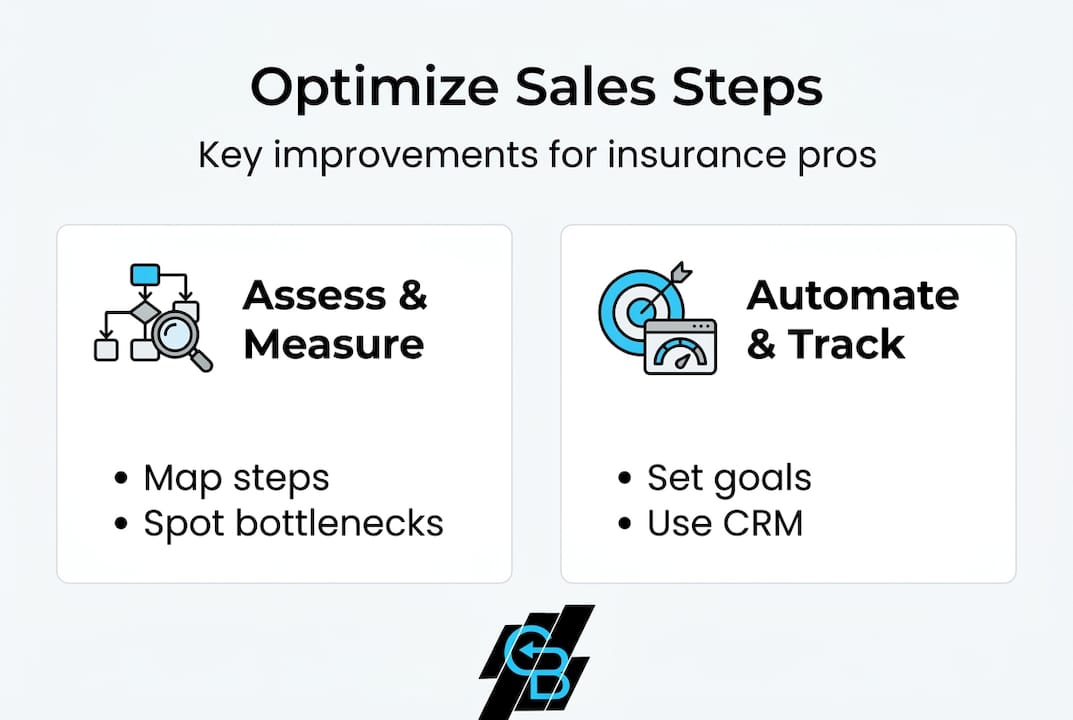
With the need for improvement clear, the first step is to map what actually happens in your current sales process. Not what you think happens. What actually happens on a typical Tuesday when ten leads come in from different sources.
Start by auditing each stage of your pipeline. Walk through the journey from the moment a prospect submits a form or calls your office to the moment a policy is bound or the lead is marked lost. Write down every step, every person involved, and every tool touched along the way. You will almost certainly find steps that are slower, more manual, or more error-prone than you realized.
Here is what to look for during your audit:
- Lead capture delays: Are leads sitting in a spreadsheet or email inbox for hours before anyone contacts them? Every minute counts. The insurance sales data is stark: a response time under five minutes increases conversion by 391%.
- Manual data entry: Are agents spending time copying prospect information from one system to another? That is productive time lost to clerical work.
- Inconsistent follow-up: Do different agents follow up at different frequencies, or does follow-up simply stop after one or two attempts?
- Slow hand-offs: When a lead comes in after hours, does it sit until the next morning? Or is there an automated process that sends an instant acknowledgment and schedules a callback?
- Unclear ownership: Does every lead have a clearly assigned owner, or do some fall through the cracks because no one claimed responsibility?
Explore the sales automation steps that map directly to these problem areas, so you know exactly which solutions correspond to which gaps.
Once you have identified the problem areas, document your baseline numbers. You cannot improve what you do not measure.
| Sales process metric | What to measure | Why it matters |
|---|---|---|
| Lead response time | Minutes from form submission to first contact | Fastest response wins the sale |
| Close rate | Closed policies divided by total leads | Benchmark against 10 to 15% industry average |
| Follow-up attempts | Average number of contacts per lead | 80% of sales need 5 or more touches |
| Lead source quality | Conversion rate by channel | Focus budget on best-performing sources |
| Time to close | Days from first contact to policy bind | Shorter cycles mean more volume |
This table gives you a working dashboard for your audit. Fill it in with real numbers from your CRM or sales records. If you cannot fill it in because you do not track these metrics yet, that itself is the biggest bottleneck to fix.
Set measurable goals and choose the right metrics
Once bottlenecks are visible, set clear goals to guide your optimization and measure results. Vague goals like “improve response time” do not move teams. Specific, numeric targets do.
A good optimization goal looks like this: “Reduce average lead response time from 47 minutes to under 5 minutes within 60 days.” Another strong goal: “Increase the percentage of leads receiving five or more follow-up attempts from 20% to 80% within 90 days.” These are goals your team can rally around because they are concrete and measurable.
Key performance indicators (KPIs) worth tracking for insurance sales:
- Time to first contact: The minutes between a lead entering your system and receiving their first call, text, or email.
- Contact rate: The percentage of leads you actually reach and speak with.
- Conversion rate: The percentage of contacted leads who move to the next pipeline stage.
- Close rate: The percentage of opportunities that result in a bound policy.
- Follow-up cadence: The average number of touches per lead before a sale or a lost decision.
Understanding how CRM empowers agents to track these metrics in real time is essential for building a data-driven culture inside your agency.
Here is a quick comparison of where most agencies start versus where optimized agencies operate:
| Metric | Typical agency | Optimized agency |
|---|---|---|
| Lead response time | 30 to 90 minutes | Under 5 minutes |
| Follow-up attempts | 1 to 2 | 5 or more |
| Close rate | 10 to 12% | 15 to 20%+ |
| CRM usage | Sporadic | Consistent, automated |
| Lead engagement tracking | Manual notes | Real-time dashboard |
Stat worth noting: CRM boosts productivity by 29% on average, while cutting response time to under five minutes increases conversions by 391%. These are not marginal gains. They are transformational.
Setting these benchmarks also helps you build the business case for investing in better tools. When leadership sees the gap between “typical” and “optimized” in a side-by-side table, the conversation about technology investment becomes much easier. Use your lead funnel optimization framework to connect metric targets directly to specific funnel changes you plan to make.
Implement AI-driven automation to accelerate workflows
With goals in place, you can now actively transform your sales workflow using modern, automated tools. This is where the real efficiency gains happen, because automation removes the human delay from the most time-sensitive steps.
Here is a practical, step-by-step workflow to implement:
- Set up centralized lead capture. Connect all your lead sources, whether that is your website, landing pages, or third-party aggregators, into one platform. Every lead should arrive in the same place, instantly, without manual imports.
- Configure instant lead routing. The moment a lead enters your system, automation assigns it to the right agent based on territory, product type, or availability. No inbox checking required.
- Launch an immediate automated response. Within seconds of a lead arriving, trigger a personalized SMS or email that confirms receipt, sets expectations, and begins warming the prospect. This is your first touch happening automatically, even at 2 a.m.
- Build a structured follow-up sequence. Design a multi-channel sequence spanning several days or weeks. Mix calls, texts, and emails. Space them intelligently. Make sure the messaging adapts based on whether the prospect has opened an email, clicked a link, or replied to a text.
- Score and prioritize leads dynamically. Use AI-driven lead scoring to surface the hottest prospects at the top of each agent’s queue. This means your best agents are spending time on the leads most likely to close right now.
- Automate task creation for agents. When a prospect takes a meaningful action, like visiting your quote page twice in one day, automation should create a task for the assigned agent to call immediately.
Understanding the full CRM and AI advantage helps you see why these steps compound. Each automated touchpoint builds data that makes the next one smarter.
Pro Tip: Do not try to automate everything at once. Start with the single highest-impact step first, which is usually the immediate response trigger. Once that is working and you can see the conversion lift, layer in your follow-up sequences. Trying to build a 12-step workflow on day one leads to errors and team resistance.
“80% of insurance sales require five or more follow-ups before a prospect converts, yet most agents give up after just one or two attempts. Automation is what makes consistent follow-up actually happen in practice.”
The all-in-one AI CRM features available in modern platforms are designed specifically to support this kind of layered, intelligent automation without requiring you to stitch together a dozen separate tools. And if you want a detailed walkthrough of building this entire process, the insurance automation tutorial provides a full step-by-step guide.

Monitor results and continuously optimize
After automating processes, routine monitoring ensures continuous improvement and agile response to new challenges. Automation is not a “set it and forget it” solution. It is a living system that needs regular attention to stay calibrated.
Build a weekly review habit around these checkpoints:
- Conversion rate by source: Which lead channels are producing contacts that actually close? Allocate more budget there and less to underperforming sources.
- Follow-up completion rate: What percentage of leads are receiving the full follow-up sequence? If it is less than 90%, something is breaking in the automation.
- Average time to first contact: Is the sub-five-minute goal being met consistently? Any degradation here should trigger an immediate investigation.
- Drop-off points in the funnel: Where are leads going cold? If most leads engage with the first two emails and then stop opening, the third message needs a rewrite.
- Agent activity versus automation activity: Are agents adding value on the high-touch calls while automation handles the repetitive touchpoints? This balance matters for both efficiency and client experience.
Your CRM dashboard should surface all of these signals in real time. If you are using funnel management tips effectively, you will also be able to spot seasonal patterns, like certain months when lead quality drops, so you can adjust targeting in advance rather than reacting after the fact.
Pro Tip: Schedule a 30-minute optimization review every two weeks. Bring one agent and one data point. Ask: “What is one thing this data is telling us to change?” Small, frequent adjustments compound into significant performance improvements over a quarter.
The AI automation strategies that top agencies rely on are not static. The best teams treat their sales system like a product: something that gets iterated, tested, and improved based on real user feedback and performance data. CRM-powered monitoring that tracks response times and conversions gives you the feedback loop to make those iterations meaningful.
Why slow follow-ups still dominate and how to change the culture
Here is an uncomfortable truth that the industry rarely says out loud: most insurance agencies already know that fast follow-up drives conversions. They have seen the statistics. They have attended the webinars. And then they go back to the office and follow up three days later anyway.
The problem is not knowledge. It is culture.
Sales teams build their rhythms around comfort and habit. When an agency has spent years operating with a “call when you can” approach, introducing automation feels threatening to some agents. It can feel like the technology is checking up on them, or worse, replacing them. That resistance is real and it quietly kills technology adoption.
Average close rates sit at 10 to 15% industry-wide, and 80% of sales require five or more follow-up attempts. Those two facts together tell a revealing story: most agents are leaving a massive percentage of their pipeline untouched. The leads are there. The interest is there. The follow-through is not.
Leadership has to make speed and automation the default, not the exception. That means building response time into performance reviews. It means celebrating agents who let automation do its job rather than trying to manually manage every touchpoint themselves. And it means removing the friction from adoption by investing in training, not just tools.
Understanding modern funnel marketing shows how forward-thinking agencies are structuring their entire acquisition and nurture process around speed and personalization at scale. The agencies winning in 2026 are not just using better tools. They are operating with a different belief: that every lead deserves an immediate, relevant response, and that automation is what makes that promise possible.
The culture shift is not easy, but it is the multiplier that turns good technology into great results.
Streamline your insurance sales process with AI-powered tools
With a process-oriented, tech-forward mindset, here is how to put optimized sales operations into practice.
CallBack CRM is built specifically for insurance agents, agencies, and IMOs who are ready to stop losing leads to slow follow-up and manual processes. The platform brings together everything you need in one place, from centralized lead capture and instant routing to AI-driven scoring and multi-channel follow-up sequences.
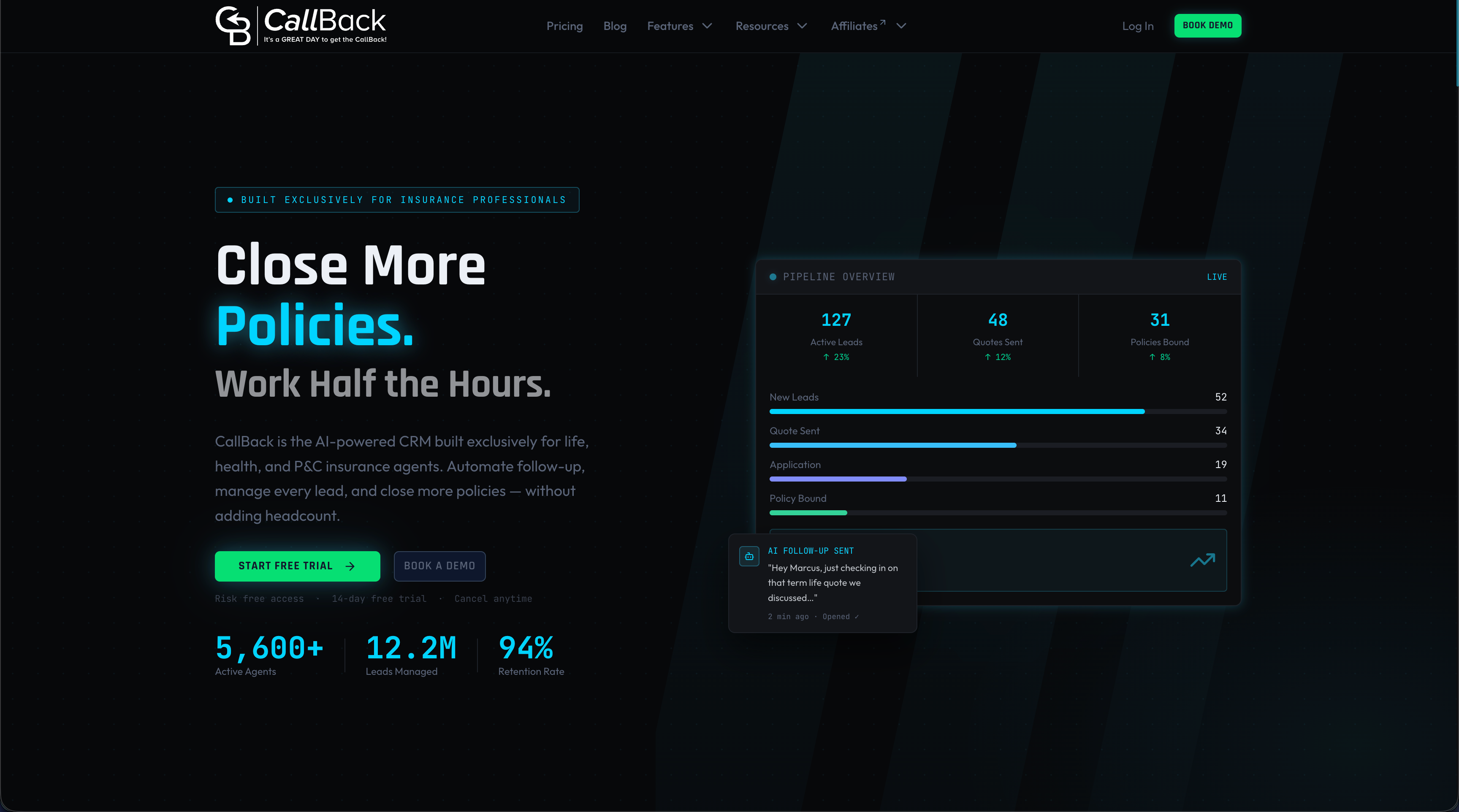
The AI features for insurance sales inside CallBack CRM automate the most time-sensitive steps in your pipeline so your agents can focus on the conversations that actually close. Pair that with email automation solutions that deliver personalized messages at every stage of the funnel, and task automation tools that keep every lead moving forward without manual effort. Whether you are a solo agent or running a multi-producer agency, CallBack CRM gives you the infrastructure to compete and win in today’s fast-moving insurance market.
Frequently asked questions
What are the most crucial KPIs for sales process optimization in insurance?
Time to first contact, conversion rate, and average number of follow-up attempts are the most important metrics to track. Close rates and follow-up volume directly reflect whether your sales process is working at the pace and consistency modern buyers expect.
How fast should I follow up with new leads?
Responding to a new lead within five minutes is the proven benchmark. Under-five-minute response increases conversion rates by 391%, making speed the single biggest lever in your lead management process.
Does automating follow-ups hurt personalization?
No. Well-configured automation actually improves personalization by delivering the right message at the right stage based on each prospect’s behavior, something no human can do consistently at scale without help.
How many follow-up attempts are needed on average to close an insurance sale?
80% of insurance sales require five or more follow-up contacts before a prospect converts, which is far more than most agents attempt without automation in place.
What’s the typical productivity lift from using a CRM in insurance sales?
CRMs improve productivity by approximately 29% for insurance agents, largely by removing manual data entry and ensuring consistent follow-up cadence without extra effort.