

A repeatable referral program for insurance agents is the lowest-cost, most predictable way to grow a book of business. The formula is straightforward: identify the right trigger moment, ask at the right time, track every referral in your CRM, and fulfill rewards consistently. Agents who do this systematically report referral close rates of 30–50%, well above cold or purchased leads.
Before building anything complex, start here:
- Defined sources. Know which clients and partners you will ask, and in what order.
- One trigger moment. Pick a single high-value moment (policy issued, claim closed, renewal saved) and automate that ask first.
- A tracking field in your CRM. Add a “Referral Source” field to every contact record today.
- Clear reward rules. Decide the reward type and amount before the first ask goes out.
- A written SOP for follow-up. Document who contacts the referred lead, when, and what they say.
The immediate next step: add one CRM field labeled “Referral Source” and schedule one automated thank-you message for your top trigger moment. That single action is the foundation everything else builds on.
Key Takeaways
A structured referral program for insurance agents, built on one automated trigger, clean CRM tracking, and consistent follow-up, is the most cost-effective lead channel available to agents at any scale.
| Point | Details |
|---|---|
| Pick one trigger first | Automate the post-issue or post-claim ask before adding other trigger moments. |
| Track four CRM fields minimum | Referrer ID, Referral Source, Referral Date, and Outcome are required for any ROI measurement. |
| Referral close rates run 30–50% | Referred leads convert at rates well above cold or purchased leads, making reward costs easy to justify. |
| Check state DOI rules before launch | Referral gift rules vary by state; set your reward ceiling at the most restrictive state’s limit if you operate across multiple states. |
| Callbackcrm automates the full workflow | Automated sequences, referral tracking fields, and reward notifications run in one platform built for insurance agents. |
Table of Contents
- Is your referral program ready to launch?
- How to build a referral program for insurance agents step by step
- Where do the best referrals for insurance agents come from?
- What referral incentives work, and what are the compliance rules?
- How to run the day-to-day operations of your referral program
- Launch plan, timeline, budget, and KPIs to track
- Scripts and templates you can use today
- How to automate and track your referral program with CRM workflows
- What actually works in referral programs over time
- Callbackcrm runs your referral program so you don’t have to
- Sources
Is your referral program ready to launch?
Use this checklist before you send the first ask. It covers the four areas where programs stall: operations, marketing, rewards, and compliance. Print it, assign owners, and check off each item.
Operational readiness
| Check | Owner | Status |
|---|---|---|
| CRM has Referral Source, Referrer ID, Referral Date, and Outcome fields | Agency admin | ☐ |
| Automated thank-you trigger is set for the chosen moment | CRM manager | ☐ |
| Referred lead intake form is live and tested | Marketing | ☐ |
| Follow-up SOP is written and assigned | Agency owner | ☐ |
| Staff trained on when and how to ask | Agency owner | ☐ |
Marketing readiness
Reward and compliance readiness
| Check | Owner | Status |
|---|---|---|
| Reward type and amount approved internally | Agency owner | ☐ |
| State DOI rules on referral gifts reviewed (see Section 5) | Compliance | ☐ |
| Reward payment or fulfillment process documented | Finance | ☐ |
| Documentation template ready for audit records | Finance | ☐ |
Soft-launch plan
Run your first pilot with 50–100 of your highest-satisfaction clients before a full rollout. This group is most likely to respond, which gives you clean conversion data without risking your entire book on an untested message.
Pro Tip: Pick clients who renewed in the last 90 days or who just had a claim resolved in their favor. These are your highest-NPS moments, and the ask lands far better when the client’s goodwill is fresh.
Practical referral program ideas for insurance agents can help you shape the right offer for this pilot group.
How to build a referral program for insurance agents step by step
A 60–90 day build is realistic for a single agent or a small agency. The steps below follow that timeline. A focused automated referral engine can double referral volume within a quarter, but only if the foundation is built correctly first.
Step 1: Define your objectives and KPIs
Decide whether you are optimizing for volume (more referrals) or quality (higher-converting referrals from specific niches). Both are valid, but they lead to different program designs. Volume programs cast a wide net across all clients. Quality programs target a narrow segment, such as commercial lines clients or high-net-worth households, and use professional partners as the primary channel.
Set three numbers before you proceed:
- Monthly referral target. How many referred leads do you want per month?
- Conversion rate target. Based on your current close rate, what is realistic?
- Cost per acquisition (CPA) ceiling. What is the maximum you will spend per converted referral, including the reward?
Step 2: Choose and prioritize trigger moments
Trigger moments are the specific events in the client lifecycle when asking for a referral feels natural and earns the highest response. The three most reliable triggers are:
- Policy issued. The client just bought and is in a positive, trusting state.
- Claim closed favorably. You delivered on your promise. This is the single highest-goodwill moment in the relationship.
- Renewal saved or improved. You found a better rate or added coverage without raising the premium.
Pick one trigger to automate first. Splitting effort across all three at launch slows results. Once the first trigger is producing consistent referrals, add the second.
Step 3: Build the referral intake flow and CRM fields
Every referred lead needs to be captured with four minimum data points:
- Referrer ID (the client or partner who referred)
- Referral Source (the channel or trigger that prompted the ask)
- Referral Date (when the referral was received)
- Outcome (quoted, sold, lost, or no contact)
Without these fields, you cannot measure which sources produce the best results or calculate ROI.
Step 4: Write the referral SOP
The SOP answers four questions: Who asks? When? What do they say? What happens next?
A minimal SOP looks like this:
- Who asks: The agent of record, or an assigned team member for high-volume agencies.
- When: Within 48 hours of the trigger event.
- Script: Use the templates in Section 8.
- Follow-up timeline: First contact with the referred lead within 24 hours of receipt. Update the referrer at day 7. Dispatch reward on conversion.
Step 5: Test, pilot, and iterate
Run the program with your pilot segment for 30 days before scaling. Track referrals received, conversion rate, and reward cost. Two A/B tests worth running early:
- Reward type: Gift card vs. charitable donation. Some clients respond better to one than the other.
- Ask timing: Immediate post-trigger vs. 3 days post-trigger. A short delay sometimes outperforms an immediate ask because the client has had time to process the experience.
Scale when your pilot conversion rate hits your target. If it does not, adjust the message or the trigger before expanding.
Pro Tip: Set a 90-day review date on your calendar the day you launch. Programs that are never formally reviewed tend to drift. One scheduled review is enough to catch the most common issues: low ask rate, slow follow-up, and unredeemed rewards.
Where do the best referrals for insurance agents come from?
Not all referral sources are equal. Professional partners such as CPAs, attorneys, and real estate professionals typically send higher-quality, higher-converting referrals because they meet clients at financial or life milestones. Here is how to approach each source category.

Existing clients
Satisfied clients are the most accessible source. The key is timing. Ask immediately after a positive experience, not at a random point in the year. Clients who score 9 or 10 on a Net Promoter Score survey are the most likely to refer, and that score can be used as an automated trigger in your CRM.
The one-liner ask: “I’m glad we could take care of that for you. If you know anyone who might benefit from the same coverage, I’d love an introduction.”
CPAs and financial advisors
CPAs see their clients’ full financial picture. When a client has a coverage gap, a CPA who trusts you will mention your name. The relationship works best when you make it easy: give them a one-page summary of the client types you serve best and a simple email introduction template they can forward.
Real estate agents and mortgage brokers
Every home purchase triggers a homeowners insurance need. A relationship with two or three active real estate agents can produce a steady stream of referred leads with no additional marketing spend. Offer a fast turnaround time on quotes, because speed matters in real estate transactions.
Attorneys and estate planners
Life events handled by attorneys, such as divorce, business formation, and estate planning, often reveal insurance gaps. These referrals tend to be high-value because the client is already in a decision-making mindset.
Employers, PEOs, and HR managers
Professional Employer Organizations and HR managers regularly field questions from employees about benefits and personal coverage. A relationship with one mid-size employer can produce multiple referrals per year. Frame the value as a free resource for their employees, not a sales pitch.
Affinity groups and associations
Industry associations, alumni groups, and community organizations give you access to pre-qualified clusters of people with shared characteristics. A single presentation to a local business association can generate more warm leads than months of cold outreach.
Sources to avoid or deprioritize
Generic lead-sharing arrangements with no defined process tend to produce low-quality contacts. Measure every partner source by conversion rate after 90 days. If a source consistently produces leads that do not convert, redirect your time.
What referral incentives work, and what are the compliance rules?
Incentive choice affects both response rate and compliance exposure. State rules on referral gifts and incentives vary, and agents should check their state DOI before finalizing any reward structure. The table below covers the most common options.
Non-cash incentives such as charitable donations often perform well for clients who feel uncomfortable accepting personal gifts. They preserve the professional tone of the relationship while still acknowledging the referral.
Compliance guardrails
The core compliance question is whether the person referring is licensed or unlicensed. Paying an unlicensed person a commission or fee for referring insurance business is prohibited in most states. Gifts and non-cash incentives are treated differently, but the rules vary by state and by the value of the gift.
Key documentation practices:
- Keep a log of every reward issued: date, recipient, amount, and the referral it corresponds to.
- Store copies of any state DOI guidance you relied on when setting reward levels.
- If you use a tiered reward structure, put the tiers in writing and apply them consistently.
Pro Tip: If you work across multiple states, set your reward ceiling at the most restrictive state’s limit. It simplifies compliance and avoids the risk of issuing a reward that is permissible in one state but not another.
The Nationwide Agency Forward guide on referral programs reports that businesses using referral programs see materially higher conversion rates, which makes the compliance investment worthwhile. The economics are favorable even with conservative reward levels.
This section provides general information about referral incentive structures. Referral compensation rules vary by state and license type. Confirm current rules with your state Department of Insurance or a licensed compliance professional before finalizing any reward structure.
How to run the day-to-day operations of your referral program
A referral program without a clear operational workflow leaks leads. The SOP below covers intake, follow-up, handoffs, and reward fulfillment.

Minimum CRM fields
Every referral record needs these five fields at minimum:
- Referrer name and ID (linked to the referring contact record)
- Referred contact name and phone/email
- Referral reason or trigger (which moment prompted the ask)
- Status (new, contacted, quoted, sold, lost)
- Reward due (yes/no, and the amount)
Follow-up timeline
| Action | Timing | Owner |
|---|---|---|
| First contact with referred lead | Within 24 hours of referral receipt | Agent or assigned rep |
| Second contact attempt if no response | Day 3 | Agent or assigned rep |
| Update referrer on status | Day 7 | Agent |
| Policy quote delivered | Day 5–10 | Agent |
| Reward dispatched on conversion | Within 5 business days of policy issue | Admin or finance |
| Thank-you note to referrer | Same day as reward dispatch | Agent |
Speed matters. Referred leads who are contacted within 24 hours convert at higher rates than those contacted later. The referrer’s credibility is on the line when they make an introduction, and a slow follow-up reflects on them.
Role assignments
- Agent of record: Owns the referral ask and the referrer relationship.
- Admin or CSR: Logs the referral in the CRM, sets follow-up tasks, and tracks reward status.
- Finance or agency owner: Approves and dispatches rewards, maintains the compliance log.
Reward fulfillment checklist
- Confirm conversion is final (policy issued, not just quoted).
- Verify the reward type and amount against the program rules.
- Issue the reward within 5 business days.
- Log the reward: date, recipient, amount, referral ID.
- Send a written or email acknowledgment to the referrer.
- File documentation for audit readiness.
Pro Tip: Set a recurring monthly task to audit open reward records. Unredeemed or delayed rewards are the fastest way to damage a referral relationship. A referrer who never received their gift will not refer again.
Launch plan, timeline, budget, and KPIs to track
90-day launch timeline
Budget checklist
- Incentive budget: Estimate based on expected referral volume and reward amount. A $50 average reward on 20 referrals per month is $1,000/month.
- Tech and automation costs: CRM subscription, SMS gateway fees, email platform costs.
- Staff time: Estimate hours per week for intake logging, follow-up, and reward fulfillment.
KPIs to track
| KPI | Formula | Review Cadence |
|---|---|---|
| Referrals received | Count of new referrals per period | Weekly |
| Referral-to-client conversion rate | Converted referrals ÷ total referrals received | Monthly |
| Referral CPA | Total reward cost ÷ converted referrals | Monthly |
| Referral LTV | Average premium × average policy years for referred clients | Quarterly |
| Referral-to-ask ratio | Referrals received ÷ total asks made | Monthly |
The referral-to-ask ratio is the most underused metric. If you are asking consistently but the ratio is low, the problem is the message or the timing, not the program structure. If the ratio is high but volume is low, you are not asking enough people.
Word-of-mouth marketing converts social capital into measurable economic outcomes when firms engineer the process rather than leaving referrals to chance. The KPIs above are the measurement layer that turns a casual ask into a managed channel.
Setting realistic targets
A single agent running a structured program for the first time can realistically target 5–10 referrals per month in the first 90 days. An agency with 500+ active clients and a dedicated admin can target 20–30.
Scripts and templates you can use today
Timing and tone rules
- Post-trigger window (0–48 hours): Warm, specific, brief. Reference the exact event.
- Annual ask (renewal time): More formal, focused on the relationship, not the transaction.
- Partner ask: Professional, mutual-value framing. Never sound like you are asking a favor.
Email templates
1. Post-policy-issue ask
Subject: Thank you for trusting us with your coverage
Hi [First Name],
Your policy is active and you’re covered. I’m glad we could get this sorted for you.
If you know anyone, a friend, family member, or colleague, who could use the same peace of mind, I’d welcome an introduction. Just forward this email or share my number: [Phone].
As a thank-you, [describe reward, e.g., “I’ll send you a $50 Visa gift card for any referral who becomes a client”].
Thanks again, [Agent Name]
2. Post-claim-closed ask
Subject: Glad we could be there for you
Hi [First Name],
I’m glad your claim was resolved and that we could help when it mattered. That’s exactly what this coverage is for.
If you have a friend or colleague who doesn’t have the same protection in place, I’d be happy to take a look at their situation. A quick introduction is all it takes.
[Reward statement if applicable.]
[Agent Name]
3. Annual nurture-to-ask
Subject: Your annual review is coming up, and a quick note
Hi [First Name],
Your renewal is coming up on [Date]. I’ll be in touch shortly to review your coverage.
In the meantime, if anyone in your network has mentioned needing insurance help, I’d love to connect with them. Referrals from clients like you are how I grow my practice, and I always take good care of the people you send my way.
[Agent Name]
SMS templates
- “Hi [First Name], your policy is confirmed. If you know anyone who needs coverage, I’d love an intro. Reply with their name and I’ll reach out. Thanks! [Agent Name]”
- “Hi [First Name], glad your claim is resolved. If a friend needs the same protection, send them my way. [Phone/Link]. [Agent Name]”
Phone script (30-second ask)
“Before I let you go, I wanted to ask one quick thing. Do you know anyone, a neighbor, a coworker, anyone who might need help with their coverage? I’d love to reach out and see if I can help them the same way I’ve helped you. Would you be comfortable making an introduction?”
Social post example
“Grateful for the clients who trust us with what matters most. If someone in your network needs reliable coverage, send them our way. We take care of the people you refer. [Link] #InsuranceAgent #Referral”
Note: Do not include client names, policy details, or any personally identifiable information in social posts. Keep referral program terms off public posts unless they have been reviewed for compliance.
How to automate and track your referral program with CRM workflows
Manual referral tracking fails at scale. A CRM with automation handles the trigger, the ask, the follow-up, and the reward notification without relying on anyone to remember. Here is a practical workflow recipe any agent can implement.
Minimum CRM workflow recipe
| Step | Action | Detail |
|---|---|---|
| Trigger | Policy status changes to “Issued” | CRM detects the field change |
| Condition | Client tag = “Referral eligible” | Filters out clients already in a referral sequence |
| Sequence step 1 | Send thank-you SMS (Day 0) | Personalized with policy type and agent name |
| Sequence step 2 | Send referral ask email (Day 2) | Uses post-issue template from Section 8 |
| Sequence step 3 | Assign follow-up task to agent (Day 5) | Reminds agent to check for referral response |
| Reward workflow | Tag contact as “Reward due” on referral conversion | Triggers admin notification and fulfillment task |
This recipe covers the post-issue trigger. The same structure applies to post-claim and post-renewal triggers. Build one, confirm it works, then duplicate and adjust for the next.
Essential CRM fields and tags
- Referral Source (text field: client, CPA, realtor, employer, other)
- Referrer ID (linked contact record)
- Referral Date (date field)
- Referral Status (dropdown: new, contacted, quoted, sold, lost)
- Reward Due (yes/no field with amount)
- Partner Score (numeric: updated quarterly based on referral quality)
- NPS Score (numeric: used to trigger automated asks for 9–10 scores)
Integration notes
A complete referral automation setup connects four systems:
- Intake form (web form or QR code) that writes directly to the CRM.
- SMS gateway for immediate text-based asks and follow-ups.
- Email platform for templated sequences.
- Reward dispatch (gift card provider API or a simple accounts payable workflow with a logged approval step).
CRM and marketing automation integrations are what make this setup reliable at scale. Without the integrations, data lives in separate systems and referrals fall through the gaps.
Callbackcrm handles all four layers in one platform. Automated SMS and email sequences fire on CRM field changes. Referral tracking fields are configurable without code. Reward workflow notifications route to the right team member automatically. The reporting dashboard shows referral source, conversion rate, and reward cost in one view, so agents can see which partners and triggers are producing results without pulling data from multiple tools.
Implementation checklist: 1-person shop vs. agency
| Task | Solo Agent | Agency (3+ staff) |
|---|---|---|
| CRM fields configured | Agent does it | Admin configures, agent reviews |
| Automation workflows built | Agent builds 1 trigger | CRM manager builds all triggers |
| Intake form live | Agent sets up | Marketing sets up |
| Reward fulfillment | Agent handles manually | Admin or finance owns |
| Reporting review | Monthly, 30 minutes | Weekly dashboard review |
For a solo agent, the AI marketing tools available for insurance agencies can reduce the setup time significantly by handling sequence building and contact segmentation automatically.
Pro Tip: Use a marketing automation checklist to confirm every workflow step is connected before you go live. A broken trigger that fires the wrong message to the wrong contact is harder to fix than a delayed launch.
What actually works in referral programs over time
Most agents launch a referral program with good intentions and then let it drift after 60 days. The ask rate drops, the CRM fields go unfilled, and referrals return to their previous random pattern. The agents who sustain referral volume do one thing differently: they treat the ask as a scheduled process, not a spontaneous gesture.
The counterintuitive behavior that separates top producers is consistency over creativity. A plain, direct ask sent at the right moment every time outperforms a clever campaign sent irregularly. Automating the gratitude window, the 48-hour post-trigger period when client goodwill is highest, is the single highest-return automation any agent can build.
Common mistakes worth avoiding: asking too broadly (“let me know if you know anyone”), skipping the referrer update at day 7, and issuing rewards late. Each of these erodes trust with the referrer. A referrer who feels ignored or forgotten will not refer again, regardless of the reward.
At that level, the program pays for itself within the first policy year, and the referred client’s lifetime value makes every subsequent year pure margin. If your CPA is climbing above that threshold, reduce the reward amount before reducing the ask frequency. Volume matters more than reward size.
Callbackcrm runs your referral program so you don’t have to
Referral programs produce the best leads in insurance, but only when the follow-up is fast, the tracking is clean, and the rewards go out on time. Most agents lose referrals not because they lack relationships, but because the operational layer breaks down.
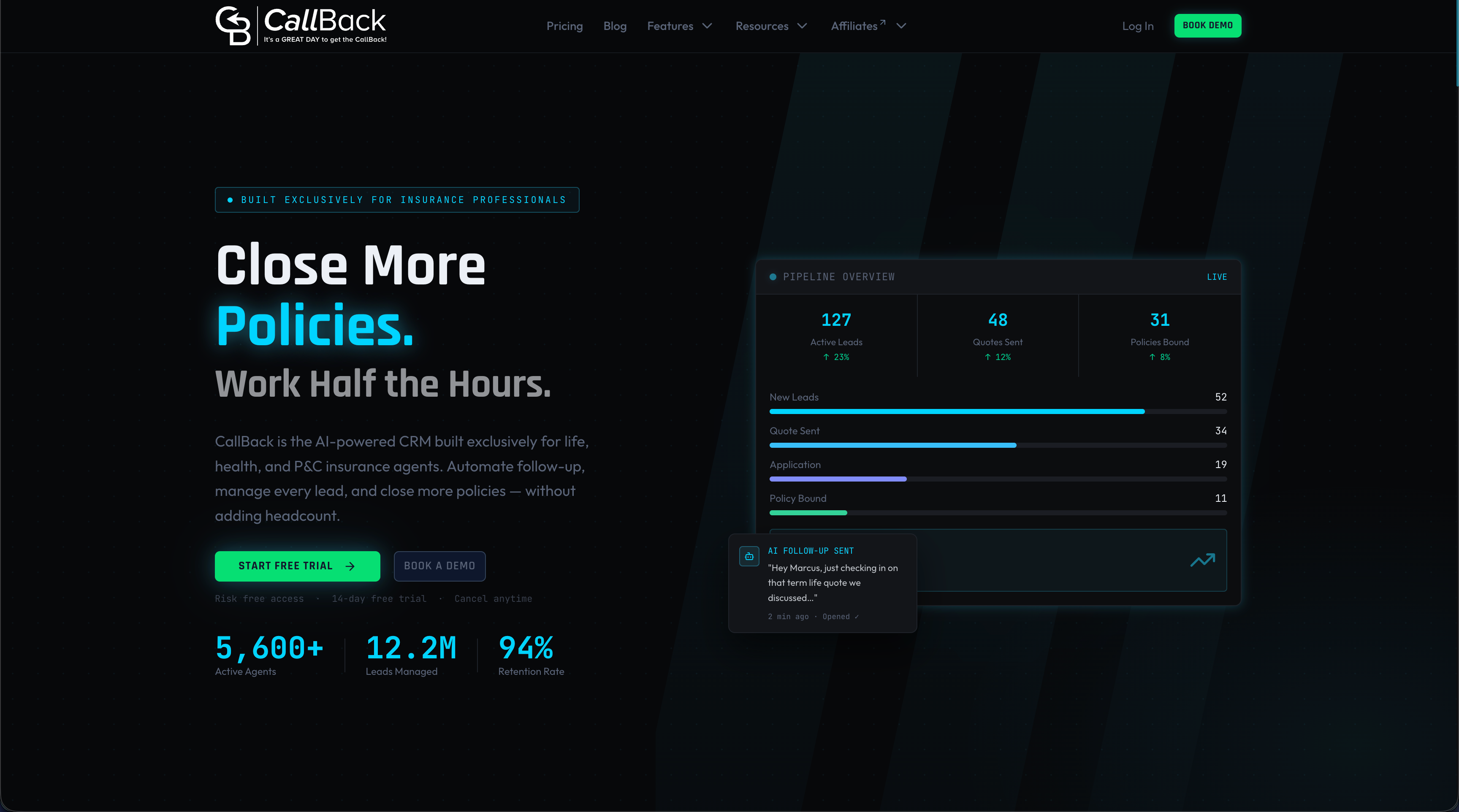
Callbackcrm gives insurance agents and agencies the full operational stack in one place: automated SMS and email sequences that fire on CRM triggers, configurable referral tracking fields, reward workflow notifications, and a reporting dashboard that shows which sources and triggers are converting. The SMS marketing features let you send referral asks and follow-ups by text within minutes of a trigger event, with no manual steps. The website and funnel builder lets you create a dedicated referral landing page and intake form without a developer.
The fastest path to results: import your top 100 clients, set up one post-issue trigger sequence, and run it for 90 days. Callbackcrm runs on Google Cloud with 24/7 support, so the platform stays up when you need it. Start a free trial and see the referral workflow in action.
Sources
- Insurance Referral Programs: How to Get 10+ Referrals Per Month
- Insurance Agents: Build a Referral Engine in 90 Days | Raion Tech Blog
- Building a Referral Engine for Insurance Agents That Works - Agency Height
- Turning social capital into economic capital: straight talk about word-of-mouth marketing - Knowledge@Wharton
Recommended
- Insurance Referral Program Ideas for Agents and Brokers | CallBack CRM Blog
- Insurance sales funnel tutorial: automate & boost conversions | CallBack CRM Blog
- ConvertMore.com Alternatives for Insurance Agents: 2026 | CallBack CRM Blog
- How to automate lead generation for insurance agents | CallBack CRM Blog