

TL;DR:
- Most insurance agents benefit from CRM-first platforms that automate lead follow-up and integrate with existing workflows. Callbackcrm offers these features along with insurance-specific templates and hosting on Google Cloud, making it a comprehensive alternative to lightweight callback widgets. Prioritizing quick CRM ingestion and automated follow-up is essential for higher conversion rates and better pipeline management.
For most insurance agents and agencies, Callbackcrm is the strongest ConvertMore alternative available. It combines CRM ingestion, automated SMS/email callback workflows, and insurance-specific templates in one platform, hosted on Google Cloud. ConvertMore itself is a lightweight callback widget priced at $2 per converted call, useful for squeezing more calls from existing traffic. But a widget alone does not route leads, trigger follow-up sequences, or integrate with dialers and carrier portals.
The shortlist of alternative categories worth evaluating is:
- Full CRM-first platforms (recommended for most agencies): automated lead ingestion, SMS/email workflows, pipeline management, and insurance templates built in
- AI personalization overlays: match landing page content to UTM and intent signals; AI landing-page personalization can lift conversions by roughly 25% versus generic pages when deployed without layout shift
- Automated experiment platforms: run continuous A/B tests with Bayesian significance engines; best for teams already running paid traffic at volume
- Lightweight callback widgets: fast to install, pay-per-call billing, minimal CRM depth; ConvertMore fits here
The priority criterion for insurance teams is CRM follow-up speed and automation, not the widget that captured the lead.
Table of Contents
- What do ConvertMore alternatives look like side by side?
- How do these categories perform for insurance workflows?
- How do you choose the right ConvertMore replacement?
- How do you migrate off ConvertMore without losing leads?
- What is the final recommendation for insurance agents?
- What insurance professionals say about switching from ConvertMore
- Key Takeaways
- Why CRM-first is the only honest answer here
- Callbackcrm is built for exactly this switch
- Useful sources
What do ConvertMore alternatives look like side by side?
The table below maps each platform category across the axes that matter most to insurance buyers. Named tools covered in this article include Callbackcrm, HubSpot, ActiveCampaign, Unbounce, Drift, and Optimizely.
| Axis | Full CRM-first (Callbackcrm) | Marketing automation (HubSpot / ActiveCampaign) | Landing page / personalization (Unbounce / Optimizely) | Conversational capture (Drift) | Callback widget (ConvertMore) |
|---|---|---|---|---|---|
| Best for | Insurance agents, agencies, IMOs | Mid-market teams with broad marketing needs | Paid traffic optimization | Chat-first lead capture | Single-site call conversion |
| Core features | CRM, SMS/email, funnels, AI assistants, webinars, reputation tools | CRM, email automation, lead scoring | Landing page builder, A/B testing, AI personalization | Chatbot, live chat, meeting scheduling | Callback widget, exit popup, floating button |
| CRM & automated follow-up | Built-in; SMS, email, voicemail drops | Strong email; SMS via integrations | Needs external CRM | Needs external CRM | None native |
| Insurance workflows | Insurance templates, dialer/calendar integrations | Needs custom build | Needs custom build | Needs custom build | None |
| Integrations | Dialers, calendars, carrier portals, ad platforms | many apps via native and Zapier | Zapier, HubSpot, Salesforce | Salesforce, HubSpot, Marketo | Basic webhook |
| Pricing model | Monthly subscription; SMS/email/AI at wholesale rates | Tiered monthly; contacts-based | Monthly per domain; usage tiers | Custom/enterprise | $2 per converted call |
| Security / hosting | Google Cloud | AWS | AWS | AWS | Not publicly listed |
| Onboarding / support | Insurance-focused onboarding, 24/7 support | Self-serve + paid onboarding | Self-serve | CSM at higher tiers | Email support |
| Trial / demo | Free trial available | Free tier; paid trial | 14-day free trial | Demo on request | Free credits on signup |
Key strengths and trade-offs by category:
- Full CRM-first platforms: shortest path from lead capture to automated follow-up; deepest insurance workflow fit; requires the most onboarding time
- Marketing automation platforms: broad feature sets but insurance-specific templates require custom configuration; contacts-based pricing scales costs quickly
- Landing page / personalization platforms: fastest time-to-live test for paid campaigns; no native CRM or follow-up; must integrate outward
- Conversational capture tools: strong for chat-qualified leads; limited SMS/email automation without a connected CRM
- Callback widgets: lowest setup friction; pay-per-call is predictable but creates data silos with no downstream automation
Automated experiment platforms like Optimizely demand the shortest time-to-live test. Full CRM-first platforms demand the deepest integration work but deliver the most durable return for insurance teams managing multi-touch pipelines.
How do these categories perform for insurance workflows?
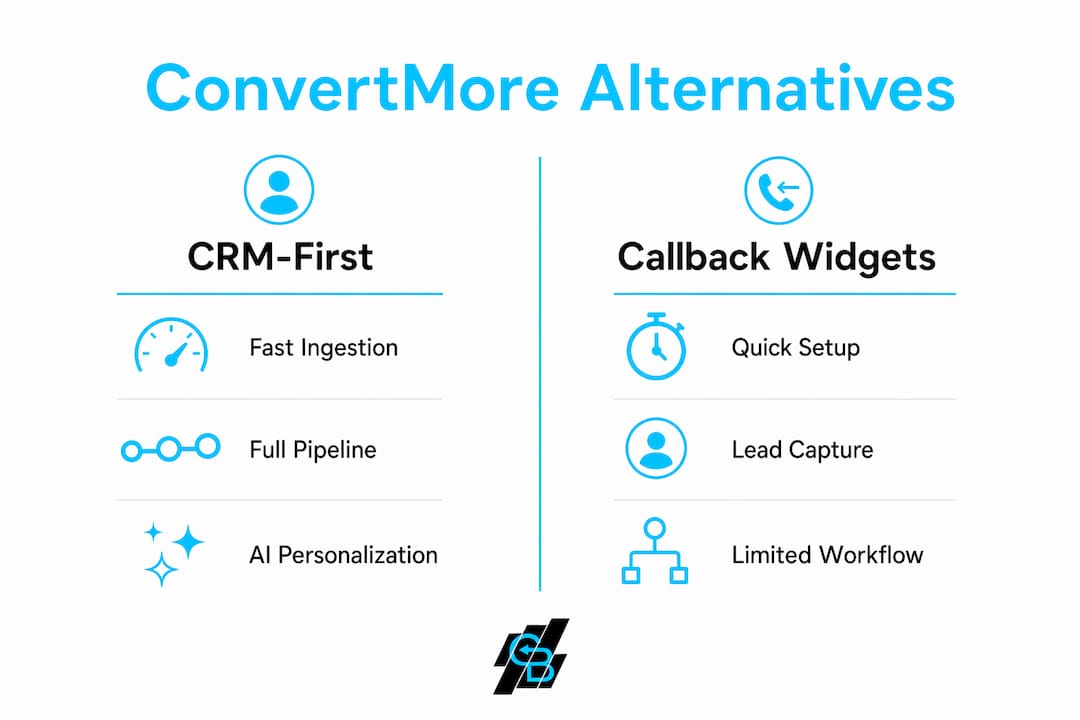
The biggest determinant of conversion lift is how quickly and accurately leads are ingested and acted on by the CRM, not the widget that captured them. That single insight reshapes how insurance agents should evaluate any ConvertMore replacement.

Intent-matching personalization addresses the top-of-funnel gap. Dynamic personalization tied to UTM and referrer signals reduces bounce on paid traffic because it preserves the ad promise on arrival. A life insurance agent running Google Ads for “term life quotes” can serve a page that rewrites its headline, CTA, and social proof to match that exact search term, without building a separate URL for each variant. Tools like BeaconMatch demonstrate this with UTM-driven personalization that rewrites page sections on the fly.
CRM auto-ingest and SMS/email automation matter most for commercial lines and broker referral flows. A commercial lines RFP capture that drops into a spreadsheet instead of a CRM loses the follow-up window. Multi-channel funnels that synchronize SMS, email, and on-site messaging can boost sales by 20–25% compared to single-channel capture when the messaging aligns across touchpoints.
Operational trade-offs to budget for:
- Integration overhead: connecting a callback widget to a separate CRM via webhook adds a failure point; validate webhook reliability before going live
- Data silos: per-call pricing tools rarely export structured lead data; migration later is painful
- Mobile UX: over 55% of online inquiries originate from mobile devices, so any personalization layer must render without layout shift on mobile
Pro Tip: Prioritize solutions that run personalization at the CDN/edge level. Edge-deployed personalization delivers instant, flash-free content swaps, which preserves trust on high-value paid traffic and avoids the flicker that erodes mobile conversion rates.
How do you choose the right ConvertMore replacement?
Rank these criteria before you open a single demo:
- CRM ingestion speed: how fast does a submitted lead appear in the pipeline and trigger a follow-up?
- Automated SMS/email follow-up: are sequences built in, or do they require a third-party connection?
- Intent-matching personalization: can the platform match page content to UTM or search term?
- Insurance-specific integrations: dialers, carrier portals, calendar booking
- Pricing predictability: flat monthly vs. per-call vs. contacts-based; clarify SMS and AI usage billing upfront
- Security and compliance: cloud provider, data residency, SOC 2 or equivalent
- Insurance templates: pre-built funnels and email sequences for life, health, commercial lines
During a 7–14 day trial, test these items specifically:
- Submit a test lead and time how long it takes to appear in the CRM
- Trigger an SMS sequence and confirm delivery and sender ID
- Verify webhook reliability with at least 10 test submissions
- Check on-page personalization latency on a mobile device
- Request a sample insurance funnel template and evaluate fit
Red flags to walk away from:
- Lead ingestion takes more than a few minutes without explanation
- The primary integration method is manual CSV export
- SMS and AI usage fees are not itemized before you sign
- No insurance-specific onboarding or template library exists
- Support response time exceeds 24 hours during the trial period
Automation and lead generation are separate goals. The highest-performing teams layer AI personalization for nurture and a CRM/callback workflow for immediate human follow-up. Evaluating both layers during the trial is the only way to know whether a platform covers both.
How do you migrate off ConvertMore without losing leads?
Pre-migration (Days 1–3)
- Export all historical leads from ConvertMore to CSV; map fields to your new CRM schema
- Document every active automation, UTM rule, and webhook endpoint
- Run one test lead through the current funnel end-to-end and record the result
- Identify any carrier portal or dialer integrations that need reconnecting
During migration (Days 4–10)
- Install the new platform’s tracking script or connector alongside the existing ConvertMore widget
- Run parallel capture: both systems receive leads simultaneously for at least 48 hours
- Validate webhook delivery on the new platform with 10+ test submissions
- Test SMS and email triggers; confirm carrier routing and sender ID registration
- Verify that UTM parameters pass through correctly to the new CRM
Post-migration (Days 11–21)
- Run a full regression test of all automated workflows
- Phase the DNS or script cutover over 3–5 days, not overnight
- Run a short A/B comparison to verify lead volume parity between old and new capture
- Confirm that funnel and automation logic matches what was documented pre-migration
The typical onboarding window for a full CRM-first platform is 1–3 weeks, depending on the number of integrations and custom workflows involved.
What is the final recommendation for insurance agents?
Callbackcrm is the recommended choice for most insurance agents, agencies, and IMOs evaluating ConvertMore alternatives. The core reasons: CRM-first lead ingestion, built-in SMS/email automated workflows, insurance-specific templates, dialer and calendar integrations, and Google Cloud hosting. It covers the full pipeline from capture to close without requiring a separate automation layer.
Concrete next steps:
- Start a free trial focused on lead ingestion speed and SMS automation
- Request insurance-specific onboarding during the trial setup call
- Ask for itemized billing details on SMS, email, and AI usage before committing
- Collect SLA documentation for support response time and uptime
Switching from a pay-per-call widget to a subscription CRM platform changes the cost structure. Expect a monthly subscription plus wholesale-rate usage fees for SMS, email, and AI features. The tradeoff is predictable pipeline automation versus unpredictable per-call charges that scale with traffic volume.
What insurance professionals say about switching from ConvertMore
Insurance professionals who have moved from lightweight callback widgets to full CRM platforms consistently report the same pattern: the widget delivered calls, but the follow-up gap cost them closed business. Agents managing high-volume Medicare or life insurance campaigns note that leads not contacted within minutes have significantly lower close rates, and a widget with no automated follow-up cannot close that gap.
Agency owners running commercial lines pipelines highlight the absence of structured lead data as the primary frustration with per-call tools. Without a CRM record, there is no pipeline visibility, no renewal tracking, and no way to measure cost per acquisition across campaigns. The shift to a CRM-first platform addresses all three gaps at once.
IMOs coordinating multiple downline agents point to routing and attribution as the deciding factor. A callback widget routes to whoever answers the phone. A CRM-first platform routes by territory, product line, or agent capacity, and logs every touchpoint for compliance and coaching purposes.
Key Takeaways
For insurance agents evaluating ConvertMore alternatives, the single most important criterion is CRM ingestion speed combined with automated follow-up, not the capture widget itself.
| Point | Details |
|---|---|
| CRM ingestion is the priority | How fast a lead enters the pipeline and triggers follow-up matters more than the widget that captured it. |
| Category match by problem | Callback widgets solve call volume; CRM-first platforms solve pipeline, routing, and follow-up automation. |
| Red flags during trials | Manual CSV exports, opaque SMS fees, and no insurance templates are reasons to move on. |
| Migration takes 1–3 weeks | Parallel capture, webhook validation, and phased cutover reduce lead loss during the switch. |
| Callbackcrm recommendation | Callbackcrm covers CRM ingestion, SMS/email automation, insurance templates, and Google Cloud hosting in one platform. |
Why CRM-first is the only honest answer here
The conventional wisdom in conversion optimization focuses on the widget: add a callback button, watch calls go up. That framing is accurate for a single metric. It misses the larger problem.
Insurance agents do not lose business at the widget. They lose it in the 20 minutes after the widget fires, when no one follows up, or the follow-up is a generic email with no context. The platforms that solve this problem are not callback tools. They are CRM-first systems where the capture event is just the first step in an automated sequence.
The category-level comparison in this article is not a knock on ConvertMore. For a small site that needs more calls and has a human ready to answer, it works. The question is whether that describes your agency in 2026, or whether you are managing a pipeline that requires routing, attribution, multi-touch follow-up, and compliance documentation. Those are different problems, and they need different tools.
Callbackcrm is built for exactly this switch
Insurance agents who have outgrown a callback widget need a platform that handles the full pipeline, not just the capture moment. Callbackcrm delivers CRM ingestion, automated SMS marketing sequences, email workflows, insurance-specific funnel templates, and 24/7 support, all hosted on Google Cloud. The billing model is transparent: a monthly subscription plus wholesale rates for SMS, email, and AI usage, so costs scale with activity, not with traffic spikes.
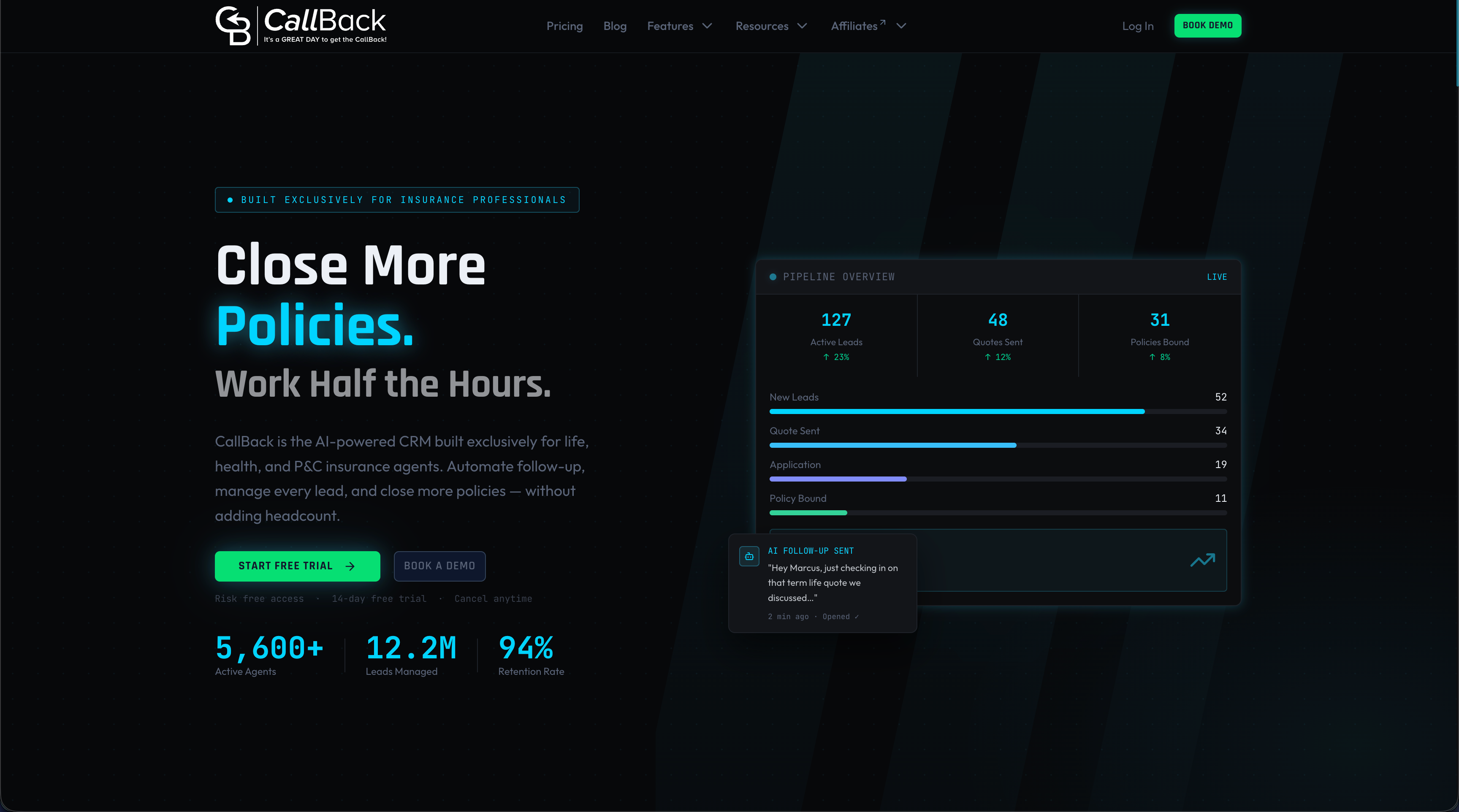
Start a free trial and test lead ingestion speed and SMS automation in the first week. Request insurance-focused onboarding during setup to get pre-built templates for life, health, and commercial lines. Ask for itemized usage billing before you commit. The website and funnel builder is included, so you can test on-site personalization and lead capture in the same trial window.
Useful sources
- ConvertMore — Callback Software: product details on the $2/call widget, exit popup, and floating button features
- GetIntent — AI Landing Page Personalization: edge-deployed personalization benchmarks and the 25% average conversion lift figure
- BeaconMatch — UTM-Driven Personalization: how one URL serves multiple tailored experiences via UTM and search-term matching
- SplitMonk — Automated Conversion Optimization: Bayesian A/B testing and the case for separating optimization from CRM workflow
- Multi-Channel Funnels and AI Content: analysis of how synchronized SMS, email, and on-site messaging outperform single-channel capture
- AI Lead Generation for Insurance Agents: Callbackcrm’s breakdown of AI lead-generation tactics built for insurance workflows
- Sales Automation Workflow for Insurance Agents: detailed guide to CRM ingestion, routing, and automated follow-up sequences