

A compliance workflow in insurance is a documented sequence of steps that captures evidence, applies a regulatory rule, routes the work to a reviewer, and records the outcome in an auditable log. Start today by picking one review type, such as call recording or claims FNOL, and running a one-week evidence-mapping pilot.
To launch your pilot this week:
- Identify one review type and the two or three stakeholders who own it (compliance officer, ops lead, IT contact).
- List every system that touches that review (phone platform, claims system, policy admin, document store).
- Collect a sample of five to ten existing records and note what evidence is present, what is missing, and where the gaps are.
Key Takeaways
Automated compliance workflows in insurance require a minimum evidence record, consent automation, immutable audit logs, and a consistent training program to produce audit-ready results.
| Point | Details |
|---|---|
| Start with one review type | Map evidence sources for one workflow first; expand only after the finding record is reliable. |
| CMS recording mandate | Since October 2022, every Medicare sales call requires a complete, timestamped recording and consent confirmation. |
| Three vendor non-negotiables | Require consent automation, immutable audit logs, and AES-256 encryption in every vendor RFP. |
| Pilot timeline | A focused pilot runs four to six weeks; a full staged rollout covering multiple review types takes three to six months. |
| Callbackcrm fit | Callbackcrm connects consent capture, CRM records, and reporting in one platform, supporting a CMS-ready audit trail for Medicare-writing agencies. |
Table of Contents
- What do compliance workflows mean for insurance operations?
- What technical components does an automated compliance workflow require?
- Which insurance compliance workflows should you automate first?
- How do you implement a compliance workflow step by step?
- What features should you require from a compliance workflow vendor?
- What governance, consent rules, and training must you put in place?
- How do you measure success with KPIs and reporting cadence?
- How does Callbackcrm support compliant insurance workflows?
- The part most teams get wrong about compliance automation
- Callbackcrm for insurance compliance workflow automation
- Sources
What do compliance workflows mean for insurance operations?
A compliance workflow is the structured process that connects a regulatory requirement to a documented, auditable outcome inside your operations. It is not a checklist sitting in a shared drive. It is a live sequence with a defined trigger, required evidence, an applicable rule, a named reviewer, and a remediation path when something fails.
The components that make a workflow “compliance” rather than just “process”:
- Trigger: the event that starts the review (a call ends, a claim is filed, a policy is issued).
- Evidence: the documents, recordings, or data records that prove the activity occurred.
- Rule: the specific regulatory or internal standard being tested.
- Reviewer: the person or system that evaluates whether the evidence meets the rule.
- Remediation: the documented corrective action when the evidence falls short.
Three concrete examples show how this maps to real work. A claims FNOL review triggers when a new loss is reported, captures the intake form and timestamp, checks state acknowledgment deadlines, routes to a claims compliance reviewer, and logs any deadline breach with a remediation ticket. An agent contracting workflow triggers when a new producer is onboarded, captures license verification and appointment documents, checks state appointment requirements, and flags missing filings before the agent writes business. A call recording review triggers at call completion, captures the audio file and consent timestamp, checks CMS or state consent requirements, routes flagged calls to a compliance reviewer, and documents findings with closure dates.
What technical components does an automated compliance workflow require?
Automated, auditable compliance workflows require eight core components. Each one serves a specific function for regulators and internal auditors.
- Evidence capture (OCR and document store): Extracts text from forms, letters, and PDFs and stores them with a policy or claim ID so records are retrievable by transaction.
- Data links: Every evidence record ties to a policy number, claim ID, or agent record so an examiner can pull the full file without manual reconstruction.
- Rules engine: Applies the regulatory or internal standard automatically, flagging records that fall outside tolerance without waiting for a manual review cycle.
- Immutable audit log: Records every action, every user, and every timestamp in a log that cannot be edited after the fact. This is what regulators look at first during a market conduct exam.
- Role-based access control (RBAC): Limits who can view, edit, or export sensitive records. Reviewers see what they need; no one else does.
- Retention and destruction automation: Enforces the retention schedule by line of business and triggers secure deletion when the retention period expires, reducing storage liability.
- Consent automation: Delivers a pre-recorded disclosure at the start of a call and captures a timestamped consent confirmation before the conversation continues.
- Encryption: Protects data at rest and in transit. AES-256 is the current standard for call recordings and document stores.
- Monitoring and alerts: Flags missing recordings, overdue remediations, or access anomalies in near real time so compliance staff can act before a problem compounds.
Gartner recommends using AI to handle mechanical tasks such as extraction, summarization, and flagging, while keeping qualified reviewers in the decision loop. That split preserves audit defensibility: the machine does the volume work, the reviewer makes the judgment call, and the log records both.
Pro Tip: Apply AI-assisted summarization to call recordings and claims documents first. Those two use cases generate the highest evidence volume and benefit most from automated tagging before human review.
Which insurance compliance workflows should you automate first?
Prioritize by regulatory risk and evidence volume. The use cases below are ranked by the combination of regulatory exposure and the operational time saved through automation.
-
Call recording and CMS compliance. Since October 2022, CMS requires agents and brokers to record every call with Medicare beneficiaries during the sales process. This creates a federal baseline layered on top of state consent laws. KPI to track: percentage of regulated calls with a complete, timestamped recording and consent confirmation.
-
Claims deadline and audit trail management. State regulations set strict acknowledgment, investigation, and payment deadlines. Claims lifecycle automation enforces those deadlines with alerts, creates immutable audit trails, and captures required documents to survive market conduct exams. KPI: percentage of claims with all required actions completed within the regulatory deadline.
-
Policy issuance and renewal compliance. Automated checks at issuance confirm that required disclosures were delivered, that the policy form is approved for the state, and that the agent is licensed and appointed. KPI: rate of policy files with complete disclosure documentation at issuance.
-
Agent licensing and appointment tracking. Automated license verification and appointment filing prevent agents from writing business in states where they are not authorized. KPI: number of active agents with a license or appointment gap.
-
Sanctions and AML screening. Automated screening of new applicants and claimants against OFAC and other watchlists reduces financial crime exposure. KPI: percentage of new transactions screened within 24 hours of initiation.
Sector-specific notes:
- Medicare and Medicaid lines carry the CMS call-recording mandate and longer retention expectations. Treat these as the highest-priority recording use case.
- Any workflow touching protected health information (PHI) falls under HIPAA. Pause recordings during PHI collection and document the pause in the audit log.
- Payment card data collected over the phone requires PCI DSS controls. Pause recording during card number entry and resume after.
How do you implement a compliance workflow step by step?
The recommended sequence moves from assessment to a contained pilot, then to a staged rollout. Hand this plan to IT or your operations lead with the checklist below.
-
Assess current state. Inventory every regulatory requirement that applies to your lines of business. Map the systems that currently hold evidence (phone platform, claims system, policy admin, document store). Identify gaps where evidence is missing or not linked to a transaction ID.
-
Map one review type. Choose the highest-risk review type from the use case list above. Document the trigger, evidence sources, rule, reviewer, and remediation path. Ubisar recommends building a minimal, reliable finding record for one review type first, then expanding once the record is stable.
-
Build the minimum evidence record. Define the fields: scope, evidence link, finding severity, root cause, remediation owner, due date, and closure date. This record should generate management reporting as a byproduct, not as a separately assembled deliverable.
-
Connect data sources. Integrate the phone platform, policy admin, and claims system so that evidence records carry a transaction ID. Test the data link before running the pilot.
-
Pilot with a small team. Run the workflow with three to five reviewers for four to six weeks. Collect findings, measure the KPI baseline, and document integration issues.
-
Audit and iterate. After the pilot, run an internal audit against the finding record. Fix gaps in evidence capture, rule logic, or reviewer routing before expanding.
-
Scale to additional review types. Apply the same record model to the next highest-risk use case. RegEd’s closed-loop regulatory change process (be aware, determine relevance, assign ownership, execute and monitor, demonstrate compliance) provides a useful framework for managing new regulatory requirements as they arise.
Pilot checklist:
- Compliance officer, ops lead, IT contact, and one front-line reviewer assigned.
- Data sources inventoried and transaction ID linkage confirmed.
- Minimum evidence record fields defined and documented.
- Consent automation configured and tested on a sample of calls.
- Retention schedule defined by line of business.
- Pilot KPI baseline measured at week one.
Timeline and cost considerations: A focused pilot runs four to six weeks. A staged rollout covering two to four review types typically takes three to six months. Primary cost drivers are integration effort (connecting legacy systems to the workflow platform), platform licensing, and storage and retention costs for call recordings and documents.
What features should you require from a compliance workflow vendor?
The three non-negotiables are consent automation with timestamped records, immutable audit logs, and role-based access with AES-256 encryption. Everything else is configurable; these three are not.
| Feature Category | Expected Behavior |
|---|---|
| Consent automation | Automated pre-call disclosure delivered before the conversation; timestamped consent confirmation stored with the call record. |
| Immutable audit log | Every action, user, and timestamp recorded in a log that cannot be edited or deleted after the fact. |
| Role-based access control | Permissions defined by role; reviewers access only the records relevant to their function. |
| AES-256 encryption | Data encrypted at rest and in transit; encryption key management documented and auditable. |
| Retention and destruction | Automated enforcement of retention schedules by line of business; secure deletion triggered at expiration. |
| Document capture and OCR | Structured extraction from forms and PDFs with linkage to policy or claim IDs. |
| Monitoring and alerting | Real-time or near-real-time flags for missing recordings, overdue remediations, and access anomalies. |
| Reporting and export | Exportable finding reports and audit logs in formats an examiner can review without vendor assistance. |
Security requirements to include in your RFP:
- AES-256 encryption confirmed in writing, with key management documentation.
- Retention for Medicare-related calls should reflect current CMS guidance; some industry sources recommend planning for up to 10 years for Medicare and Medicaid lines.
- HIPAA Business Associate Agreement (BAA) required if the vendor processes PHI.
- PCI DSS compliance documentation if the platform handles payment card data.
- SOC 2 Type II report or equivalent third-party audit attestation.
- Vendor-provided audit log that is exportable without vendor involvement.
What governance, consent rules, and training must you put in place?
Automated workflows are only legally defensible when written policies and trained staff back them up. The governance checklist below covers the minimum controls.
Governance checklist:
- Documented compliance workflow policy, reviewed and approved by legal and senior management.
- Written consent script for every regulated call type, reviewed against current CMS and state requirements.
- RBAC policy defining who can access, review, export, or delete compliance records.
- Vendor contract terms that include a BAA, data processing agreement, and audit rights.
- Retention and destruction schedule by line of business, documented and enforced by the platform.
- Internal audit cadence defined and assigned to a named owner.
Sample consent script for phone calls:
Pause recording before collecting payment card numbers or PHI. Resume after and log the pause with a timestamp. Treating all-party consent as the default operational standard simplifies compliance across state lines, since some states require every-party consent while others permit one-party recording.

Audit cadence:
| Frequency | Activity | Owner |
|---|---|---|
| Daily | Automated alerts for missing recordings, overdue remediations, access anomalies | Compliance ops |
| Weekly | Sampled call and document review; finding record update | Compliance reviewer |
| Quarterly | Full process audit against written policy; remediation trend review | Compliance officer |
| Annual | Policy review and update; training refresh; vendor contract review | Compliance officer and legal |
Training checklist for agents and reviewers:
- Consent script delivery and when to pause recording.
- How to flag a compliance issue in the workflow platform.
- Retention rules and what not to delete.
- How to read a finding record and respond to a remediation assignment.
- Annual refresher with a sign-off log retained for audit purposes.
360factors identifies cultivating a compliance culture as a foundational program priority, alongside regular risk assessments and continuous monitoring. Training is the mechanism that converts a written policy into consistent agent behavior.
How do you measure success with KPIs and reporting cadence?
Six KPIs cover the core dimensions of a functioning compliance workflow program. Measure all six from the first week of the pilot.
- Consent success rate: percentage of regulated calls with a complete, timestamped consent confirmation. Target: 100% for Medicare and Medicaid lines.
- Recording coverage: percentage of regulated calls with a complete, retrievable recording. Target: 100% for CMS-mandated lines.
- Overdue remediation count: number of open findings past their due date. Target: zero at any point in time.
- Audit pass rate: percentage of sampled records that meet all required evidence standards. Track week over week.
- Time to close findings: average days from finding identification to documented closure. Shorter is better; set a target based on finding severity.
- Access log anomalies: number of access events outside normal role permissions. Any non-zero count requires investigation.
Reporting schedule:
| Report | Frequency | Recipients |
|---|---|---|
| Missing recording and overdue remediation alerts | Daily | Compliance ops, ops manager |
| Sampled review summary | Weekly | Compliance officer |
| KPI dashboard | Monthly | Executive team, compliance officer |
| Full audit report | Quarterly | Senior management, legal |
When a regulator or market conduct examiner asks for evidence, present a sampled finding record that shows scope, linked evidence, finding severity, remediation owner, due date, and closure date. That structure, recommended by Ubisar’s workflow design guidance, means the record assembles the examiner’s report without manual reconstruction.
How does Callbackcrm support compliant insurance workflows?
Callbackcrm provides the automation, audit trail, and consent capabilities that insurance compliance workflows require. The platform’s outreach and CRM automation can be configured to embed consent prompts, link recordings to policy and lead records, and route flagged interactions to a reviewer.
| Callbackcrm Feature | Compliance Control It Supports |
|---|---|
| Automated SMS and email workflows | Consent delivery and timestamped confirmation before regulated outreach |
| CRM pipeline and record management | Transaction ID linkage for evidence records tied to policy or lead |
| Workflow automation engine | Rules-based routing of flagged calls or documents to a compliance reviewer |
| Reporting and analytics | KPI tracking for consent rate, recording coverage, and remediation status |
| Role-based user permissions | RBAC enforcement limiting access to compliance records by role |
| Google Cloud hosting | Encrypted data storage with documented infrastructure security |
Pilot scenario: An agency writing Medicare Advantage plans configures Callbackcrm to deliver an automated pre-call disclosure via the dialer integration, capture the consent timestamp in the CRM record, and tag the call recording with the policy ID. In week one, the compliance reviewer samples ten calls, confirms consent timestamps are present, and identifies any calls where the disclosure was skipped. The finding record captures scope, evidence link, and remediation assignment. By week four, the team has a baseline consent success rate and a documented audit trail ready for a CMS examination.
Week one implementation steps:
- Connect the dialer integration and confirm call recordings link to CRM records.
- Configure the automated disclosure message and test consent timestamp capture.
- Assign reviewer roles with RBAC so only the compliance officer and designated reviewers can access recordings.
- Run a sample of ten calls through the review workflow and document findings.
The customer outreach workflow guide on the Callbackcrm blog walks through how to embed consent and recording capture within outreach automation, which is a practical starting point for the pilot configuration.
The part most teams get wrong about compliance automation
The most common failure mode in compliance workflow programs is treating the technology rollout as the finish line. Teams spend months selecting a platform, configuring integrations, and building dashboards, then discover that agents are bypassing the consent step, reviewers are closing findings without evidence, and the audit log is technically complete but practically useless.
The single cultural fix that solves most of these problems is making the finding record the source of truth for management reporting from day one. When the compliance officer’s weekly summary comes directly from the workflow record rather than from a manually assembled spreadsheet, every stakeholder has an incentive to keep the record accurate. Reviewers stop treating findings as administrative overhead because the record is what gets presented to senior management.
The practical trade-off is speed versus completeness. A minimal finding record that captures scope, evidence link, finding, remediation owner, and closure date is far more valuable than a comprehensive record that takes three weeks to configure and never gets used consistently. Start with the minimum. Add fields only when the minimum record has been reliable for a full audit cycle. Completeness built on a shaky foundation is not compliance; it is documentation theater.
Callbackcrm for insurance compliance workflow automation
Insurance agencies writing Medicare, ACA, or commercial lines face the same pressure: regulators want evidence, examiners want it fast, and manual processes cannot keep up. Callbackcrm gives compliance-focused agencies a single platform where automated outreach, consent capture, CRM records, and reporting connect without a separate compliance tool bolted on.
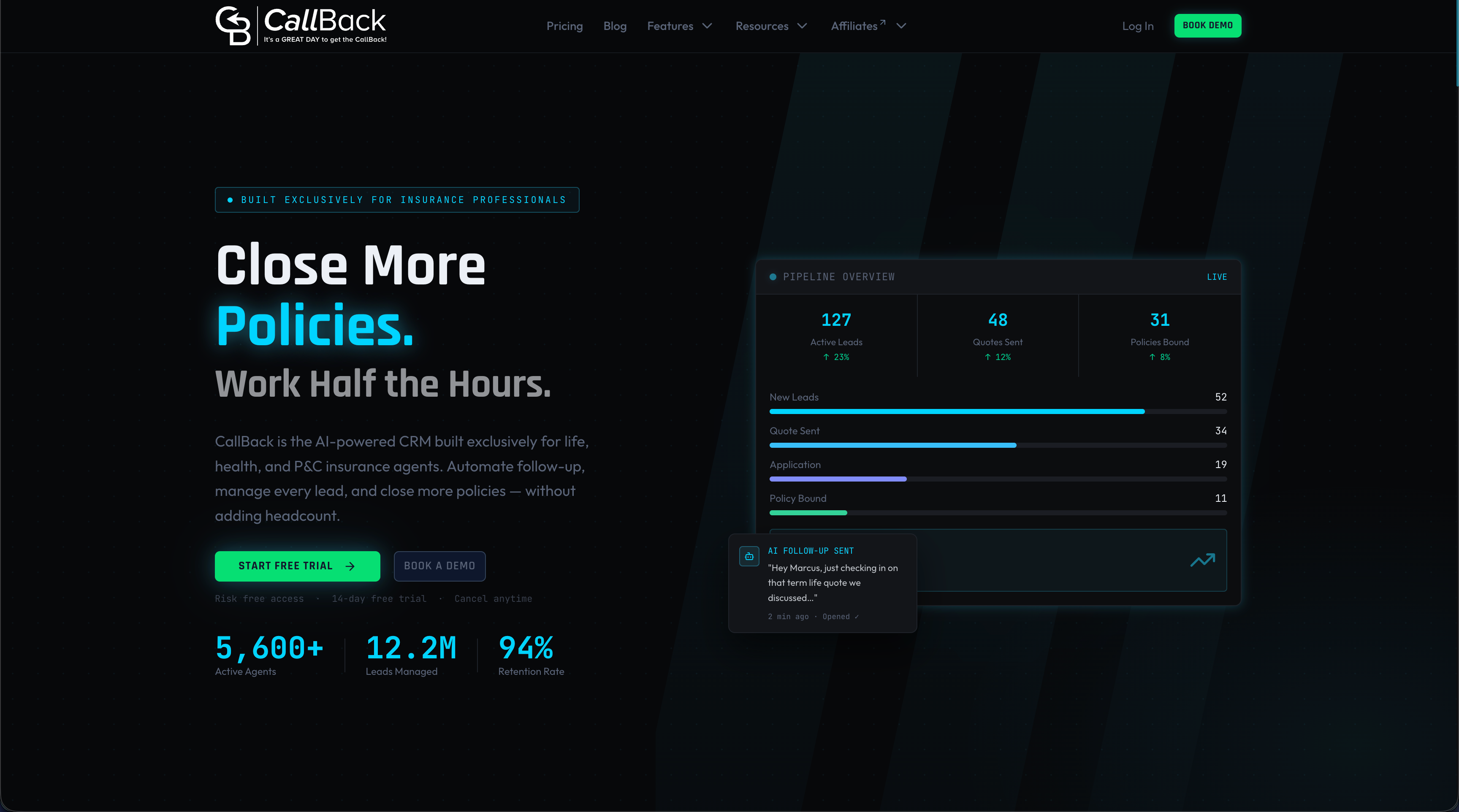
The platform handles SMS and email automation with consent prompts built into the workflow, links every interaction to a policy or lead record, and gives compliance officers role-based access to review and export records without IT involvement. For agencies running a Medicare Advantage book, that means a CMS-ready audit trail generated as a byproduct of normal sales operations, not as a separate compliance project.
Start a free trial at Callbackcrm and configure your first compliant outreach workflow this week.
Sources
The sources below cover regulatory guidance, workflow design, and call recording best practice for US insurance compliance teams.
- Reged
- Compliance in Insurance: A Complete Guide for Insurers
- Compliant Call Recording: A Guide for Insurance Agents
- Insurance Call Recording Compliance Guide 2026 | Complete
- How to Build Insurance Compliance Review Workflows Without Slowing the Business | Ubisar
This article is general information, not a substitute for advice from a qualified lawyer. Consult a qualified legal professional about your own circumstances before acting on anything here.