

TL;DR:
- Automation handles routine tasks, freeing agents to focus on personalized client interactions.
- Hybrid models combining AI and human touch deliver better client trust and retention.
- Implementing automation requires a clear strategy, starting with CRM and periodic performance reviews.
Many insurance agents assume that automating customer outreach will make their business feel cold and robotic. That fear is understandable, but it’s based on a misreading of what automation actually does. The agents pulling ahead in 2026 aren’t choosing between efficiency and warmth. They’re using automation to handle the repetitive, time-consuming tasks so they can show up fully present when it matters most. This article breaks down how automation works in insurance outreach, which tools deliver real results, how it stacks up against manual methods, and the practical steps you need to get started without losing the human touch your clients expect.
Table of Contents
- The impact of automation on insurance outreach
- Key automation tools for insurance agents
- Comparing automated vs. manual outreach
- Best practices for implementing automation in insurance outreach
- Our take: Automation is your ally, not your competitor
- Ready to elevate your outreach? Explore powerful automation tools
- Frequently asked questions
Key Takeaways
| Point | Details |
|---|---|
| Automate routine outreach | Insurance agents can automate follow-ups and reminders, improving efficiency and freeing up time for meaningful client interactions. |
| Hybrid approach works best | Combining automation for logistics and human expertise for advice achieves optimal customer satisfaction and lead conversion. |
| Select tools strategically | Starting with automation tools that address your agency’s pain points will help scale outreach without sacrificing personalization. |
| Measure and refine | Track performance regularly and tweak automation strategies to maximize lead generation and retention outcomes. |
The impact of automation on insurance outreach
Automation in insurance outreach means letting software handle the routine work, things like sending follow-up emails after a quote request, triggering SMS reminders before policy renewal dates, and routing new leads to the right agent instantly. These aren’t glamorous tasks, but they eat hours every week. When software handles them consistently, agents reclaim that time for conversations that actually require judgment, empathy, and expertise.
The business case is hard to argue with. AI enables faster lead response and 24/7 touchpoints, meaning a prospect who fills out a form at 10 p.m. gets an immediate, relevant response instead of waiting until your office opens. In a market where response speed directly influences conversion rates, that matters enormously.
Here’s what automation genuinely changes for agencies:
- Faster response times without adding staff or extending office hours
- Consistent follow-up sequences that never fall through the cracks
- Scalable lead nurturing across hundreds of contacts simultaneously
- Reduced data entry errors through CRM auto-population
- Better lead prioritization using AI-driven scoring models
The agencies seeing the strongest results aren’t going fully automated. They’re running hybrid models where AI manages the first several touchpoints and agents step in once genuine interest is established. Think of it as a relay race. Automation runs the early laps at speed, then hands the baton to a human who can read the room, handle objections, and close.
“The most effective insurance agencies aren’t choosing between technology and relationships. They’re using automation to protect time for the conversations where human judgment is irreplaceable.”
If you want to understand how this directly affects your pipeline, explore how boosting insurance sales with AI works in practice. The mechanics are straightforward, but the compounding effect on your lead volume over months is significant.
Key automation tools for insurance agents
Knowing automation has value is one thing. Knowing which specific tools move the needle is what actually changes your results. Here are the categories that matter most for insurance agencies.
| Tool Type | Primary Function | Best For |
|---|---|---|
| CRM system | Contact management, pipeline tracking | Organizing leads and client history |
| Email automation | Drip campaigns, renewal notices | Nurturing leads over time |
| SMS automation | Appointment reminders, quick follow-ups | High open-rate, time-sensitive messages |
| Lead scoring | Ranking prospects by conversion likelihood | Prioritizing agent time |
| Chatbots / AI assistants | Answering FAQs, qualifying website visitors | 24/7 initial engagement |
Leading AI marketing platforms automate these processes and meaningfully boost lead quality, reducing the volume of unqualified prospects agents waste time on.
Here’s how to approach adding these tools in a logical sequence:
- Start with your CRM. If your contact data is messy, every other tool underperforms. Clean data is the foundation.
- Add email automation. Build sequences for new leads, policy renewals, and cross-sell opportunities.
- Layer in SMS. Text messages have open rates above 90%, making them ideal for time-sensitive reminders.
- Implement lead scoring. Let the system rank your leads so your team contacts the warmest prospects first.
- Introduce AI assistants. Deploy a chatbot on your website to qualify visitors before they ever reach your inbox.
Integration is the detail most agencies overlook. Tools that don’t talk to each other create data silos where leads get lost between platforms. When your email platform syncs with your CRM, and your CRM syncs with your SMS tool, you get a single view of every prospect’s journey. Strong communication skills for marketers also matter here since your automated messages still need to sound human and relevant, not like template spam.

Pro Tip: Don’t buy five tools at once. Identify your single biggest daily bottleneck and solve that first. Master one tool before layering in the next. Explore the AI marketing tools for agents that insurance-specific platforms offer, since they’re built around the workflows you already use.
Comparing automated vs. manual outreach
Let’s put the two approaches side by side so you can see exactly where each one wins and where it falls short.
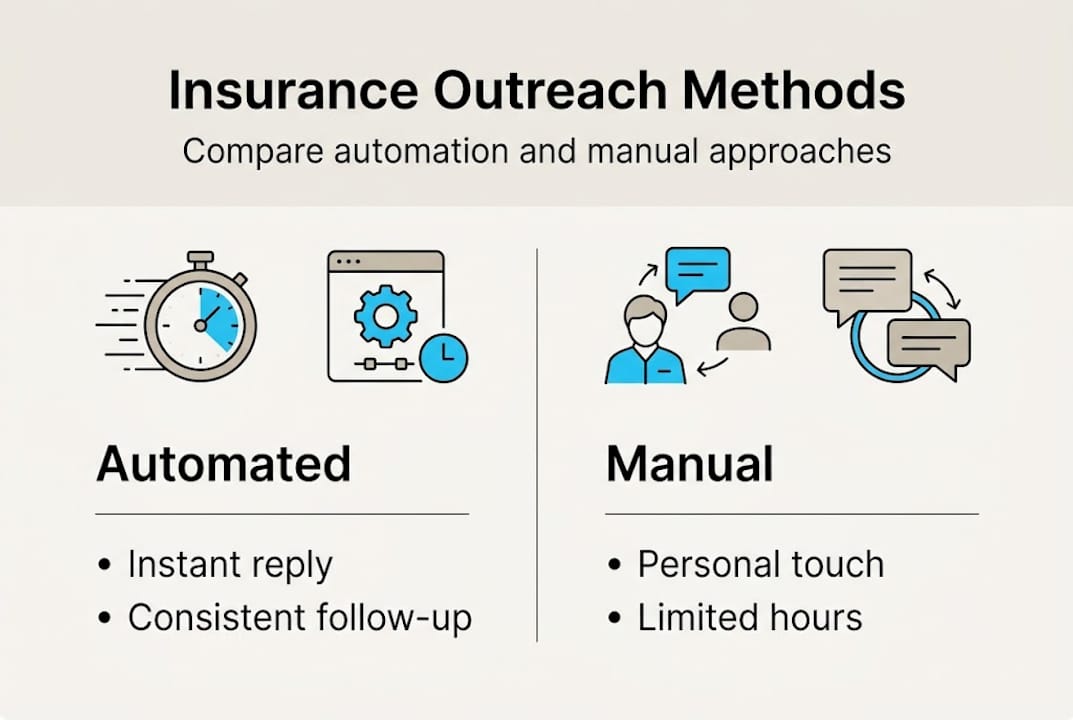
| Factor | Automated outreach | Manual outreach |
|---|---|---|
| Speed | Instant response, 24/7 | Limited to office hours |
| Scale | Hundreds of contacts simultaneously | One at a time |
| Consistency | 100% reliable sequences | Depends on agent discipline |
| Personalization | Template-based, rule-driven | Fully tailored to individual |
| Cost per contact | Very low at scale | High in agent time |
| Trust building | Difficult at early stages | Natural through conversation |
Automation clearly wins on speed, scale, and consistency. But manual outreach still holds an edge in trust-building and nuanced personalization, particularly for complex cases like whole life policies, business insurance, or clients going through major life changes.
What automation handles well:
- Initial lead response and qualification
- Scheduled follow-up sequences
- Policy renewal and birthday reminders
- Bulk announcements and educational content
- Appointment confirmations
What still needs a human:
- Explaining complex coverage options
- Handling objections and emotional concerns
- Relationship repair after a claim dispute
- High-value consultations and policy reviews
Hybrid models combining AI efficiency with human expertise consistently outperform automation-only approaches in client retention and satisfaction scores. That’s not a surprising finding. It reflects how clients actually want to be treated: efficiently when it’s routine, personally when it’s important.
Pro Tip: Use automation for reminders and routine touchpoints, but flag any lead who replies with a question or concern for immediate personal follow-up. A fast human response at that moment builds more trust than any automated sequence. See how AI-driven customer engagement keeps that balance in practice, and check out AI speaking coach benefits to sharpen how your team communicates when they do step in.
Best practices for implementing automation in insurance outreach
Having a clear implementation plan separates agencies that see ROI quickly from those that spend months configuring tools without results. Here’s a straightforward workflow.
- Audit your current outreach process. List every repetitive task your team does weekly. These are your automation candidates.
- Map your lead journey. Identify every touchpoint from first contact to policy close. Note which steps currently have gaps or delays.
- Choose one platform. Select a tool built for insurance agents rather than a generic marketing solution. Insurance-specific workflows save weeks of setup time.
- Build your first sequence. Start simple: a three-email nurture series for new leads. Test it, measure open and response rates, then refine.
- Set escalation rules. Define exactly when an automated touchpoint should trigger a human follow-up. Don’t leave this to judgment. Write the rules clearly.
- Train your team. Automation fails when agents distrust it or duplicate its work manually. Everyone needs to understand what the system handles and what they own.
- Review monthly. Automation isn’t set-and-forget. Check your metrics, adjust sequences that underperform, and retire anything that isn’t moving leads forward.
Agents who optimize workflows with automation increase conversions significantly compared to those relying entirely on manual processes. The gap widens over time as automated systems accumulate data and improve.
The most common pitfall is over-automation. Agents set up long sequences, turn them on, and never check them again. Prospects who replied weeks ago sit in a queue getting generic messages. That destroys trust fast. Review your optimizing your lead funnel strategy regularly, and pair it with data-driven insurance marketing strategies to keep your outreach grounded in real performance data.
Pro Tip: Set a recurring 30-minute monthly calendar block specifically to review your automation performance. Small, regular adjustments compound into major improvements over a policy year.
Our take: Automation is your ally, not your competitor
The loudest concern we hear from agents is that automation will make them obsolete. It’s worth saying plainly: that fear is misplaced. The agents who automate their outreach aren’t becoming less important to their clients. They’re becoming more available for the moments where their expertise actually counts.
Conventional wisdom frames automation as a threat to the relationship-driven nature of insurance sales. But the reality is the opposite. When a system handles follow-up reminders, renewal notices, and lead qualification, an agent’s calendar opens up for policy reviews, coverage consultations, and the kind of meaningful conversations that actually retain clients long-term.
What most agents miss is that AI augments the agent-client relationship by handling routine efficiency while creating more space for deeper conversations. Automation doesn’t replace empathy. It protects the time agents need to exercise it. Explore AI strategies for customer engagement to see how forward-thinking agencies are already making this shift and what it looks like in a real workflow.
Ready to elevate your outreach? Explore powerful automation tools
If you’ve been managing outreach manually and feeling stretched thin, the path forward is clearer than it’s ever been. The tools exist to handle the repetitive work, and they’re built specifically for agencies like yours.
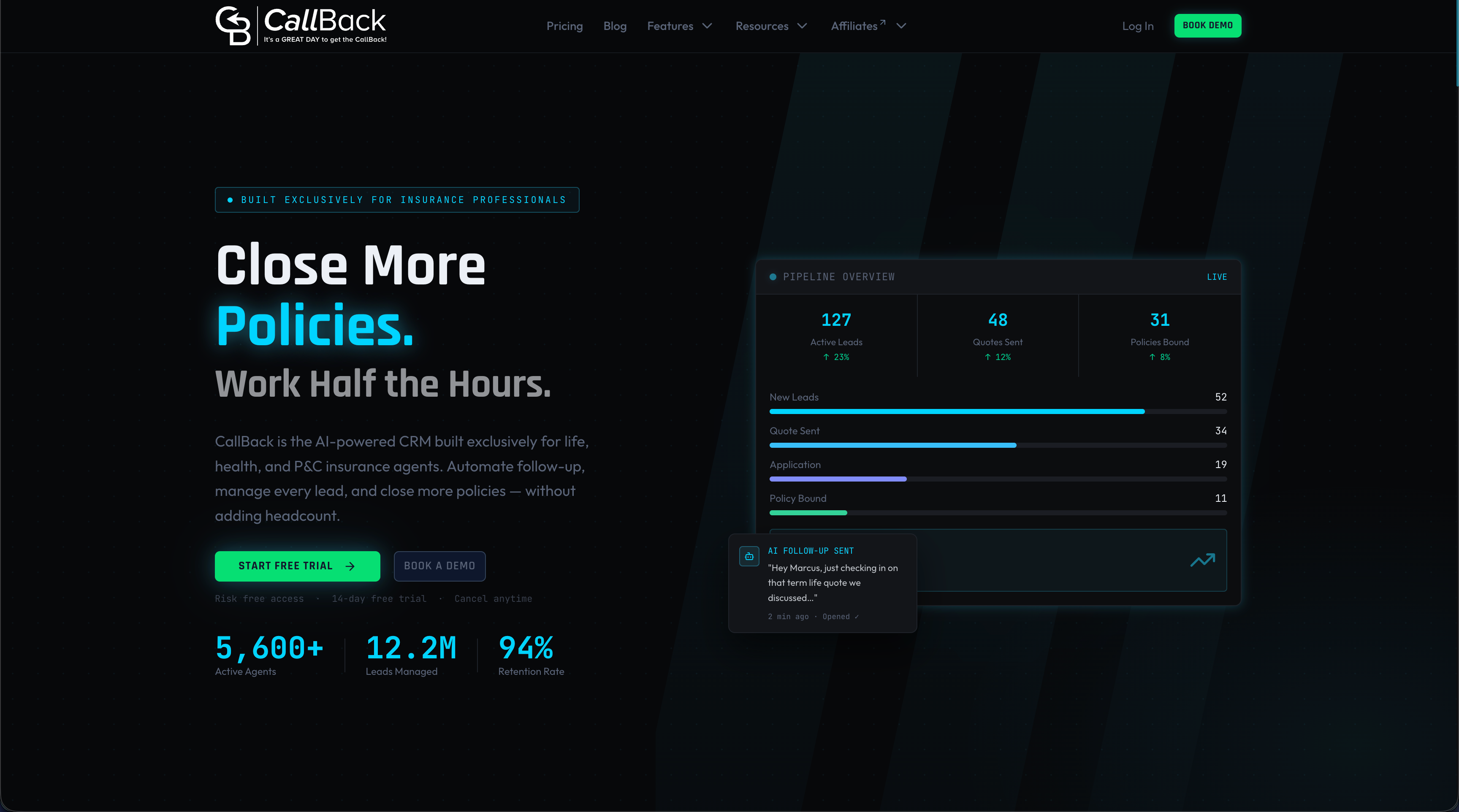
CallBack CRM brings together CRM management, SMS marketing features, email automation, lead scoring, and AI assistants in one platform designed for insurance agents and agencies. You don’t need to stitch together five different tools or hire a developer to get started. Explore the full range of AI tool features and see how quickly you can shift from chasing leads manually to letting automation do the heavy lifting while you focus on closing.
Frequently asked questions
What is the main benefit of automating customer outreach for insurance agents?
The main benefit is faster, consistent lead engagement, freeing agents to focus on relationship-building and providing expert advice. AI enables faster response and scalability that manual outreach simply cannot match.
Which types of outreach tasks can automation handle effectively?
Automation excels at scheduling follow-ups, sending reminders, qualifying leads, and managing bulk communications. Automation covers routine outreach and lead scoring so agents spend time on higher-value work.
Will using automation make customer interactions less personal?
No. When used wisely, automation handles logistics while agents deliver personalized advice and empathy during client conversations. Hybrid models combine AI efficiency with the human trust clients need for major coverage decisions.
How do I start implementing automation in my agency?
Begin by identifying repetitive outreach tasks, select tools that integrate with your CRM, and measure results for ongoing improvement. Optimizing workflows with automation boosts conversions significantly when paired with consistent performance reviews.