

TL;DR:
- Using a client’s first name in an email subject line is not true personalization, which requires relevance and timing. AI enhances this by analyzing real-time policy data and behavioral signals to trigger timely, meaningful outreach based on specific client events. Building a robust personalization system involves clean data, governed content, and measurable learning loops to ensure effective, scalable communication.
Putting a client’s first name in an email subject line is not personalization. It never was. Real personalization means reaching the right person, at the right moment, with a message tied to something genuinely relevant to their life or policy. AI-driven outreach now makes it possible to use “scoped personalization” that converts policy lifecycle events into timely, agent-driven touches that actually move people. This guide breaks down the strategies, pitfalls, and practical steps that separate modern, AI-powered personalization from the outdated tactics most agencies are still relying on.
Table of Contents
- Why traditional outreach falls short—and how AI changes the game
- The personalization stack: Data, governed content, and learning loops
- Lifecycle and event-based triggers: Moving beyond name drops
- Personalization at scale: Experimentation, measurement, and the realities of conversion rates
- Our experience: Why personalization fails (and what actually works for agents)
- Take your outreach further with the right AI solutions
- Frequently asked questions
Key Takeaways
| Point | Details |
|---|---|
| AI makes outreach relevant | Modern personalization targets customer needs at the right moment, not just by name. |
| Compliance is critical | Effective personalization requires robust data governance and clear consent tracking to avoid costly mistakes. |
| Event-based triggers win | Reaching out at moments like renewals or exposure changes drives far higher engagement and conversion. |
| Iteration beats set-and-forget | Ongoing experimentation and agent feedback are essential to scaling results and staying compliant. |
Why traditional outreach falls short—and how AI changes the game
Let’s first examine why older outreach methods can’t deliver the personalized connections that drive engagement and conversion.
Most agencies still work from static contact lists built months ago, armed with generic scripts that sound identical whether you’re talking to a 28-year-old renter or a 55-year-old small business owner. Agents feel it. Clients feel it even more. The pitch lands flat because it carries no real relevance to what the client is actually experiencing right now.
Here’s what outdated outreach typically looks like in practice:
- Mass email blasts sent to entire databases regardless of policy status or life stage
- Phone scripts that don’t account for recent claims, renewals, or risk exposure changes
- Follow-up sequences triggered by time elapsed rather than meaningful client events
- Lead scoring based on demographic data alone, missing behavioral signals entirely
AI flips this entirely. Instead of working from static data, AI continuously analyzes real-time policy information, behavioral signals, and external risk data to surface clients who genuinely need contact right now. The role of AI in marketing strategies has shifted from simple automation to genuine intelligence that identifies opportunity before an agent would even think to look.
“Personalization at scale requires smarter techniques beyond simple prompt templating. Without structured data and meaningful triggers, even sophisticated AI tools produce generic output.”
A real example worth noting: AI tools that flag clients in risk zones for timely agent outreach. When flood zone maps were updated in parts of the Gulf Coast, agencies using AI-powered tools were able to identify every affected policyholder within hours and push out relevant, personalized messages before competitors even realized the change happened. That’s the gap AI closes. Agents who want to understand the full potential here can explore data-driven insurance marketing to see how data strategy connects to real outreach results.
The personalization stack: Data, governed content, and learning loops
With a sense of why AI matters, we can break down exactly how a robust personalization system is structured.
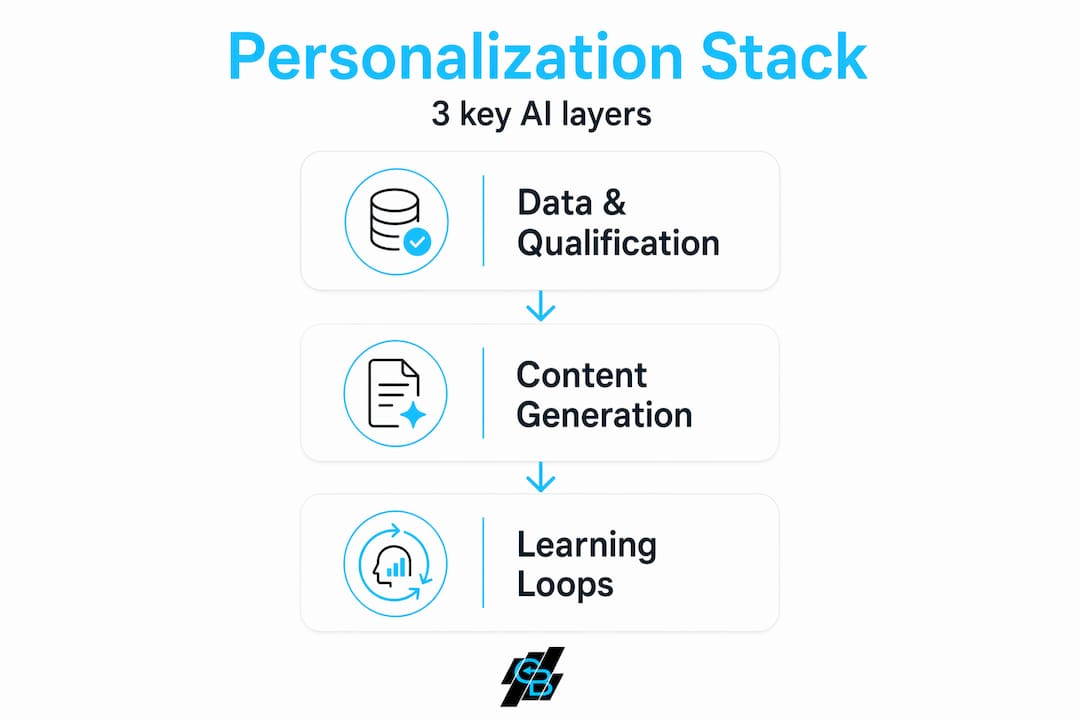
Think of a personalization system as three connected layers, not a single tool. A practical AI personalization stack separates data and qualification, governed content generation, and measurement with learning loops. Each layer feeds the next, and a weakness in any one of them quietly destroys the whole system’s output.
Layer 1: Data and qualification
This is where most agencies quietly fail. Your AI is only as smart as the data you feed it. Outdated policy records, duplicate contacts, and missing consent flags will produce outreach that feels wrong or, worse, lands you in a compliance problem. Fresh, permissioned, well-structured data is the foundation.

Layer 2: Governed content generation
AI can draft messages, but personalization quality depends on product rules, compliance requirements, data governance standards, and human oversight. An AI system generating outreach without compliance guardrails is genuinely dangerous for a licensed insurance professional. You need pre-approved templates, human review triggers, and clear rules about what the AI can and cannot say.
Layer 3: Measurement and learning loops
This layer closes the feedback cycle. Which messages drove calls? Which triggered unsubscribes? What subject lines converted? Without this data flowing back into the system, your personalization stays frozen at whatever quality it started at. For practical guidance on how analytics for better ROI can be built into your outreach workflow, the principle is simple: measure everything, act on patterns, and keep refining.
| Stack layer | Key components | Common failure point |
|---|---|---|
| Data and qualification | CRM hygiene, consent tracking, policy triggers | Stale data, missing opt-ins |
| Governed content | Compliant templates, human review, tone rules | AI drift from approved language |
| Measurement and learning | Open rates, conversion tracking, agent feedback | No loop back to improve content |
Pro Tip: Before you invest in any AI outreach tool, audit your CRM data first. If your contact records are more than 90 days old without a refresh cycle, the AI will confidently personalize messages based on wrong information. Clean data is not glamorous, but it is the single biggest factor separating effective personalization from expensive noise.
Agencies looking to build these capabilities from the ground up can find a good starting point in AI in insurance marketing strategies that map directly to each layer of this stack.
Lifecycle and event-based triggers: Moving beyond name drops
Knowing the stack, let’s focus on the practical triggers that bring outreach strategies to life and how event-driven personalization works in the real world.
Here’s a clear truth: personalization is relevance across time, channel, and policy constraints. It is not token replacement. Swapping in a first name does not make a message personal. Reaching out three weeks before a client’s renewal date, referencing their specific coverage, and flagging a gap you identified through their claims history? That’s personalization.
The best AI-driven outreach systems work from a defined set of lifecycle and event-based triggers. Here are the most impactful ones for insurance agencies:
- Renewal approach window: Reaching out 45, 30, and 14 days before policy renewal with coverage review prompts drives far higher retention than waiting for a client to call.
- Claim filing event: When a client files a claim, a timely, empathetic follow-up message that addresses next steps creates trust at exactly the moment it matters most.
- Exposure or risk change: A client who adds a teenage driver, buys a rental property, or moves to a different zip code has changed their risk profile. AI can detect these signals and trigger the right conversation.
- Annual review milestone: Proactive annual review outreach that references actual policy specifics tells clients you know their situation rather than just their name.
- Lapse or non-payment trigger: Early intervention when a payment fails can save a policy and a client relationship before either slips away.
Hyper-personalization moves beyond names toward AI-enhanced insights that actually predict client needs. This is where the distance between generic campaigns and event-triggered outreach becomes measurable.
| Campaign type | Trigger | Average open rate | Conversion outcome |
|---|---|---|---|
| Generic monthly newsletter | Calendar date | 18-22% | Low, under 3% response |
| Renewal reminder sequence | Policy expiration date | 38-45% | Moderate, 12-18% action |
| Risk-event triggered message | Exposure change detected | 52-60% | High, 28-35% engagement |
| Post-claim check-in | Claim filed | 65-72% | Very high, trust-building |
The data pattern is clear. The more tightly an outreach message is connected to something real happening in a client’s policy or life, the more likely they are to open it, read it, and respond. You can see more practical applications in AI-driven customer engagement tactics built specifically for agents. For deeper implementation guidance, the AI-powered customer engagement process outlines how to connect triggers to automated workflows without losing the human touch.
Understanding how personalized content boosts engagement reinforces why trigger-based messaging consistently outperforms even the most creatively written generic campaigns.
Personalization at scale: Experimentation, measurement, and the realities of conversion rates
Now that you’ve seen how triggers work, it’s crucial to address how to apply personalization at scale and how to make iteration and measurement a core habit rather than an afterthought.
Scaling personalized outreach without a test-and-learn mindset produces one outcome reliably: you scale your mistakes. For insurance agencies, personalization at scale requires a test-and-learn iteration loop and batch experimentation to find what actually converts rather than what sounds good in a strategy meeting.
Here’s what an effective iteration cycle looks like for a mid-sized agency:
- Batch A/B tests on subject lines: Test one variable at a time. Subject line A vs. subject line B sent to two equal segments of a trigger-qualified list. Measure open rates within 48 hours.
- Message variant testing by trigger type: Renewal messages may need a different tone than post-claim check-ins. Build and test separate libraries for each trigger category.
- Track consent status actively: Every list segment must have documented, current consent. Outdated consent isn’t just a compliance risk. It quietly tanks deliverability as opt-out rates climb.
- Agent feedback integration: Your agents know when a lead calls in confused or when a message clearly resonated. Build a simple feedback channel so that field insight flows back to improve future content.
- Measure what matters, not just vanity metrics: Open rates tell you about subject lines. Click-through rates tell you about message relevance. Conversion rates tell you about offer fit. Track all three at minimum.
The conversion rate reality check is important here. Cold outbound insurance leads convert at dramatically lower rates than inbound leads, making personalization and fast follow-up essential when outbound is part of your strategy. Cold outbound typically converts at 2% to 5%, while high-intent inbound leads can close at 25% to 30%. Personalization doesn’t close that gap entirely, but it meaningfully narrows it, especially when paired with smart targeting.
Good lead nurturing strategies are what move prospects from cold awareness through to warm conversion, and AI makes that nurturing timeline dramatically shorter when triggers are configured properly. Agents looking to improve lead pipeline health will find actionable lead generation tips and AI in lead generation for insurance professionals strategies that pair well with the measurement discipline described above.
Pro Tip: Don’t wait until you have a “perfect” dataset to start testing. Run your first batch experiment on your cleanest 200 to 300 contacts using one lifecycle trigger. The insight you gain from even a small, well-designed test is worth more than months of planning without execution.
Our experience: Why personalization fails (and what actually works for agents)
With the evidence and tactics in mind, here’s a frank perspective from agents and tech professionals who’ve worked through the real-world challenges.
Most agencies that struggle with AI-driven personalization are not dealing with a technology problem. They blame the output, they blame the AI tool, and they switch platforms looking for better results. The actual issue is almost always upstream. Personalization failures are more driven by governance, consent tracking, and data quality problems than by any limitation in the AI’s ability to generate language. The AI is doing exactly what you set it up to do. If it’s producing generic, off-putting, or compliance-risky messages, the root cause is in your data and your guardrails, not the model.
The agencies that build sustainable, conversion-positive personalization systems share a few consistent traits. They treat data governance as a standing operational discipline, not a one-time setup task. They keep a human agent in the loop for review before any new message template is deployed at scale. And they monitor for what we call “silent failures”: messages that go out without errors but produce no engagement, no responses, and no conversion. Silent failures are easy to miss because nothing breaks. But they represent real cost and lost opportunity.
The mindset shift that makes the biggest difference is treating personalization as a regulated operational capability, not a marketing shortcut. It requires the same rigor you’d bring to underwriting a new product line. Define your data standards. Document your consent processes. Establish clear human oversight triggers. Then test, measure, and refine relentlessly. Agencies that adopt this approach consistently outperform peers who treat AI outreach as a set-and-forget tool. You can find more on building this discipline through AI customer engagement strategies designed specifically for the insurance environment.
Take your outreach further with the right AI solutions
If you’re ready to level up your outreach and see real-world impact, here’s how CallBack CRM can help bridge your strategy with powerful AI tools.
CallBack CRM was built for exactly the kind of governed, lifecycle-triggered, measurement-driven personalization this article describes. From AI-assisted lead scoring to compliance-ready message templates, the platform gives insurance agents and agencies the infrastructure to execute what you’ve learned here without building it from scratch.
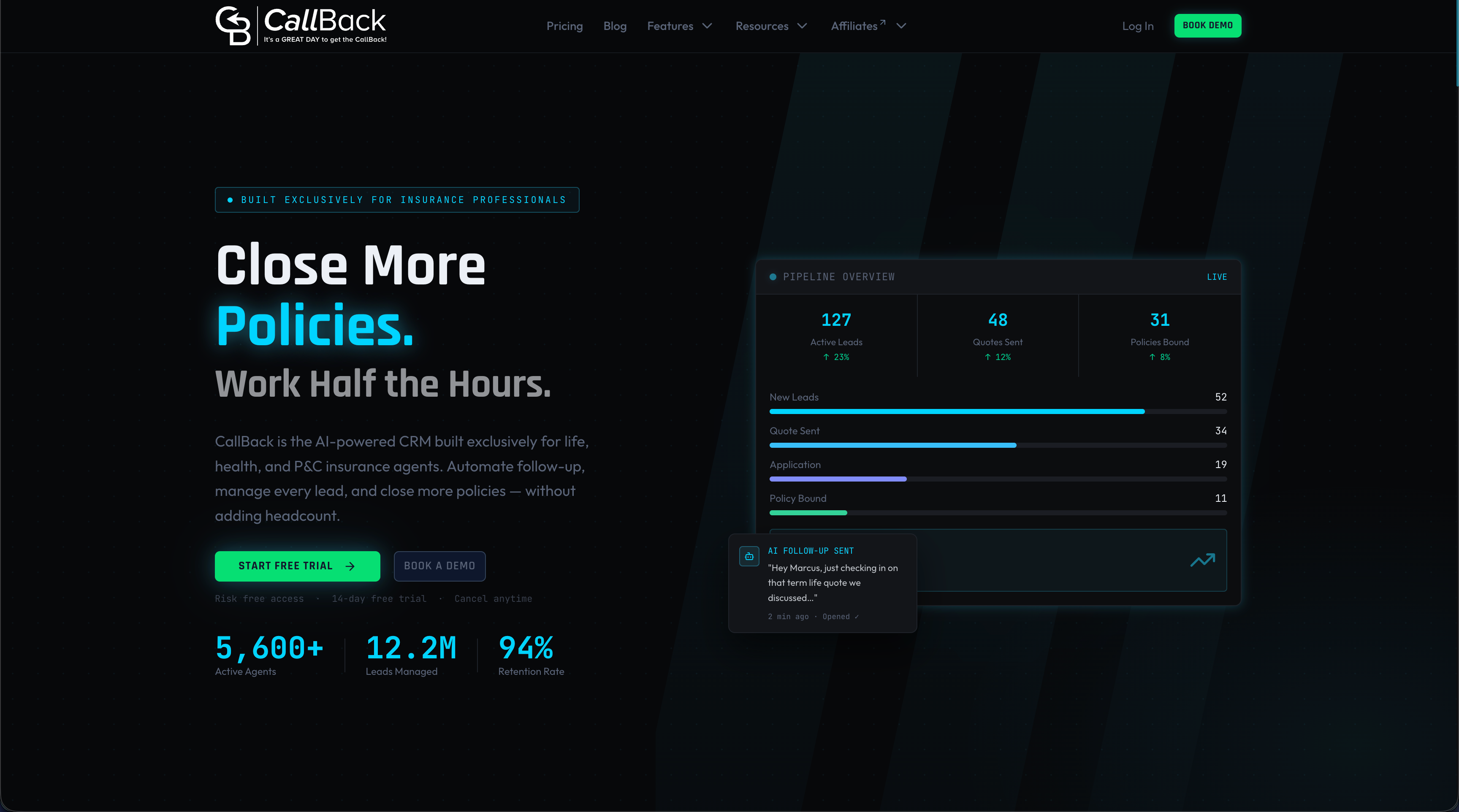
The all-in-one AI features inside CallBack CRM include CRM management, behavioral trigger automation, and real-time reporting so you can close the measurement loop described in the personalization stack. The platform’s email marketing automation tools support lifecycle-triggered sequences with full consent tracking built in. And the task automation tools let agents focus on high-value conversations rather than manual follow-up. If you’re serious about modern outreach, CallBack CRM gives you the governed, scalable foundation to make it work.
Frequently asked questions
How does AI improve lead conversion rates for insurance agents?
AI enables timely, hyper-personalized outreach tied to real policy events, and agencies using AI-driven renewal follow-up and nurture sequences have seen close rates improve from 22% to 34% in documented case studies.
What compliance risks exist with AI-driven personalization in insurance?
The main risks are data quality gaps, untracked consent, and inconsistent customer profiles. Personalization failures are primarily driven by governance and consent tracking issues rather than the AI’s language output, making human oversight essential.
Are outbound personalized campaigns less effective than inbound leads?
Yes, significantly. Cold outbound insurance leads typically convert at 2% to 5%, while high-intent inbound leads close at 25% to 30%, which is why personalization must be paired with precise targeting and fast follow-up to be cost-effective.
What’s the most impactful way to start with personalized outreach using AI?
Start with lifecycle triggers like renewals or risk exposure changes using permissioned, current data. AI-driven scoped personalization turns these events into agent-driven touches that are easy to measure and refine before scaling.