

TL;DR:
- A well-organized reputation management workflow is essential for insurance agents to build trust, respond promptly, and recover from negative feedback effectively. Proper preparation includes auditing online presence, setting up monitoring tools, and implementing AI systems to streamline review generation and responses. Regular tracking of KPIs, centralization of reviews, and strategic handling of issues help maintain a strong reputation and prevent costly crises.
Your agency’s online reputation is either working for you or against you every single day. A disorganized reputation management workflow means missed reviews, unanswered complaints, and trust that erodes quietly until a prospective client picks a competitor instead. Reputation management is a continuous cycle of building, maintaining, and recovering before issues arise. For insurance agents, where trust is literally the product, that cycle cannot be ad hoc. This guide walks you through each phase of a practical, AI-powered workflow designed to help you build authority, respond fast, and protect what you’ve worked to earn.
Table of Contents
- Preparing your insurance agency for reputation management workflow
- Building your reputation with timely review generation and positive engagement
- Maintaining reputation by efficient monitoring and rapid response workflows
- Recovering reputation through strategic response and process improvement
- Measuring and verifying the effectiveness of your reputation management workflow
- The overlooked truths about reputation workflows for insurance agents
- Leverage CallBack CRM to streamline your reputation management workflow
- Frequently asked questions
Key Takeaways
| Point | Details |
|---|---|
| Reputation is cyclical | Effective reputation management involves building, maintaining, and recovering over time, not one-time fixes. |
| Timely responses matter | Responding to reviews within 24–72 hours helps prevent issues from escalating and builds client trust. |
| Centralize feedback | Consolidating reviews and mentions into unified smart queues avoids missed responses and SLA breaches. |
| Leverage AI wisely | AI speeds up routine replies but sensitive feedback needs human review to protect your brand and ensure compliance. |
| Measure broadly | Track multiple KPIs including sentiment and response rates, not just star ratings, for a full picture of reputation health. |
Preparing your insurance agency for reputation management workflow
A solid reputation management workflow does not start with responding to reviews. It starts weeks before that, with an honest assessment of where you currently stand online.
Audit your digital footprint first, including all your reviews, social mentions, and any news or forum coverage. This creates your baseline. Without it, you have no way to measure progress or identify which platforms are most active for your audience. Think of it as your reputation assessment workflow: you cannot fix what you cannot see.
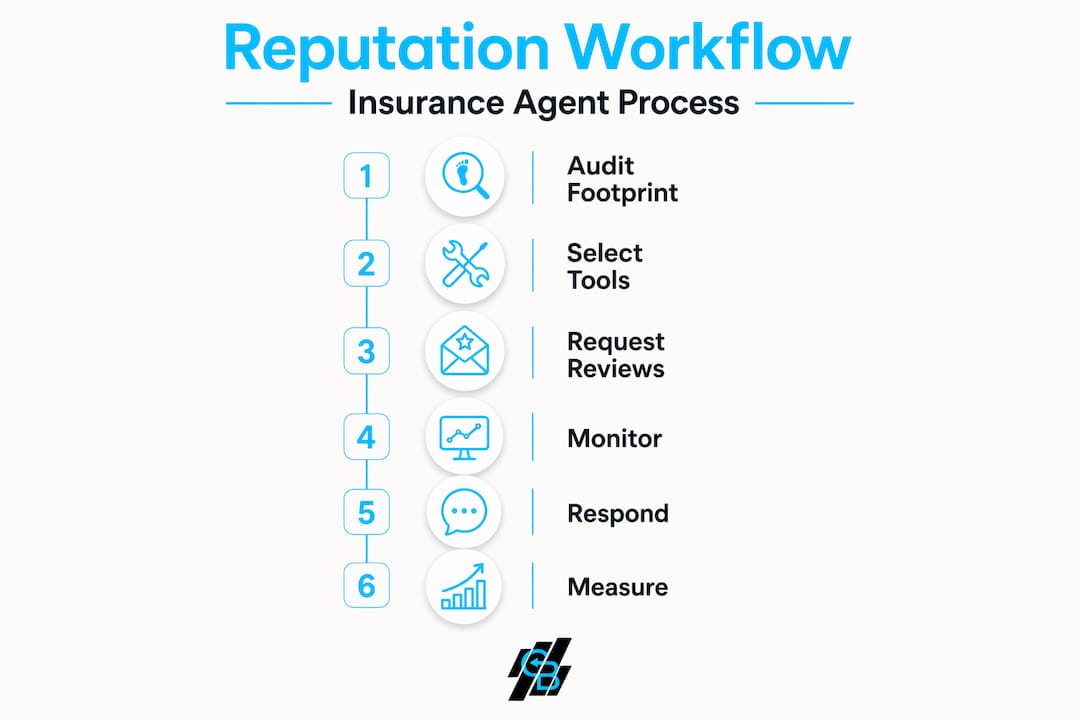
Once you know your current state, set up real-time monitoring alerts for your agency name, individual agent names, and any product or carrier brands closely tied to your business. Missing an early mention is how small complaints grow into loud problems.
What to include in your agency’s preparation checklist:
- Audit all Google, Yelp, Facebook, and insurance-specific directory listings for existing reviews
- Set up Google Alerts and a social listening tool for brand and agent name mentions
- Unify your review and social data into a single dashboard rather than checking platforms individually
- Assign clear ownership: who monitors, who responds, who escalates
- Write a brief crisis-response playbook before you need one, not during a fire
You will also want to evaluate your AI marketing tools for agents at this stage, since the right platform eliminates the manual tab-switching that causes mentions to fall through the cracks.
Reputation management monitoring tools: what to look for
| Feature | Why it matters for agents |
|---|---|
| Unified inbox for all platforms | Eliminates missed reviews across Google, Yelp, Facebook |
| Real-time mention alerts | Catches early complaints before they gain traction |
| Role-based access controls | Keeps response ownership clear across your team |
| Templated escalation paths | Speeds handling of sensitive or legal-risk reviews |
| Reporting and trend dashboards | Connects reputation data to business outcomes |
Pro Tip: Review reputation management basics before assigning roles. Many agencies hand monitoring to a junior admin who lacks the authority to escalate. That gap alone kills response SLAs.
Building your reputation with timely review generation and positive engagement
With the right preparation in place, the next step is actively building your reputation through strategic client review generation.
Most insurance agents wait for clients to leave reviews voluntarily. That approach produces an inconsistent trickle of feedback, often skewed toward unhappy clients who are self-motivated. The better approach is to build review generation directly into your client journey at moments when satisfaction is highest.
Ask for reviews immediately after client milestones like policy setup or claim resolution, with automated follow-ups at 6 and 12 months. Those are the moments when clients feel genuine relief or appreciation, making them far more likely to say something positive.
How to run a milestone-based review generation workflow:
- Map your client journey milestones. Policy binding, first premium payment, claim filed, claim resolved, annual review completed. Each is a moment of peak client engagement.
- Trigger automated review requests immediately after each milestone. Waiting even 48 hours drops response rates significantly.
- Personalize the message using AI. Reference the specific policy type or claim situation rather than sending a generic “please leave a review” email.
- Send a follow-up at 6 months. Many clients who intended to review but forgot will respond positively to a polite reminder.
- Send a second follow-up at 12 months. This doubles as a relationship touchpoint before the annual renewal conversation.
- Track review volume and velocity weekly. Are you getting more reviews this month than last? Which milestones are generating the most responses?
The AI-powered customer engagement process behind personalized outreach matters more than most agents realize. A message that mentions “your recent homeowners claim” converts at a much higher rate than a generic template, because it signals that the agency actually pays attention.
Pro Tip: Do not ask for a “positive” review. Ask for an “honest” one. Clients are more likely to leave feedback when they feel trusted rather than coached, and platforms like Google penalize obvious review solicitation language.

Maintaining reputation by efficient monitoring and rapid response workflows
Once you’ve established a base of positive reviews, it’s critical to maintain your reputation through responsive, well-organized monitoring and reply workflows.
This is where most agencies actually break down. Reviews come in across five or six platforms. One team member checks Google. Another occasionally logs into Facebook. Nobody owns Yelp or Trustpilot. The result is a fragmented reputation monitoring process with silent gaps that clients and prospects notice.
The fix is centralization. Pull every review, mention, and piece of inbound feedback into a single smart queue, then classify it by urgency and type before anyone starts drafting a reply. Here is a reputation management playbook for agencies worth reviewing for practical triage frameworks.
How to structure your smart-queue triage system:
- Tier 1 (respond within 2 hours): Negative reviews mentioning specific agents, policy errors, or claim disputes
- Tier 2 (respond within 24 hours): Neutral feedback or questions about coverage needing clarification
- Tier 3 (respond within 72 hours): Positive reviews that deserve acknowledgment and relationship reinforcement
- Escalation flag: Any review containing legal language, regulatory complaints, or media mentions goes to a senior agent or compliance officer immediately
Respond to reviews within 24 to 72 hours to prevent escalation and show genuine care. That window is not arbitrary. Reviews left unanswered for longer than three days often generate follow-up complaints and lower trust signals in local search rankings.
AI can draft Tier 2 and Tier 3 responses rapidly. Human reviewers should handle anything in Tier 1. That split keeps your AI in insurance marketing both fast and safe, reducing the risk of a poorly worded auto-reply making a complaint worse.
AI vs. human response comparison
| Response type | Best for | Risk level | Average turnaround |
|---|---|---|---|
| AI-drafted only | Positive, routine acknowledgments | Low | Under 5 minutes |
| Human-drafted only | Legal or compliance-adjacent complaints | High | 4 to 8 hours |
| AI draft with human approval | Most negative reviews and disputes | Medium | 30 to 90 minutes |
Also factor in Google’s moderation process. Replies do not go live the moment you submit them. Build verification steps into your insurance sales automation workflows to confirm that replies actually published, not just that they were submitted.
Pro Tip: Assign one person per week to manually verify that the previous week’s responses are visible on each platform. Google occasionally rejects replies without notification, leaving what looks like an unanswered complaint to anyone reading your profile.
Recovering reputation through strategic response and process improvement
Inevitably, some issues will arise; let’s explore how to recover your reputation effectively by addressing problems head-on and learning from feedback.
A single bad review is not a crisis. A pattern of similar complaints with no visible response? That is a crisis. Effective recovery starts with acknowledging the issue fast, then addressing the root cause internally so the same complaint does not appear again next quarter.
“Turn negative feedback into opportunities by responding quickly and transparently, correcting misinformation, and improving underlying processes.”
Here is a practical recovery sequence for negative reviews:
- Acknowledge within 2 hours. Even a brief “Thank you for bringing this to our attention, we’re reviewing your situation and will follow up directly” stops the public spiral.
- Move the conversation offline. Include a direct contact email or phone number in your public reply. This shows other readers you take complaints seriously and protects sensitive client details.
- Apply an AI plus human review gate. AI drafts the empathetic initial response; a senior agent or compliance reviewer approves tone before it posts.
- Log the complaint in your monthly themes report. If three clients mention slow claims processing in one month, that is a workflow problem, not three random bad days.
- Close the loop internally. Share complaint themes with operations or carrier contacts to address what is actually frustrating clients.
- Update your crisis playbook. After each significant incident, add what worked and what did not to your reputation management documentation.
This approach turns a reactive problem into a systematic improvement process. The agents who benefit most treat every complaint cluster as a product quality report.
Measuring and verifying the effectiveness of your reputation management workflow
After recovering from issues, measurement and verification help confirm your workflow’s success and identify areas to refine.
Tracking only your star rating is like tracking only your blood pressure and ignoring everything else. Key reputation KPIs include response time, response rate, review volume, average rating, and sentiment trends across platforms. Each metric tells a different part of the story.
Core metrics every agent should track monthly:
- Review volume: Total new reviews received across all platforms
- Response rate: Percentage of reviews that received a reply
- Average response time: Time from review posted to reply submitted
- Average star rating: Tracked over time, not just point-in-time
- Sentiment trend: Are positive mentions increasing relative to negative ones?
- Review velocity: Rate at which new reviews are arriving, a sudden spike can signal either a campaign working or a crisis brewing
Workflow approach comparison
| Workflow type | Response speed | Compliance risk | Best for |
|---|---|---|---|
| AI only | Fastest | Higher | High-volume routine reviews |
| Human only | Slowest | Lowest | Legal or dispute-heavy replies |
| AI plus human hybrid | Balanced | Low to medium | Most insurance agency scenarios |
Visit your reputation management KPIs dashboard regularly to track these numbers inside a single view rather than manually aggregating data from multiple platforms.
Do not assume a submitted reply went live. Google moderates responses before publishing, and that process can take anywhere from minutes to weeks. Build a verification step into your weekly workflow to confirm visibility.
Pro Tip: Present a quarterly reputation report to your agency leadership. Showing how response rates and review volume correlate with new client inquiries makes a compelling case for investing more in your online reputation strategy rather than cutting it.
The overlooked truths about reputation workflows for insurance agents
Having explored measurement, here is what most insurance agents do not realize about mastering reputation workflows.
The most common failure mode is not being rude in a reply or getting a bad review. It is queue fragmentation across multiple review sources, which causes missed SLA windows and requires data normalization into single schemas for scalable workflows. Put simply: agencies using five separate logins to manage reputation are already losing. The mental overhead alone means things slip.
Here is the second truth most articles skip. Treating AI-generated replies as instantly live creates silence gaps. Agents who set up auto-posting without accounting for Google’s moderation cycle end up with reviews that appear unanswered to the public for days while the reply sits in a pending queue they never check.
The third insight is a risk management angle most brokers miss entirely. Separating your workflow for positive routine responses from your workflow for complaints is not just about efficiency. It is about brand risk and legal exposure. A casual AI-drafted acknowledgment of a billing dispute can inadvertently admit liability if it is not routed through a human approval gate. The AI marketing tools boosting leads that work best for insurance agents are the ones with built-in human-in-the-loop approval steps, precisely because this industry carries real regulatory stakes.
Finally, the agents who invest early in automated plus human hybrid workflows almost never face the expensive reactive recoveries that their competitors do. Crisis reputation management costs far more in time, money, and lost prospects than a well-maintained proactive workflow. That is not a theory. It is what separates the agencies with 4.8-star profiles from the ones scrambling to explain a 3.2 every time a prospect searches their name.
Leverage CallBack CRM to streamline your reputation management workflow
You now understand the full workflow. The question is whether you are going to run it manually across a dozen platforms or let a purpose-built system handle the heavy lifting for you.
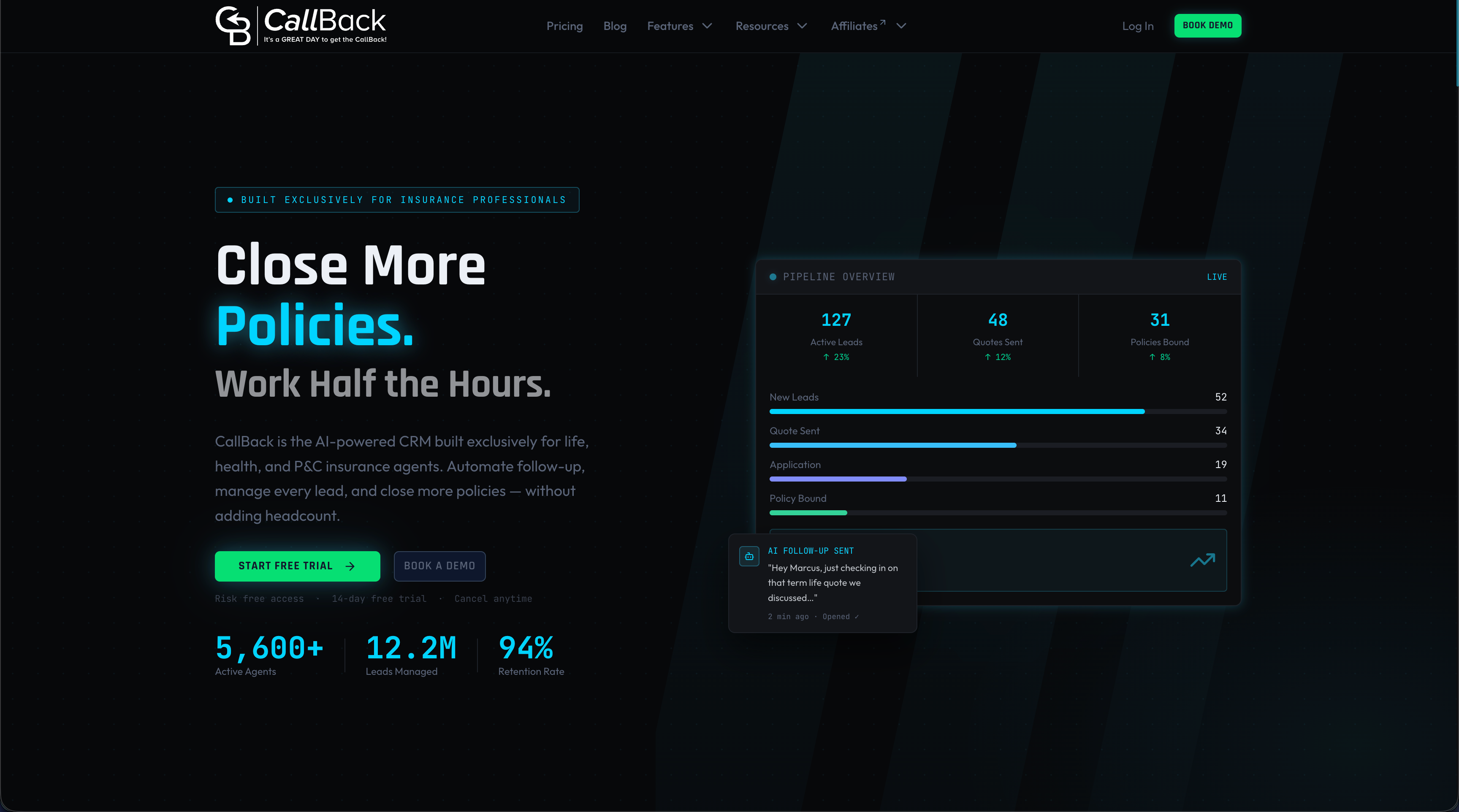
CallBack CRM’s reputation management feature automates review requests triggered by client milestones, centralizes incoming reviews and mentions into one actionable inbox, and provides AI-assisted draft responses with human approval gates before anything posts publicly. You get detailed KPI dashboards and monthly reports built in, so leadership visibility is no longer a separate project. The platform also connects your reputation workflow directly to your SMS marketing and website and funnel builder so that satisfied clients convert into referrals, not just star ratings. For insurance agents ready to stop managing reputation reactively, CallBack CRM is where that shift starts.
Frequently asked questions
What are the three phases of a reputation management workflow?
The workflow consists of building your reputation proactively, maintaining it through consistent monitoring and timely responses, and recovering as a continuous cycle by addressing negative feedback swiftly.
How quickly should insurance agents respond to online reviews?
Agents should respond within 24 to 72 hours to prevent issues from escalating and to demonstrate attentiveness to prospective clients reading those reviews.
Why do Google review replies sometimes not appear immediately?
Google moderates business replies before publishing, which can take anywhere from minutes to 30 days, meaning replies may sit in pending or rejected states without notifying you.
How can AI improve reputation management workflows for insurance agents?
AI helps draft responses rapidly and route sensitive cases to human reviewers, while also analyzing feedback trends to drive process improvements and stronger client satisfaction over time.
What key metrics should agents track to measure reputation management success?
Agents should monitor response time, volume, rating, and sentiment trends across platforms rather than focusing on star ratings alone, which only capture part of the picture.