

TL;DR:
- Effective lead prioritization relies on a structured scoring workflow tailored specifically for insurance professionals. Building and regularly recalibrating a simple, transparent model based on a well-defined ideal customer profile can significantly improve conversion rates and pipeline quality.
If you are in insurance sales or marketing and spending hours chasing leads that never convert, the problem usually is not your product or your pitch. It is your lead prioritization. Without a structured lead scoring workflow guide to follow, your team treats a casual website visitor the same as someone who downloaded your term life comparison tool and requested a callback. That gap costs you real revenue. This article walks you through everything you need to build, implement, and continuously improve a lead scoring workflow built specifically for insurance professionals.
Table of Contents
- Key takeaways
- Your lead scoring workflow guide starts here
- Building your lead scoring model step by step
- Common challenges when running your workflow
- Measuring and optimizing your workflow over time
- My honest take on why most scoring projects stall
- Put your lead scoring on autopilot with Callbackcrm
- FAQ
Key takeaways
| Point | Details |
|---|---|
| Define your ICP first | Build your scoring model on a clear Ideal Customer Profile before assigning any point values. |
| Combine fit and behavior | Score leads on both demographic fit and engagement activity for the most accurate qualification. |
| Use negative scoring and decay | Remove points for inactivity to keep your pipeline current and prevent wasted sales effort. |
| Keep scoring models simple | Three-tier systems outperform complex 100-point scales because sales reps actually trust and use them. |
| Review and recalibrate regularly | Monthly scoring reviews tied to conversion data are what separate high-performing teams from the rest. |
Your lead scoring workflow guide starts here
Before you build anything, you need to answer one honest question: do you actually know what your best insurance customers look like on paper before they buy? Most teams think they do, but their CRM data tells a different story. The foundation of any lead scoring process guide is a well-defined Ideal Customer Profile.
For insurance, your ICP should cover the specific product line. A small business owner shopping for commercial general liability looks nothing like a 42-year-old head of household pricing out whole life coverage. Age range, coverage type interest, household income bracket, employer size, and geographic location all belong in your ICP definition. Get granular.
Once your ICP is locked, audit every data source you have access to. That means your CRM, website analytics, email engagement history, call logs, and any third-party data feeds you use for lead enrichment. The quality of your scoring model depends entirely on the quality of the data underneath it.
- CRM records: Check for duplicate contacts, missing fields, and outdated phone numbers or emails
- Behavioral data: Confirm your tracking captures page visits, content downloads, form completions, and video views
- Firmographic data: For commercial lines, verify company size, industry classification, and revenue range
- Source attribution: Know where every lead came from so you can weight inbound leads correctly
Pro Tip: Run a deduplication pass on your CRM before you start scoring. Poor data governance is the leading cause of lead scoring failure, not the algorithm you choose.
Building your lead scoring model step by step
Now you are ready to construct. This is where your lead scoring strategy takes shape. Follow these steps in order, and do not skip the pilot phase.
-
Define your scoring criteria. Split your criteria into two buckets: fit attributes and engagement behaviors. Fit attributes include things like job title, age band, product interest, and geographic territory. Engagement behaviors include website visits, email opens and clicks, content downloads, form submissions, and demo or callback requests. Each criterion gets a point value.
-
Assign point values. Keep the math simple. A 100-point scale works fine, but only if your thresholds are clearly defined. A reasonable starting structure for insurance leads might look like this:
| Behavior or attribute | Points |
|---|---|
| Requested a quote or callback | +25 |
| Downloaded a product comparison guide | +15 |
| Opened 3+ emails in a campaign | +10 |
| Visited pricing or product pages | +10 |
| Matches ICP age range and territory | +15 |
| Unsubscribed from email | -20 |
| No activity for 30 days | -20% of score |
| No activity for 60 days | -50% of score |
-
Set MQL and SQL thresholds. A Marketing Qualified Lead (MQL) might be anyone scoring 40 to 64. A Sales Qualified Lead (SQL) is anyone scoring 65 or above. These numbers are starting points, not permanent fixtures. You will adjust them after your pilot.
-
Build in negative scoring and score decay. This is where most teams cut corners and regret it later. Score decay best practices call for reducing scores by 20% after 30 days of inactivity and by 50% after 60 days, with a full reset at 90 days. Teams that implement this see 20 to 40% better conversion rates because their pipelines stop filling up with dead weight.
-
Integrate scoring into your CRM and marketing automation platform. Real-time scoring and automated routing are what separate a live workflow from a spreadsheet exercise. When a lead crosses your SQL threshold, your CRM should automatically assign them to a rep, trigger an SMS or email sequence, and log the reason for the handoff.
-
Align your marketing and sales teams with SLAs. Define in writing what happens when a lead hits SQL status. How fast does a rep need to follow up? Companies following up within one hour achieve 53% SQL conversion rates versus just 17% for teams that wait 24 hours. That is not a minor difference. That is a pipeline-defining gap.
-
Run a two-week pilot. Score a segment of your existing leads using your new model. Compare the output against your reps’ gut instincts and against actual closed business from that same group. Then adjust.
Pro Tip: A typical lead scoring implementation takes 8 to 12 weeks from assessment to full scale. Build that timeline into your project plan so your team does not rush the pilot phase.
Common challenges when running your workflow
Even well-designed workflows run into trouble. Knowing where things break down helps you fix them before they cost you pipeline.
Data hygiene slipping over time is the most common issue. Your CRM gets messier every week if no one owns governance. Assign someone specifically to audit data quality monthly. Models trained on stale CRM snapshots create feature bias that penalizes newer leads who simply lack historical data.

Sales rep skepticism derails more lead scoring rollouts than technical failures. Reps who do not understand why a lead scored 72 will ignore the score entirely. Explainability features such as rationale fields that display the top three scoring reasons directly in the CRM record build rep trust fast.
Other common failure points include:
- Threshold drift: Your MQL cutoff was set at 40 six months ago but your business has changed. Review thresholds quarterly.
- Temporal leakage: If your predictive model uses data that was only available after a conversion event, your accuracy numbers look great in testing but fail in production. Only use data available at scoring time when training any predictive component.
- No feedback loop: Sales reps should have a one-click way to flag a lead as incorrectly scored. Without that, your model never improves.
“Regular simple alignment rituals between marketing and sales dramatically increase lead scoring reliability and pipeline velocity.”
Schedule a weekly 20-minute sync between marketing and sales to review lead quality. It sounds small, but it is one of the highest-leverage habits you can build around effective lead management.
Measuring and optimizing your workflow over time
Building the workflow is step one. Keeping it sharp is the real work. Your lead scoring framework should be treated as a living system, not a one-time project.
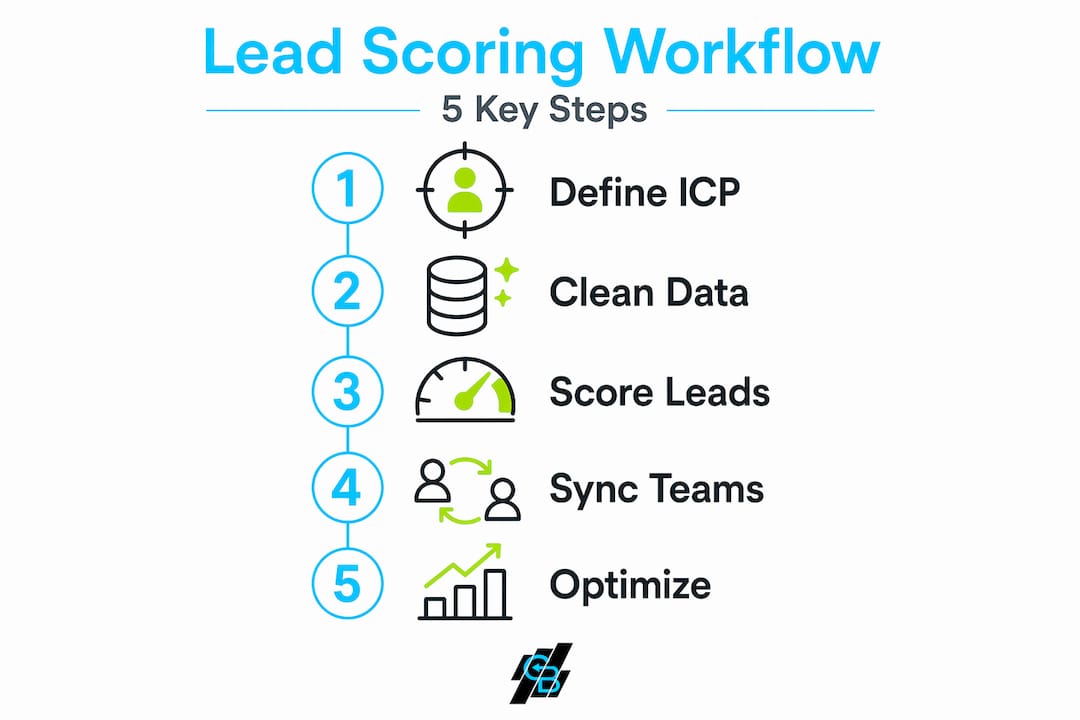
These are the metrics worth tracking on a monthly basis:
| Metric | What it tells you |
|---|---|
| MQL to SQL conversion rate | Whether your MQL threshold is calibrated correctly |
| Sales acceptance rate | Whether reps trust and act on the scores |
| False positive rate | How often high-scoring leads fail to convert |
| Lead velocity | How quickly leads move through the funnel |
| Revenue per SQL | Whether scoring improvements are connecting to actual revenue |
When your sales acceptance rate drops below 70%, that is your signal that something is wrong with the scoring criteria or the threshold. Either the bar is too low or your fit attributes are not aligned with what your reps see in real conversations.
Pro Tip: Hybrid scoring that combines manual rules with predictive AI performs best over time. Start with manual rules to align your teams, then layer AI scoring after 6 to 12 months of clean data collection.
A/B testing is underused in lead scoring optimization. Route a random 20% of your leads to a modified scoring model and compare conversion outcomes against your control group over 60 days. This is the cleanest way to validate whether a scoring change actually improves results or just looks better on paper.
Predictive scoring can deliver 20 to 40% higher conversion rates compared to static models, but only when your underlying data is trustworthy. Automating lead scoring with AI tools accelerates results significantly once that data foundation is solid. The best lead scoring methods at scale combine clean CRM lead scoring data with real behavioral signals, feeding a model that gets smarter with every closed deal. You can explore lead generation workflows built specifically for insurance to see how this comes together in practice.
My honest take on why most scoring projects stall
I have worked with enough insurance sales and marketing teams to tell you the real reason lead scoring initiatives fail. It is almost never the technology. It is trust.
Sales reps who built their careers on intuition and relationship-building do not automatically defer to a score. In my experience, the teams that get the most out of lead scoring spend as much time on internal alignment as they do on model design. The workflow has to be explainable at the rep level. When a producer can look at a lead and understand exactly why it scored 78 and not 45, they use the score. When they cannot, they ignore it.
I have also seen teams overcomplicate their scoring models in an attempt to impress leadership. A 40-variable model trained on three years of noisy CRM data sounds sophisticated. In practice, simple three-tier systems like Hot, Warm, and Cold drive better adoption because they match how reps actually think during a workday.
What I have learned is that the biggest wins come from iteration, not from getting the model perfect before launch. Launch something defensible, measure it rigorously, listen to your reps, and recalibrate every month. That cadence is what high-performing teams treat as a living SLA. The teams that wait for perfect data or perfect model accuracy never ship at all.
Lead scoring is an operational system. Treat it like one, not like a one-time analytics project.
— Kyle
Put your lead scoring on autopilot with Callbackcrm
Callbackcrm was built specifically for insurance agents, agencies, and IMOs that need more than a generic CRM. It brings together AI-powered lead scoring, automated routing, and real-time engagement tools in one platform so your workflow runs without manual intervention.
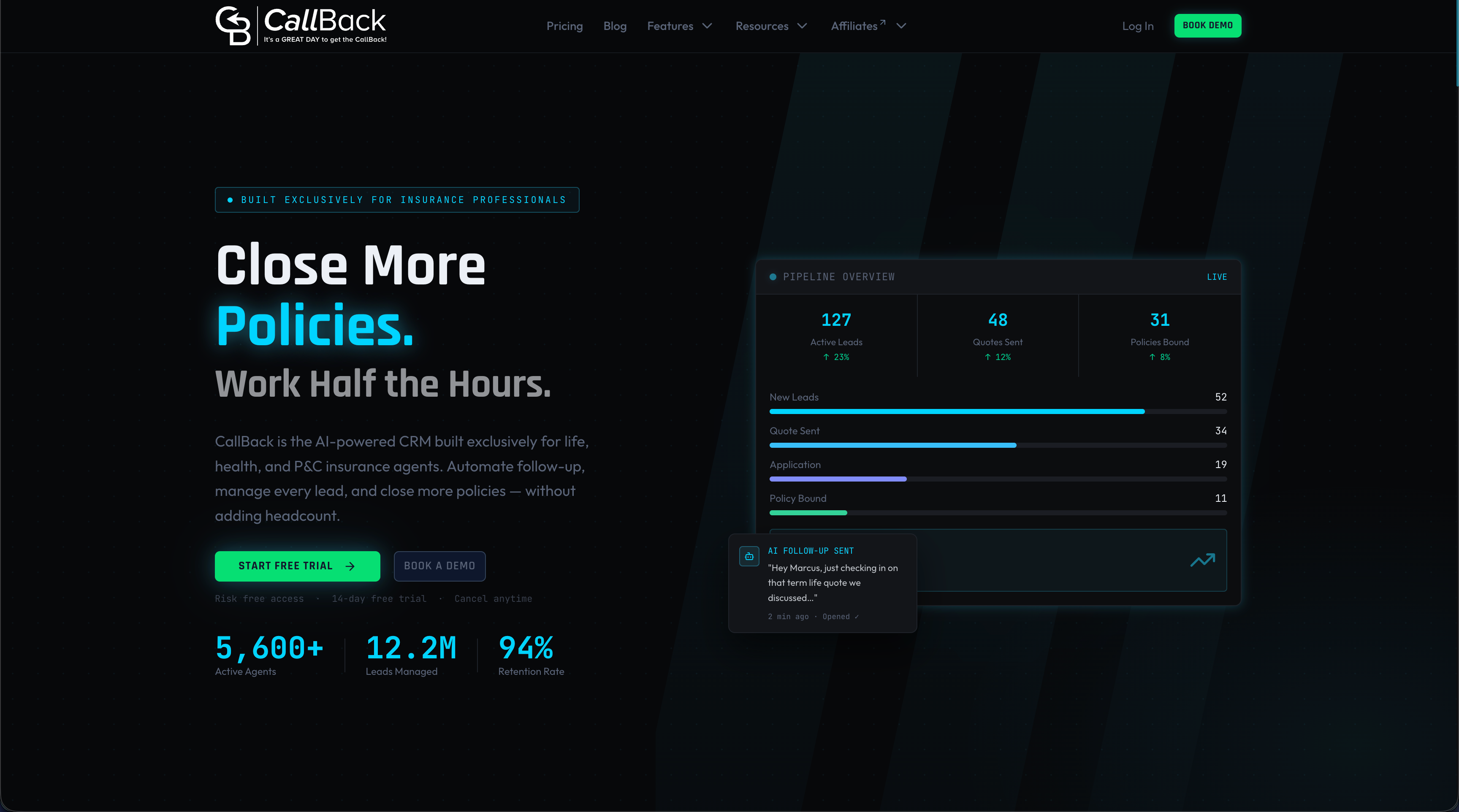
When a lead hits your SQL threshold inside Callbackcrm, the platform can instantly trigger a personalized SMS follow-up, assign the contact to the right producer, and log the scoring rationale directly in the contact record. That kind of speed matters. Explore the full feature set including lead scoring automation, email and SMS marketing, and AI-assisted outreach built for insurance. You can also see how SMS marketing integration connects directly to your scoring thresholds for immediate, high-converting follow-up. If you want to see the insurance-specific lead scoring approach in more detail, that resource is worth your time.
FAQ
What is a lead scoring workflow?
A lead scoring workflow is a system that automatically assigns point values to leads based on their profile attributes and engagement behaviors, then routes them to the right sales action when they cross a defined threshold.
How long does it take to build a lead scoring model?
A full implementation typically takes 8 to 12 weeks, covering data assessment, integration, model training, piloting, and scaling. Teams that prioritize data hygiene reach 80% or better prediction accuracy within 30 days of launch.
What metrics should I track to measure lead scoring success?
Track MQL to SQL conversion rate, sales acceptance rate, false positive rate, lead velocity, and revenue per SQL. These metrics together tell you whether your scoring is accurate and whether your sales team trusts it.
How do I get my sales team to trust lead scores?
Add explainability fields to your CRM that show the top reasons a lead received its score. Feedback mechanisms that allow reps to flag incorrect scores also build trust by showing that their input directly improves the model.
When should I add AI to my lead scoring workflow?
Start with a manual rules-based model to align your marketing and sales teams. After 6 to 12 months of clean data collection, layer in predictive AI scoring. Using manual rules as guardrails while AI handles pattern detection gives you both accuracy and team confidence.