

TL;DR:
- A CRM transforms insurance agencies by automating tasks and centralizing client interactions.
- Proper CRM use can significantly improve sales, retention, and team collaboration.
- Selecting a CRM with AMS integration and growth-focused features boosts long-term performance.
Insurance agencies running on spreadsheets, sticky notes, and disconnected software know the pain well. Leads fall through the cracks, renewal reminders go out late, and agents spend more time hunting for client data than actually talking to clients. The result is a slow, reactive operation that struggles to compete with agencies that have modernized their approach. A well-implemented CRM changes that equation completely, turning fragmented workflows into a coordinated system that supports every stage of the client relationship. Here are the ten most impactful benefits that agencies experience when they make the switch.
Table of Contents
- How CRM transforms insurance agencies
- The top 10 benefits of CRM for agencies
- CRM vs. AMS vs. manual processes: Comparison table
- How to choose the right CRM for your agency
- A smarter agency’s perspective: Growth engine mindset is key
- Unlock these CRM benefits for your agency
- Frequently asked questions
Key Takeaways
| Point | Details |
|---|---|
| CRM boosts agency growth | A CRM powers sales and marketing while AMS covers compliance, driving balanced growth. |
| Automation saves time | Automated CRM workflows cut manual tasks and let agents focus on relationships. |
| Integrated systems win | Syncing your CRM with AMS creates a seamless client experience and operational flow. |
| Analytics drive improvement | CRM dashboards give visibility into client data and sales performance for better decisions. |
How CRM transforms insurance agencies
Before jumping into the list, it helps to understand what a CRM actually does inside an agency, because many teams confuse it with their Agency Management System (AMS). These two tools serve very different purposes and work best together.
Your AMS handles the backend of your business: policy records, carrier compliance, document storage, and regulatory reporting. A CRM, on the other hand, is your sales and marketing engine. It manages prospects, tracks conversations, automates follow-ups, and helps your team move leads through the pipeline with less effort. As industry experts note, CRM complements AMS by serving as the sales and marketing frontend while AMS handles the policy and compliance backend, with both tools integrated via sync for full coverage.
The core advantages a CRM brings to an agency include:
- Client data visibility across every touchpoint and interaction
- Process automation that reduces time spent on low-value manual tasks
- Smarter outreach through segmentation, lead scoring, and AI-powered personalization
- Team alignment through shared pipelines, notes, and task assignments
Poor data quality for CRM tools is one of the most common reasons agencies fail to get ROI from their investment, which is why data hygiene and integration strategy matter from day one.
A great CRM doubles leads and boosts retention when it is set up correctly and supported by strong automation habits. Cutting manual tasks with AI is where the efficiency gains become most visible, especially for agencies scaling their books of business without adding headcount.
“CRM serves as the growth engine for sales and marketing, while AMS serves as the record engine for policy and compliance. Use both together for complete agency coverage.”
Pro Tip: When evaluating CRM vendors, confirm that they offer a native sync or API integration with your existing AMS. Agencies that run both tools in silos lose exactly the visibility they are trying to gain.
With the significance of CRM clear, let’s break down the ten most impactful benefits agencies experience in daily operations.
The top 10 benefits of CRM for agencies
Now that you understand the CRM’s transformative role, here is an in-depth look at each benefit and how it applies to real insurance agency workflows.
-
Automates repetitive sales and onboarding tasks. Agents spend a surprising amount of time on tasks that a CRM can handle automatically: sending welcome emails, scheduling follow-up calls, assigning new leads to the right producer, and triggering renewal sequences. Automation frees your team to focus on conversations that actually require human judgment. Well-designed CRM workflows for insurance eliminate dozens of manual steps that currently eat into productive selling time.
-
Centralizes all client interactions and documents. When a client calls in, your agent should see the full picture in seconds: every email, call log, policy note, and past conversation. A CRM makes that possible by pulling all client interactions into a single timeline view. This eliminates the “let me check with someone else” delays that erode trust and frustrate clients.
-
Improves cross-team collaboration and task handoff. In a multi-producer agency, information often lives in one person’s inbox. A CRM creates a shared workspace where tasks, notes, and pipeline stages are visible to everyone who needs them. When a producer goes on leave or a client is reassigned, the transition happens cleanly without data loss.
-
Personalizes outreach with segmentation and AI. Generic email blasts perform poorly in the insurance market. Clients expect outreach that reflects their actual situation: their product type, life stage, renewal date, and past conversations. CRM segmentation lets you build audience lists based on dozens of criteria, so your messages land at the right time with the right message. The marketing automation benefits for agencies that adopt this approach include measurably higher open rates and response rates.
-
Tracks key metrics automatically for smarter decisions. Manual reporting means someone on your team is building spreadsheets instead of selling. A CRM collects performance data in real time: lead conversion rates, average sales cycle length, campaign ROI, and producer activity. Advanced analytics for agencies reveal which channels, products, and outreach sequences are actually generating revenue, so you can double down on what works.
-
Boosts client satisfaction and retention. The number one reason clients leave an insurance agency is that they feel forgotten. Automated renewal reminders, birthday touches, and periodic check-ins keep your agency visible without requiring manual effort from your producers. Clients who feel consistently cared for renew at higher rates and refer more often.
-
Streamlines compliance and reduces manual errors. While your AMS handles formal policy compliance, a CRM reduces the human error risk in your sales and communication workflows. Automated data capture eliminates transcription mistakes. Documented audit trails show exactly who communicated what and when, which matters in regulated industries.
-
Integrates with other tools for end-to-end coverage. A CRM that plays well with your AMS, email platform, phone system, and quoting tools creates a genuinely connected tech stack. As CRM automation benefits demonstrate, agencies that integrate their tools see compounding efficiency gains because data flows automatically between systems rather than being re-entered manually.
-
Speeds up renewal and upsell cycles. A CRM can flag upcoming renewals 90 days out and trigger a multi-touch sequence automatically: email, SMS, agent task, and a final call reminder. That same logic applies to cross-sell opportunities. When a client’s auto policy renews, the system can prompt a conversation about home or life coverage. Agencies treating CRM as a growth engine alongside their AMS achieve superior revenue visibility compared to those relying on manual processes that limit ROI to the primary conversion only.
-
Enhances agent productivity and morale. Agents who spend less time on administrative busywork and more time on meaningful client conversations report higher job satisfaction and close more business. A CRM gives producers a clear daily task list, removes ambiguity about who owns which lead, and shows them exactly where each deal stands in the pipeline. That clarity reduces stress and improves performance.
Pro Tip: Track your team’s adoption rate closely in the first 90 days. The biggest CRM implementation failures happen not because the software is wrong, but because agents revert to old habits. Short weekly huddles reviewing CRM data help reinforce the new workflow.
CRM vs. AMS vs. manual processes: Comparison table
With the benefits and use cases outlined, this comparison makes it easy to benchmark your current setup against CRM-led strategies.
| Feature area | CRM | AMS | Manual processes |
|---|---|---|---|
| Lead management | Automated pipeline tracking | Not designed for this | Spreadsheets, inconsistent |
| Client communication | Automated, personalized sequences | Basic policy notices | Ad hoc, agent-dependent |
| Renewal tracking | Automated alerts and sequences | Policy record tracking | Calendar reminders, high error rate |
| Compliance documentation | Audit trail for communications | Full policy compliance records | Incomplete, risk-prone |
| Sales analytics | Real-time dashboards and reporting | Financial/policy reporting | Manual spreadsheet builds |
| Team collaboration | Shared pipeline, tasks, and notes | Role-based policy access | Email threads, tribal knowledge |
| Cross-sell and upsell | Triggered by data and life events | Policy listing only | Relies on agent memory |
| Integration capability | Broad: AMS, email, SMS, phone | Carrier and regulatory systems | No integration |
The contrast is striking. Manual processes force your agency to operate reactively, responding to what clients bring to you rather than proactively engaging based on data. A sales automation workflow built inside a CRM shifts that dynamic entirely, turning your team into a proactive growth machine.

It is also worth noting that CRM data quality directly affects the reliability of your analytics and automation. Agencies that invest in clean data governance early get significantly more value from their CRM over time.
According to the integration-first model, CRM complements AMS by handling what the AMS cannot: nurturing prospects, managing multi-channel outreach, and tracking sales performance across the entire book of business.
How to choose the right CRM for your agency
By comparing the options, you can create a practical CRM selection checklist tailored to your agency’s needs.
Agencies that treat CRM as a growth engine alongside their AMS record system consistently outperform agencies still dependent on manual processes for sales and marketing. Choosing the right platform starts with knowing exactly what to look for.
Here is a checklist for evaluating any CRM solution:
- Automation and workflow features: Can you build multi-step sequences for lead nurturing, renewals, and onboarding without needing a developer?
- AMS integration: Does the CRM offer a native or API-based sync with your existing AMS? Disconnected tools defeat the purpose.
- Intuitive dashboards and analytics: Can your producers and managers access real-time pipeline data without a training course?
- Compliance support and data security: Is client data encrypted, access-controlled, and stored on reliable infrastructure such as Google Cloud?
- Scalability and vendor support: Can the platform grow with your agency, and does the vendor offer dedicated support during and after implementation?
- Insurance-specific features: Generic CRMs often lack renewal tracking, certificate of insurance workflows, and insurance-specific reporting. Prioritize platforms built for your vertical.
A step-by-step automation guide can help your team map out exactly which workflows to build first, avoiding the common mistake of trying to automate everything at once and overwhelming your team in the process.
For health and life agencies specifically, boosting leads and sales through CRM adoption has been shown to deliver measurable gains in conversion rates and average premium per client within the first year of implementation.
Pro Tip: Always ask vendors for references from insurance agencies of your size and type. A CRM that works brilliantly for a large commercial lines operation may be overkill or poorly suited for a personal lines agency with five producers. Fit matters as much as features.
A smarter agency’s perspective: Growth engine mindset is key
Here is the uncomfortable truth most CRM conversations skip: the majority of insurance agencies that invest in a CRM never unlock more than 20 percent of its potential. They use it as a glorified address book, logging contacts and maybe tracking a few tasks, then wonder why the ROI feels flat. The problem is not the software. It is the mindset going in.
Most agency principals evaluate a CRM the same way they evaluate a filing cabinet: “Will it hold our stuff safely?” That is the wrong question entirely. The right question is: “Will this platform help us systematically grow revenue, retain clients, and expand our book without proportionally adding headcount?”
When you shift to that mindset, everything changes. You stop asking whether the CRM can store contact records (they all can) and start asking whether it can trigger a personalized three-touch renewal sequence 90 days before expiration, then escalate to a producer task if the client has not responded. That is a growth engine.
The agencies winning right now are the ones treating their CRM and AMS as two halves of a complete operating system. The AMS is the record of what happened. The CRM is the engine driving what happens next. Manual processes, by contrast, limit your ROI to the primary conversion only. You close the initial sale and then hope the client calls you at renewal. That is not a strategy, it is wishful thinking.
Reducing manual workload through AI-assisted automation is not just an efficiency play either. It is a retention play. Agents who are not buried in administrative work build stronger client relationships, which directly reduces lapse rates and increases referrals.
The agencies that will dominate the next decade are not necessarily the largest or the best-capitalized. They are the ones that connect their data, automate their follow-up, and use every client interaction to build a more intelligent and responsive growth system.
Unlock these CRM benefits for your agency
After exploring the practical and strategic CRM advantages, here is how to act on this insight with solutions built specifically for agencies like yours.
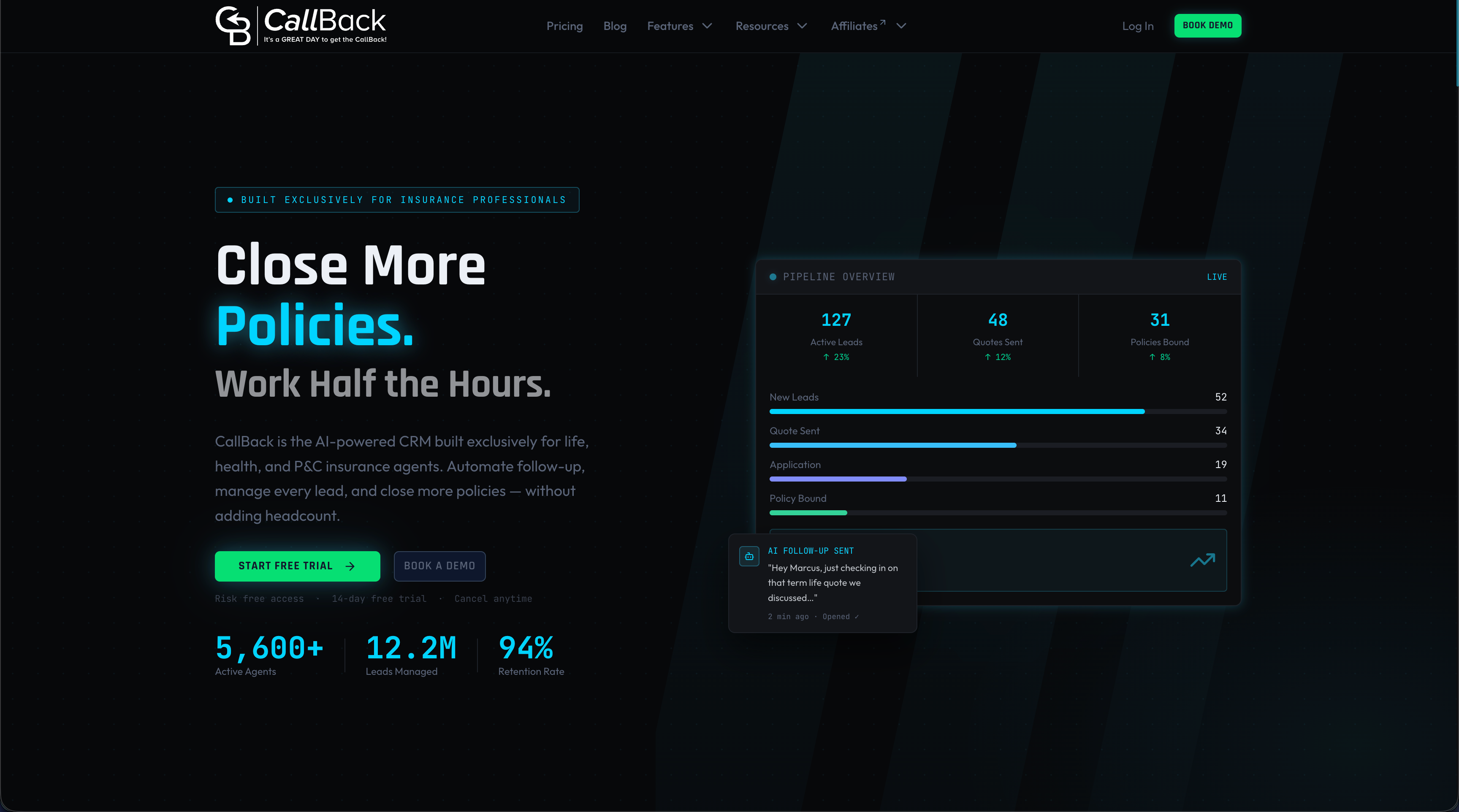
CallBack CRM is built from the ground up for insurance agencies and IMOs that want to replace slow, manual processes with a smart, AI-powered growth platform. From all-in-one CRM features that centralize every client interaction to SMS marketing features that keep your agency top of mind, and CRM task automation that handles the follow-up your team always means to do but never gets around to, CallBack gives your producers the tools to close more business and retain more clients without burning out. If these ten benefits sound like exactly what your agency needs, CallBack CRM is the logical next step.
Frequently asked questions
Is a CRM different from an AMS for insurance agencies?
Yes. CRM handles sales and marketing while AMS focuses on policy records and compliance, and the two tools work best when integrated via a sync or API connection.
Can a CRM really increase sales and retention in an agency?
Agencies using CRM tools consistently report higher sales conversions and improved client retention, driven by personalized outreach sequences and automated renewal engagement that manual processes cannot match at scale.
How does CRM automation reduce manual work?
CRM automation handles repetitive tasks like follow-up emails, renewal reminders, lead assignments, and data entry, freeing agents to focus on client conversations and new business opportunities.
What features should agencies prioritize in a CRM?
Prioritize workflow automation, AMS integration, real-time dashboard analytics, compliance audit trails, insurance-specific renewal tracking, and ease of use for non-technical producers.
Does CRM adoption require replacing our existing AMS?
No. CRM is designed to complement your AMS, not replace it. Integrating both systems gives your agency complete coverage across policy management and sales and marketing operations.