

TL;DR:
- AI marketing enhances personalization, lead response speed, and reduces customer acquisition costs.
- Automating lead qualification and communication increases efficiency and improves close rates.
- Trust is vital; AI should be paired with human oversight to address customer concerns and reduce risks.
Choosing the right marketing technology can feel like navigating a minefield. Insurance agency owners face hundreds of competing platforms, tightening budgets, and customers who expect instant, personalized responses. One wrong move and you’re either overspending on tools that underdeliver or watching tech-savvy competitors steal your prospects. AI marketing cuts through that noise. It gives agencies measurable performance gains, smarter lead handling, and communication that actually resonates with clients. This article breaks down the real advantages of AI-powered marketing for insurance agencies, backed by data and real-world use cases, so you can make a confident, informed decision about modernizing your operations.
Table of Contents
- How AI transforms insurance marketing: The core advantages
- Efficiency and lead conversion: Automating what matters most
- AI-powered content and communication: Personalized engagement at scale
- Trust, acceptance, and risk: Navigating the human side of AI in insurance marketing
- What most agencies miss about AI marketing
- Ready to transform your insurance marketing with AI?
- Frequently asked questions
Key Takeaways
| Point | Details |
|---|---|
| Boost lead conversions | AI marketing quickly increases insurance lead conversion rates while cutting costs. |
| Scalable personal engagement | AI tools enable personalized, empathetic communication with every client at scale. |
| Higher marketing ROI | Insurance agencies experience up to 3.2x ROI and significant time savings using AI. |
| Build trust with transparency | AI works best with clear human oversight and customer transparency policies in place. |
How AI transforms insurance marketing: The core advantages
AI marketing is not a buzzword. It’s a performance shift that shows up in your numbers. When insurance agencies adopt AI-powered platforms, they typically see faster response times, sharper customer segmentation, fewer manual errors, and lower cost per acquisition. Those aren’t promises; they’re outcomes tied to specific capabilities that AI brings to your marketing stack.
Here’s what AI delivers across your core marketing functions:
- Personalized outreach at scale: AI analyzes customer data to tailor messages based on policy type, life stage, and behavior, without a human manually building every segment.
- Faster lead response: Automated triggers fire within seconds of a prospect’s action, beating the typical human response window by hours.
- Reduced acquisition costs: AI-driven personalization improves conversion rates and reduces acquisition costs by deprioritizing low-potential leads before your team wastes time on them.
- Consistent communication quality: AI removes the variability that comes with team size, mood, or workload.
- Lower operational overhead: Automating repetitive tasks like data entry, follow-up emails, and lead tagging frees up hours every week.
The ROI case is strong. Generative AI boosts marketing ROI up to 3.2x and content creation efficiency 4.1x compared to traditional methods. Agencies also report saving up to 12 hours per marketer per week once core workflows are automated. That’s nearly a third of a work week returned to your team.
Pro Tip: Start with AI in your highest-volume communication channel, whether that’s email or SMS, and measure the lift there first. A focused rollout builds confidence and quick wins before you expand across your full funnel.
These benefits don’t exist in isolation. They compound. Better segmentation feeds better personalization. Better personalization improves open rates. Better open rates lead to more boosting insurance lead conversions. The compounding effect is why agencies that adopt AI marketing strategies early tend to widen the gap on slower-moving competitors.
Efficiency and lead conversion: Automating what matters most
Lead management is where most insurance agencies leak revenue. A prospect fills out a form, sits in a queue, and by the time a rep calls, the window has closed. AI fixes that cycle by removing the manual handoffs that cause delays.
Here’s how a typical AI-powered lead workflow operates:
- Lead capture: A prospect submits a quote request or clicks an ad.
- Instant qualification: The AI scores the lead based on data signals like location, coverage type, and intent keywords.
- Automatic routing: High-potential leads go directly to your top closers. Low-potential leads enter a nurture sequence.
- Personalized first touch: An automated, personalized message goes out within seconds, keeping the prospect warm.
- Salesperson closes: Your agent enters the conversation with context already loaded, knowing the lead’s profile and what they’re looking for.
Autonomous AI agents process insurance leads, deprioritize low-potential ones, and enhance conversion rates by ensuring your team only works the leads worth their time. Real-world results back this up. Agencies using AI report up to 36% more efficient underwriting processes and over 30% productivity gains in customer service functions.
“AI-driven marketing lets agents focus on high-potential leads, not tedious admin tasks.”
That shift in focus matters. When your agents stop wading through cold leads and start working qualified ones, close rates climb. The volume of conversations doesn’t change; the quality does.

Pro Tip: Set up AI-triggered re-engagement sequences for abandoned or cold leads. A well-timed, personalized follow-up sent automatically can recover prospects who went quiet weeks ago.
For deeper strategies, explore AI lead generation for insurance workflows and top AI lead generation tips agencies are using right now. If you want foundational approaches, the core lead generation tips still apply and get amplified with AI.
AI-powered content and communication: Personalized engagement at scale
Efficiency gets leads in the door. But what keeps clients engaged and loyal is communication that feels relevant, timely, and human. AI now makes that possible at a scale no human team can match alone.
Generative AI can create personalized email campaigns, policy renewal reminders, claims updates, and cross-sell messages tailored to individual customer profiles. Allstate is a standout example: the company uses AI to handle 50,000 claims emails per day, producing messages with greater empathy and clarity than previous templates, while saving significant staff time.
The performance data supports the investment. AI-generated emails lift open rates by 28% compared to standard campaigns. Here’s how AI and human-written campaigns compare across key metrics:
| Metric | Human-written campaigns | AI-powered campaigns |
|---|---|---|
| Average open rate | 21% | 27-29% |
| Response time | Hours to days | Seconds to minutes |
| Personalization depth | Segment-level | Individual-level |
| Content volume capacity | Limited by headcount | Virtually unlimited |
| Consistency of tone | Variable | Consistent |
The benefits of AI-powered content go beyond speed:
- Consistent brand voice across every touchpoint, regardless of team size.
- Always-on responsiveness so customers get answers at 11pm, not the next business day.
- Easy repurposing across product lines, auto, home, and life, without rebuilding campaigns from scratch.
- Scalable personalization that grows with your book of business, not your headcount.
For agencies ready to operationalize this, the AI email automation guide walks through practical setup steps specific to insurance workflows.
Trust, acceptance, and risk: Navigating the human side of AI in insurance marketing
Personalized engagement wins customers over only when they trust the system delivering it. And trust is where insurance agencies need to tread carefully.
Customer acceptance of AI in insurance is mixed. 62% of customers accept AI for policy support and FAQs, but 61% reject AI for critical decisions like claim approvals or coverage denials. Only 18% have a broadly positive view of AI in insurance overall. That data tells a clear story: customers are fine with AI handling routine tasks, but they want a human in the room when stakes are high.
Top customer concerns to address:
- Transparency: Customers want to know when they’re talking to a bot.
- Human backup: Easy access to a live agent when the situation requires it.
- Data privacy: Clear communication about how their information is used.
- Fairness: Confidence that AI isn’t making biased decisions about their coverage.
Here’s how the three common approaches compare:
| Approach | Pros | Cons | Trust factor |
|---|---|---|---|
| Human-only marketing | High trust, personal touch | Slow, expensive, not scalable | High |
| AI-assisted (human oversight) | Scalable, efficient, personalized | Requires training and governance | High when managed well |
| Fully automated AI | Maximum scale, lowest cost | Risk of errors, bias, E&O exposure | Low without transparency |
Risks include AI hallucinations, data bias, and errors and omissions exposure when human judgment is removed from consequential decisions. Governance isn’t optional here.
“AI works best when paired with human oversight. Transparency builds trust and manages risk.”
Practical governance steps: document every AI-assisted decision, run regular audits for output accuracy, and build explainability into your customer communications. Reviewing customer acceptance of AI strategies can help agencies find the right balance between automation and human touch.
What most agencies miss about AI marketing
Most agency owners assume that adopting AI means buying a platform, flipping a switch, and watching revenue climb. That’s not how it works. The agencies that win with AI aren’t just using better tools. They’re pairing those tools with a culture of oversight, empathy, and honest customer communication.
Over-reliance on automation creates real gaps. When every interaction is scripted by an algorithm, clients feel it. Loyalty comes from moments where someone actually listened, not just responded. AI is a force multiplier, but only when your team knows where to step in and add the human layer that no model can replicate.
Here’s the uncomfortable truth: agencies that use AI purely as a cost-cutting measure tend to underperform those using it to expand what’s humanly possible. The goal isn’t to replace conversations. It’s to have better ones, faster, with more people.
Pro Tip: Set clear internal policies that define exactly where human review is required before a decision or message goes out. That guardrail protects your clients and your E&O coverage.
For agencies ready to go deeper, data-driven marketing with AI offers practical frameworks that balance automation with the human judgment your clients depend on.
Ready to transform your insurance marketing with AI?
The evidence is clear: AI marketing delivers real advantages for insurance agencies, from smarter lead qualification and faster follow-up to personalized communication at scale and stronger campaign ROI. The agencies moving now are setting a pace that will be difficult to match later.
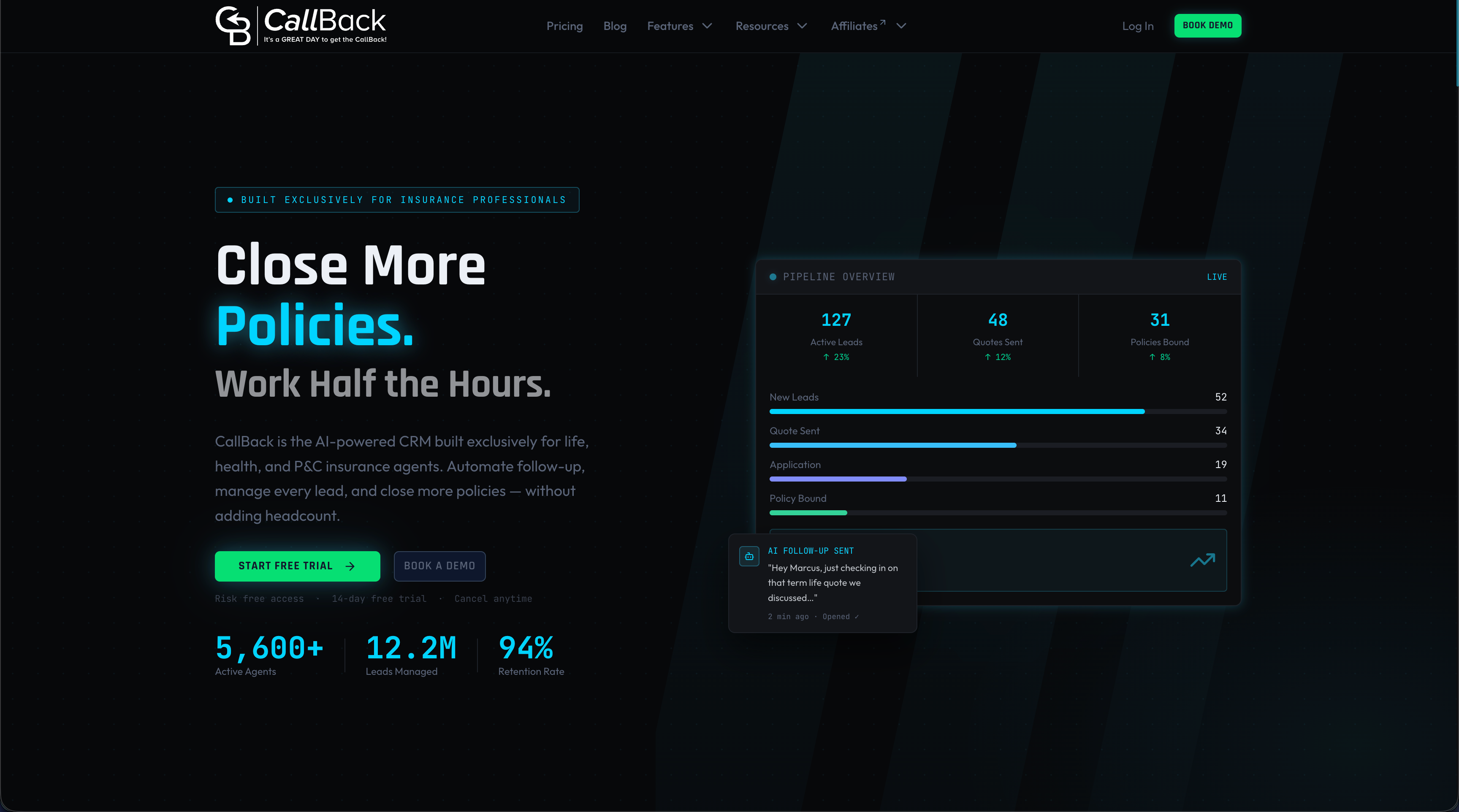
CallBack CRM brings these capabilities into one connected platform built specifically for insurance. From lead automation and SMS marketing for insurance to a full website builder with AI, everything you need is already integrated. Explore the full range of AI marketing features and see how CallBack CRM can help your agency move faster, close more, and keep clients coming back.
Frequently asked questions
What is the biggest advantage of using AI in insurance marketing?
AI-driven personalization enables automated lead management and targeted communication that significantly increases conversion rates while lowering acquisition costs compared to traditional outreach methods.
How much ROI can insurance agencies expect from AI marketing tools?
Agencies report up to 3.2x ROI on overall AI marketing efforts and 4.1x gains in content creation efficiency compared to traditional campaign approaches.
Is AI accepted by insurance customers or does it risk losing trust?
62% of customers accept AI for policy support, but most prefer human involvement for critical decisions, making transparency and easy access to live agents essential.
What are the main risks of relying on AI in insurance marketing?
The primary risks include AI output errors, potential data bias, and E&O exposure when consequential decisions are made without adequate human validation or oversight.
How quickly can an insurance agency see benefits from adopting AI marketing?
Most agencies report noticeable time savings of up to 12 hours per marketer weekly and measurable engagement improvements within the first few weeks of deployment.