

TL;DR:
- AI is transforming insurance by automating claims, underwriting, and fraud detection to improve speed and accuracy. Successful scaling depends on redesigning workflows, implementing human oversight, and focusing on measurable business outcomes. Insurers that adopt comprehensive, process-oriented AI strategies will gain a competitive edge in the evolving industry.
The insurance industry is under more technological pressure than ever before. Professionals and decision-makers who want to stay competitive need to see real, concrete examples of AI in insurance — not theoretical frameworks, but working deployments that deliver measurable results. The challenge is knowing which applications actually move the needle across claims, underwriting, fraud prevention, and customer engagement. This guide cuts through the noise with specific use cases, real carrier examples, and practical guidance on scaling what works.
Table of Contents
- Key takeaways
- 1. Examples of AI in insurance: claims processing
- 2. AI for underwriting and risk assessment
- 3. AI applications in customer engagement and marketing automation
- 4. AI for fraud detection and regulatory compliance
- 5. Scaling AI adoption: challenges and best practices
- My honest take on AI’s role in insurance
- Put AI to work in your insurance business today
- FAQ
Key takeaways
| Point | Details |
|---|---|
| Claims automation delivers speed | AI can automate the majority of claims end-to-end, cutting resolution time dramatically and reducing manual workload. |
| Scaling AI requires workflow redesign | Most insurers fail to scale beyond pilots because they automate old processes instead of rebuilding them. |
| Fraud detection gains are measurable | Pixel-level AI analysis increases fraud detection rates by nearly 30%, protecting loss ratios at scale. |
| Customer engagement is AI’s fastest win | AI-driven chatbots, SMS, and personalized outreach deliver faster ROI than any back-office AI deployment. |
| Human oversight remains non-negotiable | Regulators require explainability in AI decisions, making human-in-the-loop design a compliance requirement, not a preference. |
1. Examples of AI in insurance: claims processing
Claims processing is where AI has made its most dramatic and well-documented impact. The traditional claims cycle involved manual intake, manual routing, adjuster review, and weeks of back-and-forth. AI collapses that timeline significantly.
Lemonade is the most cited proof point in the industry. Its claims bot handles 96% of first notices of loss without any human intervention, and the company automates 55% of claims end-to-end. That is not a pilot. That is production at scale.
Allianz took a different but equally instructive approach with Project Nemo, deploying seven AI agents that work in sequence to process claims. The result was an 80% reduction in claim resolution time while keeping human adjusters in the loop for exception handling.
Key AI capabilities driving claims transformation include:
- Image recognition for damage assessment: Computer vision models analyze photos from claimants and flag severity, estimate repair costs, and route appropriately without an adjuster touching the file.
- Automated FNOL intake: AI-powered chatbots collect structured data at first notice of loss, pre-populating claim records and reducing data entry errors.
- Intelligent claims triage: Agentic AI systems score complexity and route simple claims for straight-through processing while escalating high-risk files to experienced adjusters.
- Fraud flag at intake: Real-time scoring during the claim submission process identifies anomalies before any payment is triggered.
Pro Tip: Do not just automate the intake form. Map the full claims journey first and identify where manual decisions actually add value. AI should own the repetitive steps; your adjusters should own judgment calls.
2. AI for underwriting and risk assessment
Underwriting is the actuarial heart of any insurance operation, and AI is changing both the speed and precision of risk evaluation in ways that legacy models simply cannot match.

Aviva deployed machine learning models that cut medical underwriting review time by 50% and saved £100 million in claims costs. That figure represents a direct improvement in loss ratio, not just operational efficiency.
Zurich went further by integrating AI-powered aerial imagery with document summarization tools. The program processed over 1 million underwriting submissions with 89% user adoption among underwriters, demonstrating that when AI tools are built for how underwriters actually work, adoption follows.
AI applications reshaping underwriting include:
- Predictive risk profiling: Models trained on claims history, third-party data, and behavioral signals generate risk scores that outperform traditional actuarial tables for specific segments.
- Aerial and satellite imagery analysis: AI evaluates roof condition, property surroundings, and vegetation proximity in property underwriting without requiring a physical inspection.
- IoT and telematics integration: Real-time data from connected devices allows dynamic risk detection and proactive mitigation, fundamentally changing how insurers manage exposure.
- Dynamic pricing optimization: AI models continuously refine pricing based on updated risk signals rather than waiting for annual policy renewal cycles.
AI-assisted intake and pre-fill alone can reduce time-to-quote by 30 to 40%, which is a competitive advantage that compounds over time as competitors still relying on manual submissions fall further behind.
3. AI applications in customer engagement and marketing automation
The front end of the insurance sales funnel is where most independent agents and smaller agencies feel the most pain. AI tools for insurance marketing are not just productivity boosters. They change what is possible for a team of any size.
AI chatbots and virtual assistants now handle policy inquiries, coverage explanations, renewal reminders, and cross-sell prompts around the clock, without adding headcount. A prospect who fills out a quote form at 10 PM gets an immediate, personalized response instead of waiting until Monday morning.
Beyond reactive service, AI enables proactive outreach. Platforms like Callbackcrm use AI to identify which leads in your CRM show buying signals, then trigger personalized SMS and email sequences at the right moment. That is a fundamentally different model from batch-and-blast email marketing. For insurance agents looking to dig deeper, this guide on AI-driven customer engagement covers the specifics of how these tools are being applied in 2026.
Key uses of AI in customer engagement for insurance:
- AI-powered lead scoring: Behavioral data from web visits, email opens, and form submissions is scored in real time, so your producers know exactly who to call first.
- Personalized policy recommendations: AI matches prospect profiles to the right products based on life stage, coverage gaps, and purchase history.
- Omnichannel automation: AI coordinates SMS, email, social, and voice outreach so every touchpoint feels intentional rather than generic.
- Retention prediction: Models flag policyholders with high churn probability before renewal, giving agents a window to re-engage proactively.
Pro Tip: AI marketing tools are only as good as the data you feed them. Before deploying any AI-driven engagement, audit your CRM for duplicate records, incomplete contacts, and stale segments. Garbage in, garbage out applies to every AI application.
If you want to see how AI is specifically improving lead flow and conversion in insurance, Callbackcrm’s analysis on AI in lead generation for insurance professionals is worth your time.
4. AI for fraud detection and regulatory compliance
Insurance fraud costs the industry an estimated $308 billion annually in the United States, according to the Coalition Against Insurance Fraud. AI is now the most effective tool available for closing that gap, and the technology has moved well beyond simple rule-based flagging.
The most significant advancement is pixel-level image analysis. AI models can detect metadata inconsistencies, lighting irregularities, and digital manipulation in photos submitted with claims. This single capability delivers a 29% increase in fraud detection rates across carriers that have deployed it.
Allianz’s Project Nemo again serves as a strong reference point. The multi-agent system does not just resolve claims faster. It runs fraud probability scoring at each processing stage, combining structured claim data, claimant history, and external reference databases simultaneously.
Here is a breakdown of AI fraud capabilities versus traditional rule-based systems:
| Capability | Traditional rules | AI-powered detection |
|---|---|---|
| Pattern recognition | Static thresholds | Dynamic, learns from new schemes |
| Image analysis | Manual review | Automated pixel-level analysis |
| Cross-claim correlation | Limited lookups | Network analysis across thousands of claims |
| Real-time scoring | Batch processing | Continuous scoring at intake |
| Regulatory explainability | Easy to document | Requires deliberate model design |
Regulators are paying close attention. The NAIC and state insurance departments increasingly require explainability and fairness in AI underwriting, pricing, and claims decisions. Any AI fraud or compliance tool you deploy needs documented logic, audit trails, and a human review layer for contested decisions. That is not optional. It is the price of using AI in a regulated environment.
5. Scaling AI adoption: challenges and best practices
Here is the uncomfortable reality for most insurance organizations: only 7% of AI initiatives in insurance move beyond the pilot stage. And only 38% of P&C insurers generate value at scale from AI at all.
The reason is almost never the technology itself. The failure point is process. Companies deploy AI on top of broken or outdated workflows and wonder why the ROI does not materialize. BCG research consistently shows that redesigning workflows around AI, rather than bolting AI onto existing processes, can reduce operating costs by 15 to 25%.
Best practices for scaling AI across insurance operations:
- Start with end-to-end process mapping. Identify every step in your target process, every decision point, and every handoff before selecting an AI tool. The tool should fit the redesigned process, not the current one.
- Define your human-in-the-loop policy up front. Leadership must establish where AI has authority to act autonomously and where a human must review, according to EY workforce research on AI governance in insurance.
- Prioritize workforce upskilling. The same EY research found a 22% rise in AI training completion across the industry, but companies leading this effort treat it as a cultural shift, not a one-time training event.
- Measure business outcomes, not AI metrics. Tracking model accuracy is necessary but insufficient. Tie every AI deployment to a business KPI: claims cycle time, loss ratio, customer retention, or cost per acquisition.
- Expand from a single use case before buying a platform. Prove ROI on one specific workflow before committing to enterprise-wide AI infrastructure. The discipline this forces will save you from expensive, underutilized contracts.
Pro Tip: The organizations seeing the best results from AI in insurance are not the ones with the largest AI budgets. They are the ones who redesigned their workflows before they purchased any software. Sequence matters.
My honest take on AI’s role in insurance
I’ve spent years watching insurance organizations chase AI with enormous enthusiasm and middling results. And I have a clear perspective on why.
Most carriers and agencies treat AI as a faster version of what they already do. They automate a form. They add a chatbot to their website. They run a predictive model on their existing data. And they wonder why the transformation never comes. What I’ve seen actually work is when leadership commits to rebuilding a process around AI from the ground up rather than enhancing an existing one.
Agentic AI is becoming the next serious priority across carriers, and I think it will define the competitive gap in the next three years. The insurers who deploy multi-step autonomous systems with clear human oversight policies will process more, price better, and serve customers faster than those still running manual queues.
The workforce concern is real, but I would reframe it. The industry is not losing jobs to AI. It is changing which jobs exist. The agents and adjusters who learn to supervise AI, interpret its outputs, and handle the exceptions it escalates will be more valuable than ever. That is not optimism. That is where the data is pointing.
My advice: pick one high-cost, high-volume process in your operation today. Map it completely. Then ask where AI could own it. That single exercise will tell you more than any vendor demo ever will.
— Kyle
Put AI to work in your insurance business today
If you are an insurance agent, agency owner, or IMO leader who has read this far, you already know the opportunity is real. The next step is having the right tools to act on it.
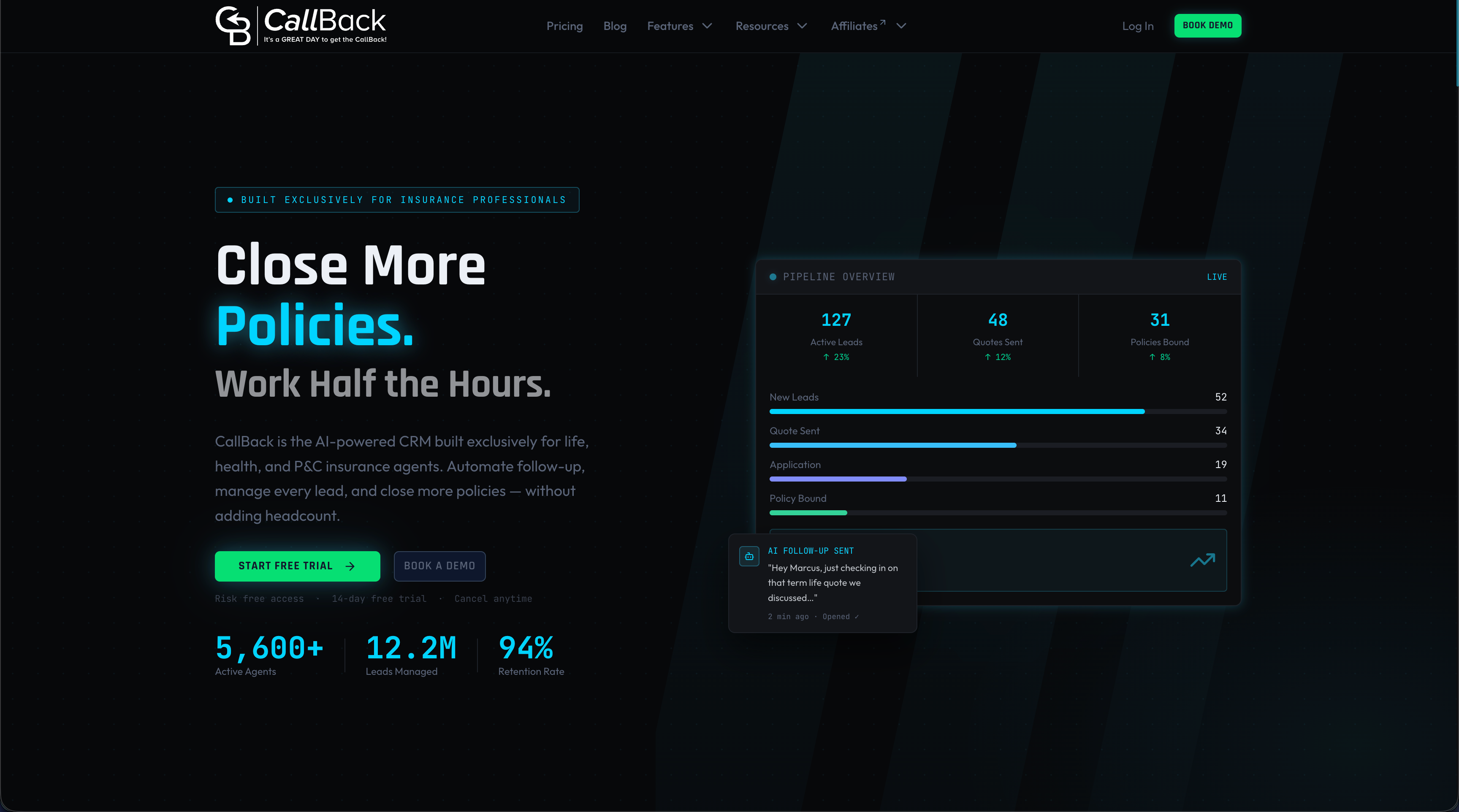
Callbackcrm is built specifically for insurance professionals who want to apply AI without needing an IT department or a six-figure implementation budget. The platform covers AI-driven lead scoring, automated SMS and email outreach, CRM management, funnel building, and much more — all in one place. You can explore the full suite of AI features designed for insurance operations, or take a closer look at the SMS marketing tools built for high-conversion customer engagement. The platform is designed to replace the manual, repetitive work that slows your team down so your producers can focus on closing.
FAQ
What are the best examples of AI in insurance?
The strongest examples include Lemonade’s claims bot handling 96% of first notices autonomously, Zurich’s AI underwriting system processing over one million submissions, and Allianz’s Project Nemo reducing claim resolution time by 80% using seven coordinated AI agents.
How is AI transforming the claims process?
AI automates intake, damage assessment, fraud scoring, and routing to cut resolution time significantly. Companies like Lemonade and Allianz have demonstrated that end-to-end claims automation is achievable without sacrificing accuracy or regulatory compliance.
What are the main benefits of AI in insurance?
The primary benefits include faster claims resolution, more accurate risk pricing, improved fraud detection rates, and personalized customer engagement at scale. BCG research shows workflow redesign powered by AI can cut operating costs by 15 to 25%.
Why do most insurers struggle to scale AI?
Only 7% of insurance AI initiatives move beyond the pilot stage, primarily because companies automate existing broken processes rather than redesigning workflows around AI capabilities. Cultural change and workforce upskilling are as important as the technology itself.
Do regulators allow AI in underwriting and claims decisions?
Yes, but with conditions. The NAIC and state regulators require insurers to maintain explainability and fairness in AI decisions related to underwriting, pricing, and claims. Any deployed model must include documented logic and a human review mechanism for disputed outcomes.