

TL;DR:
- AI assistants in insurance are designed to augment agents’ effectiveness by automating repetitive, data-heavy tasks. Their success depends on proper integration into workflows, regulatory compliance, and clear human oversight to support complex decision-making. Redesigning processes around AI capabilities and leveraging platforms like CallBack CRM enhances productivity, client satisfaction, and practice growth.
The conversation around AI in insurance usually goes one of two ways: either AI is a silver bullet that will automate everything, or it’s a threat that will cut agents out entirely. Both are wrong. AI assistants in insurance are purpose-built to make you more effective, not to work around you. They handle the data-heavy, repetitive parts of your day so you can spend more time on the conversations that actually close business. This article breaks down what AI assistants really do, how to implement them without the common pitfalls, and what AI supports when it comes to human workers in your practice.
Table of Contents
- Understanding AI assistants in insurance workflows
- Regulatory compliance and responsible AI use for insurance agents
- From pilot to scale: redesigning insurance workflows for AI assistants
- Practical AI assistant applications improving insurance sales and service
- Why AI assistants empower insurance agents, not replace them
- Enhance your insurance practice with CallBack CRM’s AI tools
- Frequently asked questions
Understanding AI assistants in insurance workflows
Before you can use AI effectively, you need to know what you’re actually working with. An AI assistant in insurance is not a basic chatbot that reads from a script. It’s a system trained on policy data, guidelines, and customer interaction history that can perform real tasks inside your daily workflow. Think of it less like software you switch to and more like a knowledgeable colleague sitting beside you who never gets tired and never forgets a policy detail.
When you’re understanding AI assistants for the first time, the most useful frame is function, not technology. What can it actually do inside your day? Here’s where AI assistants fit most naturally into an insurance agent’s or broker’s workflow:
- Policy Q&A: Instantly pulling specific coverage details or exclusion language during a client call, without you needing to dig through documentation
- File summarization: Condensing a 40-page claim file or underwriting submission into a structured, readable brief in seconds
- Next-step recommendations: Prompting agents with follow-up actions based on where a client is in the sales or renewal cycle
- Data entry automation: Logging call notes, updating contact records, and tagging leads by coverage interest without manual input
- Escalation routing: Identifying when a customer interaction requires human judgment and flagging it clearly
The key here is integration. AI-powered assistants that operate inside core insurance systems improve underwriting, claims, and customer service in ways that generic tools simply cannot replicate. A standalone chatbot that doesn’t connect to your actual policy data is functionally useless for a licensed agent. The benefits of AI assistants for agents become real only when the assistant has access to the same information you use every day.
Regulatory compliance and responsible AI use for insurance agents
Here’s something many agents overlook when evaluating AI tools: the regulatory layer. As an agent or broker, you are accountable for every recommendation made on your behalf, including those that AI assists with. That accountability doesn’t transfer to the software vendor.
The NAIC (National Association of Insurance Commissioners) has made this explicit. Insurance decisions supported by AI must comply with laws and regulations, requiring governance frameworks and documentation that regulators can examine. In practical terms, that means any AI assistant you deploy needs to leave a paper trail. You need to know what it told a customer, why, and when.
Responsible AI compliance strategies for agents and brokers include several non-negotiable elements:
- Transparency with clients: Customers should know when they are interacting with an AI, not a licensed human agent
- Human-in-the-loop oversight: Every AI recommendation that affects a coverage decision or a claim should be reviewed by a qualified person before it becomes final
- Audit-ready documentation: Decisions, responses, and escalations need to be logged and retrievable
- Ongoing monitoring: AI models can drift or produce errors as your product catalog changes; you need a process to catch that
“Allianz applies responsible AI principles and human-in-the-loop oversight to ensure trust, compliance, and measurable improvements in claim processing times.”
What Allianz does at scale, you can replicate at the agency level. The principle is the same: AI accelerates execution, but a human owns the outcome. Platforms that support responsible AI in engagement build these oversight mechanisms into the product rather than leaving compliance as your problem to solve manually.
Review the NAIC AI regulatory guidelines before deploying any AI tool in your practice. The standards exist to protect your clients and your license.
From pilot to scale: redesigning insurance workflows for AI assistants
Most agents who feel underwhelmed by AI are not using bad tools. They’re using good tools inside bad workflows. Dropping an AI assistant into an existing legacy process, where data is siloed, handoffs are manual, and communication is fragmented, produces modest results at best and frustrating ones at worst.
BCG research makes this concrete: only 38% of P&C insurers generate value at scale from AI because the real gains come from redesigning end-to-end processes, not from adding AI as a layer on top of what already exists. That number should recalibrate your expectations and your implementation strategy.
The BCG “Deploy, Reshape, Reinvent” framework gives agents a practical roadmap:
- Deploy: Start with AI doing discrete tasks inside your current workflow. Automating follow-up emails, transcribing calls, or scoring leads. Quick wins that build confidence.
- Reshape: Redesign specific workflows around AI’s strengths. Restructure your renewal process so the AI handles outreach and data collection while you handle the closing conversation.
- Reinvent: Build new capabilities that were not possible without AI. Proactive risk flagging, predictive renewal scoring, or real-time compliance prompting during live calls.
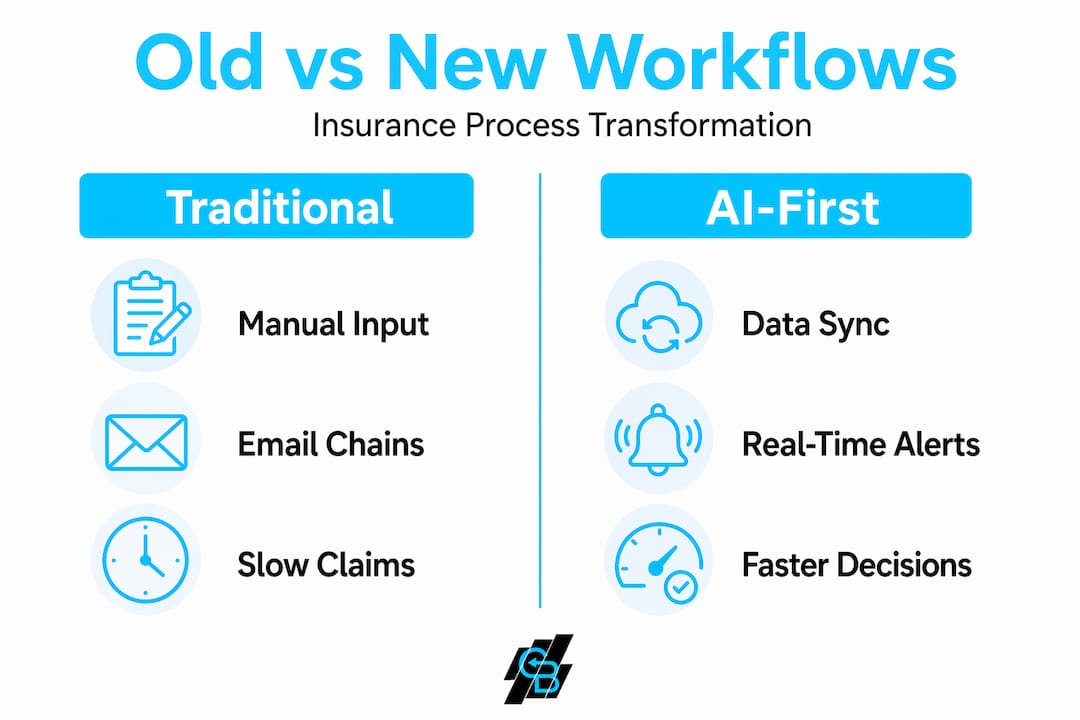
Here’s how the shift looks in practice:
| Workflow area | Traditional approach | AI-first approach |
|---|---|---|
| Underwriting data collection | Agent manually gathers and enters client data | AI assistant collects, validates, and pre-fills submissions |
| Claims first notice of loss | Client calls agent; agent logs details manually | AI handles initial intake, structures data, routes to adjuster |
| Renewal outreach | Agent reviews expiration list and calls down manually | AI flags at-risk renewals, drafts personalized outreach, tracks responses |
| Compliance tracking | Agent relies on memory or manual checklists | AI surfaces required disclosures in real time during the sales call |
The AI workflow redesign benefits go well beyond time savings. When workflows are built around AI from the start, agents handle more clients without making more errors, and clients get faster, more consistent service. Pair that with a focus on leveraging AI for lead generation and you have a practice that grows without requiring proportional headcount growth.
Pro Tip: Before selecting an AI tool, map your three most time-consuming weekly tasks. Choose AI that directly targets at least two of them. Broad platforms that do everything moderately well are less valuable than focused tools that solve your actual bottlenecks.
Practical AI assistant applications improving insurance sales and service
Let’s get specific about where AI assistants create measurable results across different functions in your practice.
There are two models for conversational AI in insurance. The autonomous model handles customer interactions independently, managing straightforward inquiries like billing questions, policy status checks, or basic coverage explanations without agent involvement. The agent-assist model runs alongside you in real time, surfacing relevant policy data, flagging compliance gaps, and suggesting next steps while you lead the conversation.
For most independent agents and brokers, the agent-assist model delivers faster ROI because it augments your existing strengths rather than trying to replace your client-facing role.
Conversational AI in insurance supports a range of high-value tasks, including claims intake, policy servicing, underwriting data collection, and real-time agent assistance, all of which reduce repetition and improve compliance. Here are the applications with the clearest payoff:
- FNOL (First Notice of Loss) intake: AI collects structured claim data from clients immediately, reducing the back-and-forth that delays claim opening
- Renewal outreach: Automated, personalized contact with policyholders approaching expiration dates, including coverage summaries and upgrade prompts
- Real-time compliance prompting: AI surfaces required disclosures during live calls so nothing gets missed
- Lead qualification: Machine learning models score inbound leads by likelihood to convert, so you call the right people first
- Policy servicing Q&A: Clients get instant answers to routine questions at any hour without tying up your time
| Insurance function | AI assistant benefit | Measurable outcome |
|---|---|---|
| Claims processing | Automated FNOL and file summarization | Faster cycle times, fewer handoff errors |
| Underwriting | Pre-filled submissions and risk data collection | Reduced submission errors and faster decisions |
| Sales | Real-time prompts and lead scoring | Higher conversion rates and shorter sales cycles |
| Customer service | 24/7 automated policy Q&A | Lower inbound call volume, higher client satisfaction |
| Renewals | Predictive outreach and at-risk flagging | Improved retention and earlier intervention |
The smart AI tools for agents that move the needle most are the ones connected directly to your CRM and policy data. A CRM built for agents that integrates AI natively removes the friction of switching between systems and makes every client interaction more informed. Pair that with AI marketing enhancements and you create a practice where no qualified lead goes untouched and no renewal falls through the cracks.
Pro Tip: If a vendor cannot clearly explain how their AI assistant accesses and uses your policy data, assume it doesn’t. Ask specifically: “Where does the assistant pull information from when answering a client question?”
Why AI assistants empower insurance agents, not replace them
Here is the uncomfortable truth most AI vendors won’t tell you: the agencies getting the most from AI assistants are not the ones who bought the most sophisticated tools. They’re the ones who thought carefully about where human judgment is irreplaceable and built AI around those boundaries.
Insurance is fundamentally a trust business. A client calling about a denied claim, a family renegotiating coverage after a health change, a small business owner worried about liability exposure after an incident — these conversations require empathy, nuance, and contextual reasoning that AI cannot replicate. What AI does brilliantly is everything that happens around those conversations.

When you deploy AI that supports human judgment, with structured automation and clear escalation pathways, you avoid the “AI loop” problem that frustrates customers. That’s the scenario where a client gets trapped in a cycle of bot responses that never resolve their issue. Customers who hit that wall don’t call back. They switch carriers.
The real role of AI supporting agents is converting unstructured interactions into structured data. Every call, form submission, and chat message contains information that most agencies lose because there’s no system to capture it in usable form. AI changes that. And when assistants operate inside agent workflows with policy and guideline grounding, they reduce errors and eliminate the constant context-switching that drains agents’ attention.
The agents who fail with AI share a common pattern: they buy a standalone chatbot, plug it into their website, and expect results. Without connection to policy data, CRM history, or compliance rules, those bots produce generic responses that frustrate clients and create liability. The agents who succeed treat AI as infrastructure, not a widget. They build it into the foundation of how their practice operates, with clear human oversight at every decision point that matters.
Pro Tip: Prioritize AI assistants that log every decision and response in a way you can retrieve later. That audit trail is not just a regulatory requirement — it’s your protection when a client disputes what they were told.
Enhance your insurance practice with CallBack CRM’s AI tools
You now understand what separates AI assistants that deliver results from those that collect dust. The next step is putting that understanding into practice with tools built specifically for insurance agents and brokers.
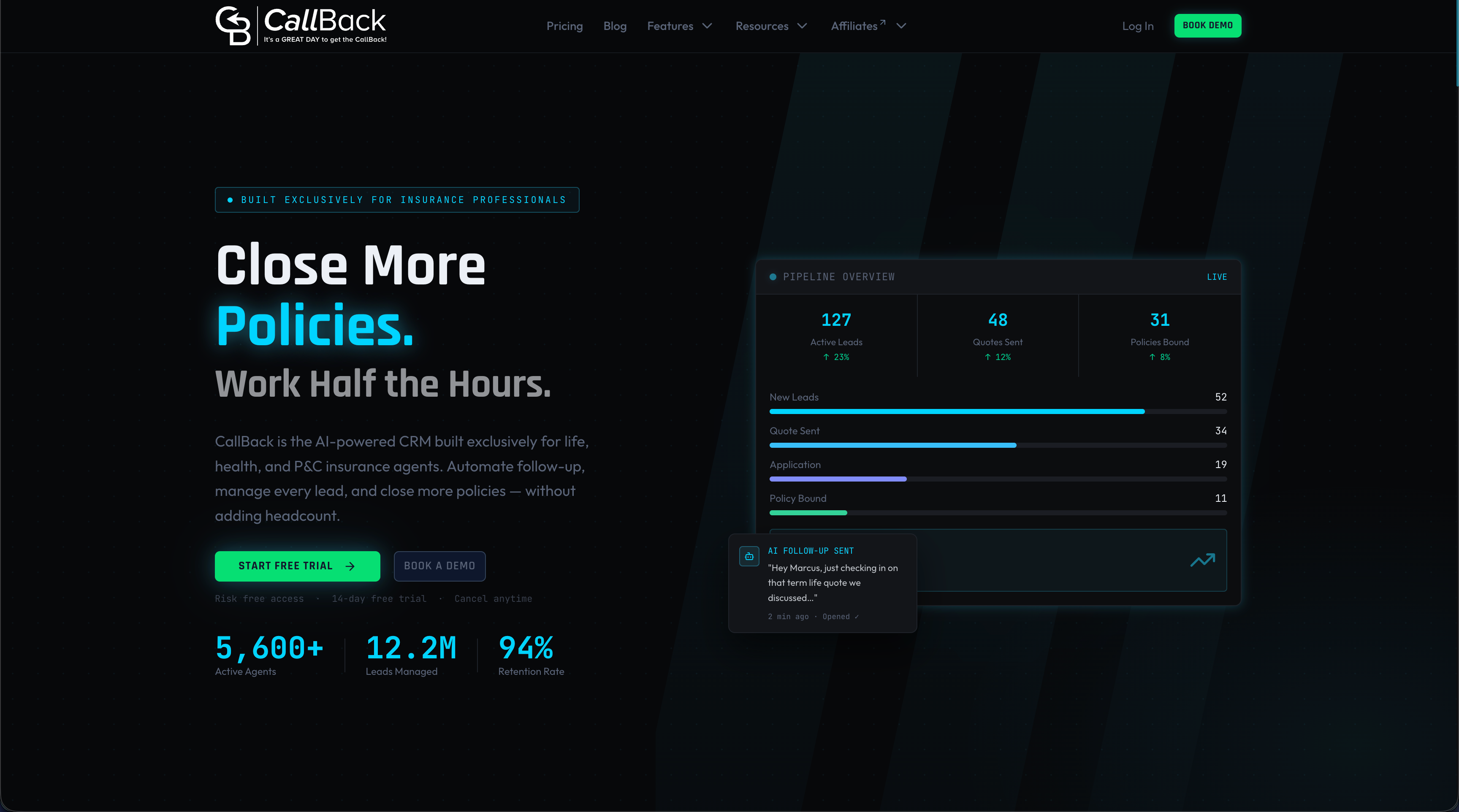
CallBack CRM is an all-in-one platform designed for exactly this: combining AI assistants, CRM management, and automated marketing into a single system that fits how insurance agencies actually operate. You don’t need to stitch together five different tools or manage separate vendors. SMS marketing campaigns launch directly from your contact database, targeting the right clients at the right moment in their policy lifecycle. The website and funnel builder converts inbound traffic into qualified leads that feed directly into your automated follow-up sequences. Every interaction is logged, every lead is scored, and your AI assistant stays grounded in the policy and client data that makes it actually useful. That’s the difference between AI that works and AI that impresses in a demo.
Frequently asked questions
Can AI assistants fully replace insurance agents?
No. AI assistants are designed to handle routine, data-heavy tasks while leaving complex coverage decisions, sensitive client conversations, and judgment calls to licensed agents. The NAIC confirms that AI supports human workers rather than replaces them.
How do AI assistants ensure regulatory compliance in insurance?
They operate within governance frameworks that include transparency disclosures, human oversight at decision points, and logged audit trails. Insurance decisions supported by AI must comply with applicable laws, and human-in-the-loop oversight is central to maintaining both trust and compliance.
What insurance tasks benefit most from AI assistants?
Claims intake, underwriting data collection, policy servicing, renewal outreach, and real-time compliance prompting during sales calls deliver the clearest gains. Conversational AI supports FNOL, claims updates, underwriting support, and real-time agent assistance across these functions.
Why do many insurers struggle to scale AI value?
Because they add AI on top of existing processes instead of redesigning those processes around AI capabilities. Only 38% of P&C insurers generate value at scale, specifically because workflow redesign, not tool adoption, is what unlocks meaningful results.
How can insurance agents start implementing AI assistants effectively?
Begin by mapping your most time-consuming tasks and selecting AI tools embedded within your existing workflow that connect directly to your policy and CRM data. Assistants perform best when they operate inside agent workflows with policy and guideline grounding, reducing errors and allowing for proper human review.