

TL;DR:
- Predictive analytics identifies high-probability prospects using data and modeling, increasing sales efficiency.
- Companies implementing predictive tools report significant gains, including higher conversion rates and better lead quality.
- Agents should combine data-driven prioritization with human judgment for optimal sales outcomes.
Most insurance agents assume the path to higher revenue runs through more leads. Buy a bigger list, run more ads, make more calls. But volume without precision is just expensive noise. Predictive analytics flips this logic entirely, helping you identify which prospects are most likely to buy, when they’re ready, and what they need to hear. This guide walks through what predictive analytics actually means for your agency, where it creates the biggest wins, how to apply it today, and where the technology is heading next.
Table of Contents
- What is predictive analytics in insurance sales?
- Real-world wins: How insurance companies boost sales with predictive analytics
- Core use cases: Where predictive analytics drives value for insurance agents
- How to get started: Integrating predictive analytics into your sales process
- Looking ahead: The future of predictive analytics in insurance sales
- The real key: Why successful agents blend predictive analytics with human touch
- Power your sales process with AI-driven tools
- Frequently asked questions
Key Takeaways
| Point | Details |
|---|---|
| Target high-value leads | Predictive analytics helps you zero in on prospects most likely to convert based on real signals. |
| Boost conversion and revenue | Agencies using predictive data see measurable sales increases, more efficient pipelines, and greater customer retention. |
| Blend data with human touch | The top-performing agents combine analytics with relationship building for sustained sales growth. |
| Adopt practical AI tools | Modern CRMs and sales platforms make it easier for agencies of any size to harness predictive insights in daily routines. |
What is predictive analytics in insurance sales?
Predictive analytics is the practice of using historical data, statistical models, and machine learning to forecast future outcomes. In insurance sales, that means predicting which leads will convert, which policyholders are likely to lapse, and which customers are ripe for a cross-sell before you ever pick up the phone.
This is fundamentally different from how most agents have worked. Traditional sales relies on intuition: experienced reps develop a “feel” for good prospects based on years of pattern recognition. That instinct has real value, but it doesn’t scale. It also can’t process hundreds of signals simultaneously or update itself in real time as new data comes in. Predictive models do exactly that.
The data feeding these models covers a wide range of behaviors and characteristics. According to lead scoring research, the most predictive factors in insurance include renewal timing, lead source, quote requests, content consumption, email engagement depth, and direct contact history. Crucially, the model weighs both fit (demographics, firmographics, coverage type) and intent (behavioral signals like visiting a quote page or opening multiple emails) at roughly 50/50. Neither alone is enough. A perfect-fit prospect who shows no intent is a cold call. A high-intent visitor who doesn’t fit your product is a dead end.
Here’s what that looks like in practice:
- Renewal timing: A commercial client whose policy renews in 60 days scores much higher than one with 11 months remaining.
- Lead source: Inbound referrals and organic search leads consistently outperform purchased lists.
- Quote activity: A prospect who requested three quotes in 90 days is signaling urgency.
- Content consumption: Reading a long-form article on business liability coverage is a stronger signal than clicking a banner ad.
- Email depth: Opening an email and clicking through to a landing page is worth more than a simple open.
This is why predictive lead generation is reshaping how top agencies allocate their time and budget. Instead of treating every lead the same, agents can rank their pipeline by likelihood to close and work from the top down. The result is more productive conversations and fewer wasted hours on prospects who were never going to buy.
The role of the agent shifts too. Rather than being a prospector, you become a closer. The model does the filtering. You bring the relationship.
Real-world wins: How insurance companies boost sales with predictive analytics
The business case for predictive analytics is not theoretical. Across the industry, companies of every size are reporting measurable gains.
| Company | Application | Result |
|---|---|---|
| Aviva | Machine learning for claims and underwriting | Saved £100M in claims, halved review time |
| InsuranceCo | Predictive cross-sell targeting | 25% revenue boost, 10x marketing performance |
| National provider | Quote-to-bind scoring for agents | 2 to 8% conversion lift across 20,000 agents |
| Generali | AI-powered lead identification | 3x increase in qualified leads |
These are not outliers. They represent a pattern playing out across the industry as carriers and agencies invest in smarter targeting.
“Predictive analytics gave our marketing team the ability to focus on the right customers at the right time. The lift in cross-sell revenue wasn’t marginal. It was transformational.” — InsuranceCo marketing leader
What’s especially relevant for independent agents and smaller agencies is the national provider example. A 2 to 8% improvement in quote-to-bind rates sounds modest until you multiply it across thousands of conversations. For an agency writing 200 policies a year, that’s 4 to 16 additional closed deals without adding a single new lead to your pipeline. The math compounds fast.
The Generali result, tripling qualified leads, points to a different benefit: efficiency in lead generation itself. When your model identifies who to target before you spend on outreach, your cost per acquisition drops significantly. You’re not generating more noise. You’re surfacing better signal.

Smaller agencies often worry that these tools are only accessible to carriers with massive IT budgets. That’s no longer true. Modern platforms built for lead generation success bring these capabilities to individual agents and small teams without requiring a data science department. The technology has democratized faster than most agents realize.
Core use cases: Where predictive analytics drives value for insurance agents
Predictive analytics is not a single feature. It touches multiple stages of your sales process, and understanding where it applies helps you prioritize where to start.
Lead prioritization is the most immediate use case. Instead of working your CRM alphabetically or by date added, you work it by score. High-score leads get called first, emailed sooner, and followed up more aggressively. This alone can transform agent productivity.
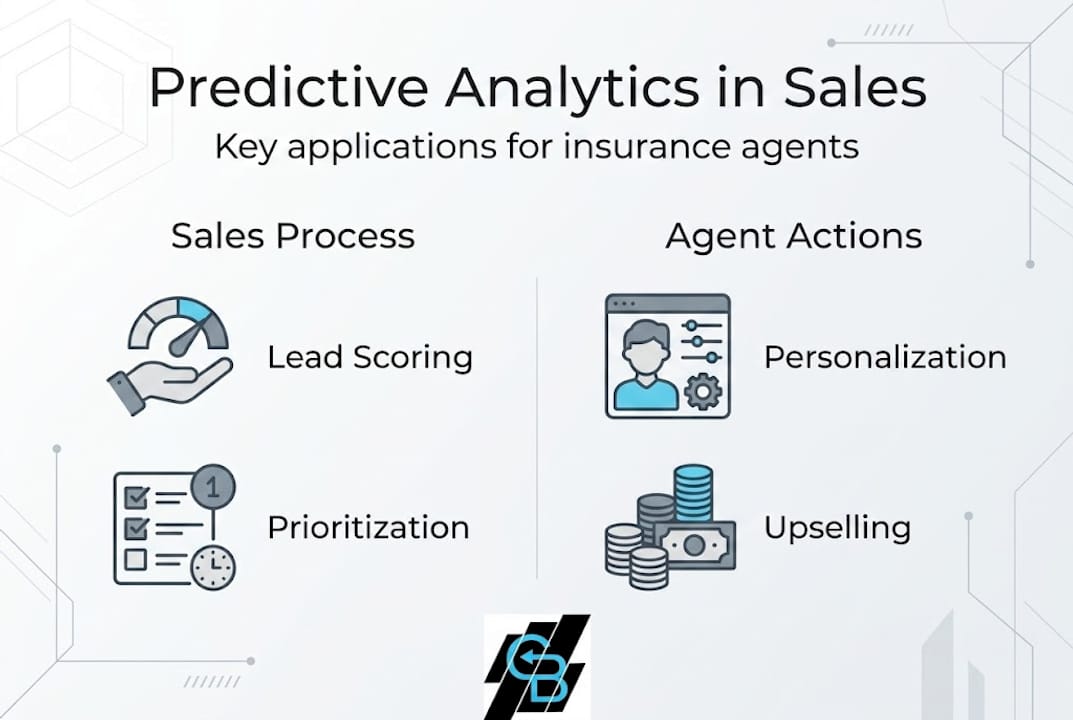
Personalized communication is the next layer. Nationwide uses predictive models to route leads to the right agents and tailor messaging based on customer profiles. Duck Creek applies similar logic for customer loyalty programs and cross-sell campaigns, using behavioral profiles to determine which customers are most likely to respond to specific offers.
Cross-selling and upselling become far more precise. Rather than offering every product to every customer, predictive models identify which policyholders have the highest probability of adding a new line. A homeowner with a teen driver and no umbrella policy is a predictable cross-sell opportunity. The model finds those patterns at scale.
Risk pricing is a more advanced application but increasingly relevant as carriers share data with agency partners. Agents who understand a prospect’s risk profile can position coverage more accurately and avoid writing business that will churn.
Here’s a simple numbered workflow for applying lead scoring in your daily routine:
- Pull your lead list each morning sorted by predictive score.
- Call or email the top 20% first, before any other outreach.
- For mid-tier leads, use automated sales automation workflows to nurture them with relevant content.
- Review low-score leads weekly rather than daily to avoid wasted effort.
- Track which score bands actually convert and adjust your thresholds quarterly.
Comparison: Manual vs. predictive sales approach
| Task | Manual approach | Predictive approach |
|---|---|---|
| Lead prioritization | First-in, first-out or gut feel | Ranked by conversion probability |
| Cross-sell identification | Policy anniversary review | Continuous behavioral scoring |
| Communication timing | Scheduled blasts | Trigger-based on intent signals |
| Follow-up frequency | Same for all leads | Scaled by score band |
Pro Tip: Set up score bands (high, medium, low) rather than working from a single ranked list. This lets you apply different follow-up cadences to each group and makes it easier to spot when a mid-tier lead suddenly spikes in activity, which is often the signal to act fast. Use the automation sales guide to map your cadences to each band.
How to get started: Integrating predictive analytics into your sales process
The biggest mistake agents make is waiting until they feel “ready.” There is no perfect moment. The right approach is to start simple, measure everything, and improve over time.
Here’s a practical adoption sequence:
- Step 1: Audit your current data. Before any tool can score your leads, you need clean data. Review your CRM for completeness. Are renewal dates captured? Lead sources tagged? Contact history logged? Gaps here will limit your model’s accuracy.
- Step 2: Choose a platform with built-in scoring. You don’t need to build a model from scratch. Look for CRM and marketing platforms that include predictive scoring features designed for insurance workflows.
- Step 3: Integrate your lead sources. Connect your web forms, referral tracking, and carrier feeds to your CRM so behavioral signals flow in automatically.
- Step 4: Train your team. Agents need to understand what a score means and how to act on it. A score is not a guarantee. It’s a probability. High-score leads still need a skilled conversation.
- Step 5: Track conversion by score band. This is where most agencies skip a step. Knowing your model works requires comparing actual close rates to predicted scores. If your top-band leads aren’t converting at a higher rate than mid-band, something needs adjustment.
The automation benefits compound over time. Agents who start tracking score-to-sale data in month one have a much richer dataset to refine their model by month six.
Common pitfalls to avoid:
- Treating scores as absolute. A score is a signal, not a verdict. Always allow for human override when you have contextual information the model doesn’t.
- Ignoring data hygiene. Garbage in, garbage out. A model trained on incomplete or outdated data will produce unreliable scores.
- Skipping the review cycle. Markets shift, products change, and customer behavior evolves. Review your score-to-sale conversion data at least quarterly.
Pro Tip: Set a calendar reminder for the last week of each quarter to pull a conversion report by score band. Compare it to the prior quarter. If a band’s conversion rate dropped, investigate whether your data inputs changed or your follow-up process drifted.
Looking ahead: The future of predictive analytics in insurance sales
The tools available today are impressive. What’s coming in the next two to three years is a significant step further.
Agentic AI is the next frontier. Rather than surfacing a score for a human to act on, agentic systems will handle outreach autonomously, triggering emails, scheduling callbacks, and updating CRM records without manual input. The agent’s role shifts further toward relationship management and complex case handling.
Workflow-embedded analytics is already happening. Platforms like Salesforce Einstein are integrating predictive scoring directly into the tools agents use every day, making it invisible and automatic rather than a separate step. Expect this pattern to expand across insurance-specific platforms.
Proprietary data becomes a competitive moat. Agencies that have spent years capturing clean, detailed customer data will have a significant advantage. The model is only as good as what it learns from. Agencies investing in data collection now are building an asset that compounds in value.
MLOps (the practice of managing machine learning models in production) will become relevant even for mid-size agencies. As models get more sophisticated, maintaining them, monitoring for drift, and retraining on new data becomes a real operational requirement.
What you can do right now to stay ahead:
- Start capturing behavioral data in your CRM today, even if you’re not scoring it yet.
- Evaluate your current automation tools for AI readiness and scoring capabilities.
- Build a data hygiene habit into your team’s weekly workflow.
- Ask your CRM vendor about their roadmap for predictive features and AI integration.
- Document your sales process in enough detail that it can eventually be partially automated.
The agencies that will dominate the next five years are not necessarily the ones with the biggest budgets. They’re the ones that started building smarter systems earlier.
The real key: Why successful agents blend predictive analytics with human touch
Here’s an opinion that runs counter to a lot of vendor messaging: full automation is not the goal. The agents consistently closing the most business are not the ones who handed everything to an algorithm. They’re the ones who use data as a compass and then bring genuine human judgment to every conversation.
Predictive models are exceptional at identifying who to call and when. They are not good at understanding that a prospect just went through a divorce, that a business owner is anxious about a specific risk, or that a referral relationship requires a softer approach. Those nuances change everything.
The best use of optimizing lead generation tools is to free you from low-value tasks so you can invest more deeply in high-value conversations. Let the model sort your pipeline. Let automation handle nurture sequences. Then show up to the conversation as a knowledgeable, empathetic advisor who has done their homework.
Agents who treat a high score as a green light to push hard often underperform compared to those who use the score to prioritize and then adapt their approach based on what they learn in the first 60 seconds of a call. Data tells you who. Skill tells you how.
Power your sales process with AI-driven tools
If this article made one thing clear, it’s that the gap between agents using predictive analytics and those still working from cold lists is growing fast. The good news is that you don’t need a carrier’s IT budget to compete.
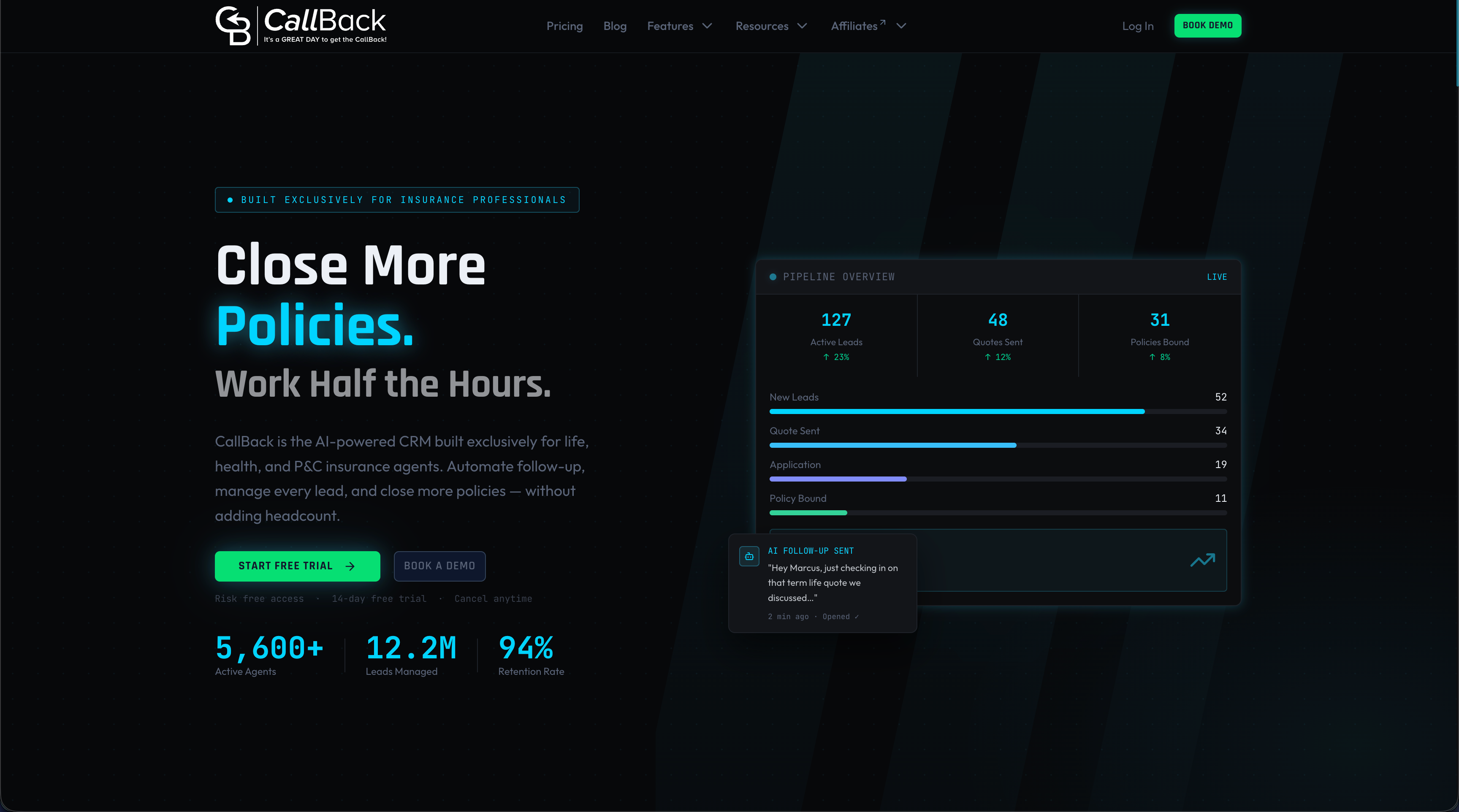
CallBack CRM gives insurance agents and agencies an all-in-one platform that puts AI-powered lead scoring, automated follow-up, and behavioral tracking directly into your daily workflow. From AI sales features that identify your best prospects to insurance landing pages that capture intent signals and SMS marketing that reaches leads at the right moment, everything connects in one place. Start building a smarter pipeline today and see what data-driven selling actually looks like in practice.
Frequently asked questions
What factors does predictive analytics use for insurance sales lead scoring?
The most predictive factors are renewal timing, lead source, quote activity, content engagement, email depth, direct contact history, and a balanced combination of customer fit and intent signals.
How much of a sales lift can agents expect from using predictive analytics?
Results vary by agency size and implementation quality, but documented case study outcomes show 2 to 8% conversion lift, up to 25% revenue increases from cross-sell, and up to 3x more qualified leads.
How can smaller agencies start using predictive analytics without a full data science team?
Start with a CRM platform that includes built-in lead scoring, focus on capturing clean behavioral data, and use conversion tracking reports to refine your approach over time without needing technical staff.
What is the role of human judgment in a predictive analytics sales process?
Agents should use scores as a guide for prioritization and then apply personal knowledge and contextual judgment to override or adjust targeting when the situation calls for it.