

Lead prioritization is the practice of deciding which leads get contacted first, how fast, and through which channel. It starts after a lead exists. Lead generation brings names in. Prioritization decides which names get the next call. A scoring model, fixed contact windows and a CRM that applies both automatically keep the best leads from waiting behind the weakest ones. CallBack is built for this work: it handles pipelines, automated follow-up by SMS, email and voicemail, and AI assistants for insurance agents, agencies and IMOs.
TL;DR
- Prioritization is ranking existing leads by intent (how ready the person is) and fit (whether the agent can write the product for that person).
- A simple point score with three or four tiers is enough. Engagement should override the score.
- Each tier gets its own response time, channel mix and number of attempts.
- Score again after every meaningful action, because intent fades.
- Track contact rate, quote rate and quote-to-bind by tier to learn whether the model works.
Table of Contents
- What lead prioritization means in insurance
- Signals that mark a high-intent insurance lead
- A working scoring model
- Turning a tier into the next best action
- Where manual prioritization breaks down
- Setting up prioritization in a CRM
- Measuring whether prioritization works
- Differences by line of business
- Perspective
- Putting it into practice with CallBack
- FAQ
- Sources
What lead prioritization means in insurance
Most agents already prioritize, informally. They call the newest lead first, or the one with the biggest face amount, or the one that looks familiar. Formal prioritization replaces that habit with rules. Every lead gets a score or a label, and the label sets what happens next and by when.
Two ideas sit inside every good model:
- Intent: how likely the person is to act soon. Examples are a requested quote, a call back, a recent life event or an open enrollment window.
- Fit: whether the person can be sold to. This covers state, carrier appetite, age, health class, product match and valid contact details.
The two are separate. One published guide on buyer intent points out that a highly motivated consumer may not qualify for a product, and a qualified consumer may not be ready to act. A lead needs both to rank high. It also advises judging intent as a pattern of signals rather than a single event.
The terms are close but not the same. Lead generation is about volume and source. Lead scoring is the arithmetic. Prioritization is the operating rule built on the score: who is called, when and how. For the scoring side in more depth, see the CallBack guide to lead scoring methods for insurance.
Signals that mark a high-intent insurance lead
A signal is any fact about the lead that changes the odds of a sale. Signals fall into three groups.
Contact quality
A lead with a working phone number and email can be reached in several ways. A lead with a bad number cannot be called, however interested the person is. Contact completeness is the cheapest signal to check and the first one most scoring models use.
Behavior and timing
- The lead requested a quote or an appointment rather than downloading a general guide.
- The lead answered a text or opened several emails.
- The lead called back after a missed call or voicemail.
- The lead filled out a form during business hours, when a live call is possible.
Line-specific triggers
The strongest cues differ by product.
- Life, final expense, mortgage protection: a recent trigger event such as a new mortgage, a birth, a death in the family or a retirement date. One agent playbook scores timeline, trigger event, contact completeness, product specificity and engagement, each from 1 to 5.
- Auto and home: a near-term renewal, a coverage gap, a recent vehicle purchase or a pending home closing point to a buyer who needs a policy soon.
- Medicare: the enrollment period and the person’s consent to be contacted matter as much as interest. Part of prioritization here is compliance. CallBack covers the rules in its posts on Medicare permission to contact and CMS Medicare marketing compliance.
- Annuities and IUL: specific product questions and stated amounts to move or protect usually show more intent than general retirement interest.
A working scoring model
A model does not need to be complex. One published example from a lead provider’s education center scores four factors:
| Factor | Points |
|---|---|
| Contact quality: phone and email | +3 |
| Contact quality: phone only | +2 |
| Contact quality: email only | +1 |
| Insurance type match with the agent’s strongest carrier rates | +3 to +1 |
| Geographic fit with the agent’s competitive markets | +3 to +1 |
| Timing: lead arrives during business hours | +2 |
The same model sorts totals into tiers: 9 to 11 points is Tier 1, 5 to 8 is Tier 2 and 1 to 4 is Tier 3. Engagement overrides the number. A Tier 3 lead who calls back becomes Tier 1.
The weights are an example, not a standard. An agent who writes only final expense in three states should weight product and state heavily. An agency selling Medicare should add consent status and enrollment timing. The playbook mentioned above recommends treating its rubric as a starting point and recalibrating after 90 days of the agency’s own data. That is the right habit for any model.
A worked example
Two leads arrive at 10:15 on a Tuesday for a final expense agent licensed in Texas and Ohio.
- Lead A: Texas, phone and email, asked for a quote on burial coverage. Contact +3, product +3, state +3, timing +2 = 11 points. Tier 1.
- Lead B: Florida, email only, downloaded a general guide. Contact +1, product +2, state +1, timing +2 = 6 points. Tier 2 at best, and the agent cannot write in Florida, so it is a nurture or referral lead.
Under first-come, first-served, Lead B might get the first call simply because it came in a minute earlier. Under a model, Lead A gets the call.
Turning a tier into the next best action
A score has no value until it sets an action. The next best action answers four questions for each lead: when to contact, by what channel, with what message and how many times.
Timing
Speed matters most for the top tier. A research page from the same provider cites an MIT and InsideSales study reporting that companies contacting a lead within 5 minutes were about 21 times more likely to qualify it than companies waiting 30 minutes. The same page reports that the average insurance agent makes about 1.5 call attempts per lead, against a research-supported optimum of about 6.
The education center’s tier rules put it in practice:
| Tier | First call | If no answer | Sequence |
|---|---|---|---|
| Tier 1 | Within 2 minutes | Voicemail, text and email within 5 minutes | 7 touches, 6 to 8 attempts over 72 hours |
| Tier 2 | Within 15 minutes | Voicemail and text | 5 touches over 48 hours |
| Tier 3 | Within 30 minutes | Text only | 3 touches over 24 to 48 hours |
These windows come from one source’s model. Agents set their own based on lead volume and staffing. The principle that holds in any version is that the top tier is contacted first and followed up most persistently.
Channel
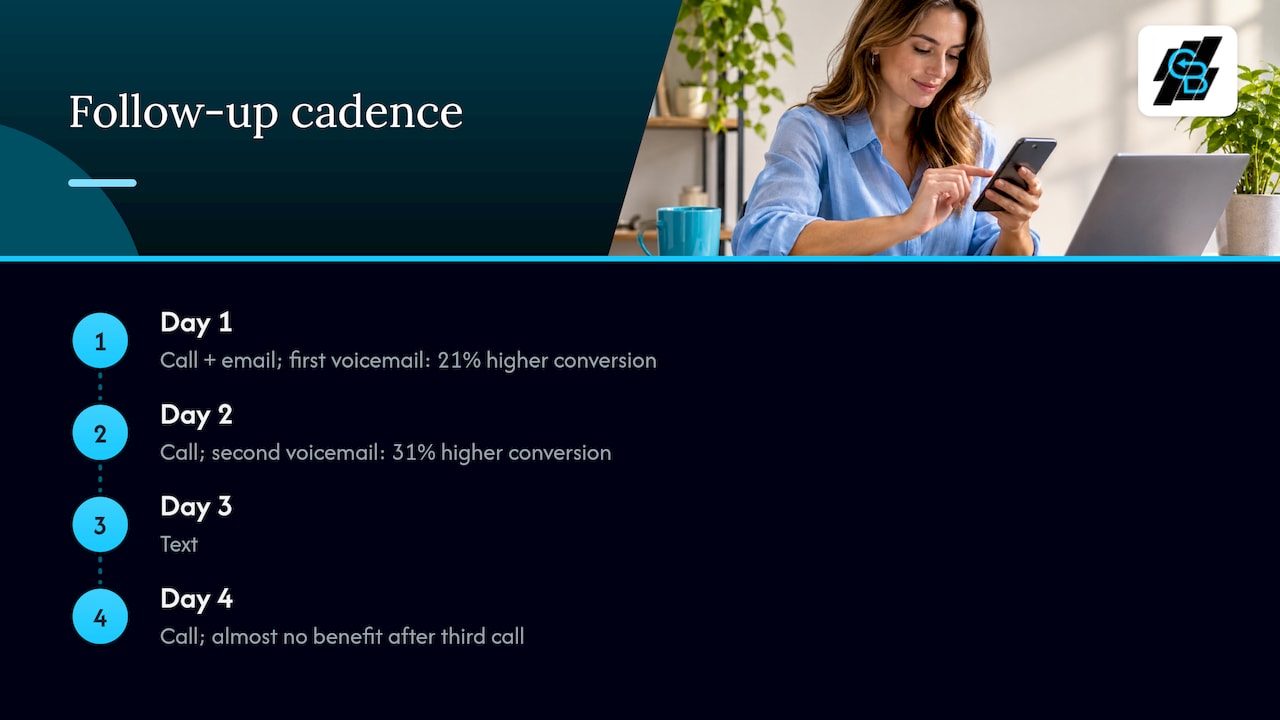
The same source reports that voicemails left on the first and second attempts are associated with 21% and 31% higher conversion, with almost no benefit after the third call. A multi-channel cadence it suggests runs call and email on day 1, a call on day 2, a text on day 3 and a call on day 4.
Channel also matters because phones are hard to answer for strangers. A Pew Research Center survey, cited in a KPI guide for agencies, found only about 1 in 5 US adults answers a call from an unknown number. A text or an email sent a few minutes after a missed call gives the lead a second way to respond. For more on how fast and how often to follow up, see this overview of lead nurturing strategies.
Message
The message should match the trigger. A lead who requested a mortgage protection quote after closing on a house should hear about that. A lead who downloaded a retirement guide should get a short question about their goal. Generic “checking in” messages waste the position the score gave the lead.
Re-scoring
Intent decays. The life-insurance playbook routes scores of 20 to 25 (out of 25) to a same-day call, 14 to 19 to a call within 24 hours and 8 to 13 to nurture. It recommends re-scoring after meaningful engagement. A lead in nurture who opens three emails and clicks a quote link should move up the same day.
Where manual prioritization breaks down
A spreadsheet model works at ten leads a day. It fails at fifty, because someone has to enter each score, sort the list and remember each follow-up. The delays this creates fall on the leads that matter most, the new, high-intent ones.
Three problems show up repeatedly:
- Scores go stale. Nobody re-scores a lead after it replies, so the list reflects last week.
- Follow-up depends on memory. The third and fourth touches are the ones most often skipped.
- Channels are split. Calls live in the dialer, texts in a phone and email in an inbox, so no one sees the whole history.
Automation fixes these because it applies the same rules to every lead, instantly. A case study of a P&C and auto provider with more than 20,000 agents reports that predictive lead models showing leads as Urgent, Hot or Warm raised quote-to-bind rates by 2 to 8% in agent offices, and at least 70% of surveyed agents said they could focus their efforts better. The same study found website leads tended to convert at higher rates than leads from internet lead providers, a useful reminder to score by source as well.
Setting up prioritization in a CRM
A CRM turns the rules into workflows. The setup has six parts.
- Define the fields. Capture state, product interest, phone, email, source, consent and trigger event on every lead. Missing fields cannot be scored.
- Write the point rules. Start with four to six factors and no more. Fewer rules are easier to audit.
- Set the tiers. Three tiers are enough for most agencies. Tie each to a response window and a cadence.
- Build the workflows. When a lead enters, the score is set, the tier is tagged, the right task is created and the first message goes out. CallBack supports workflow automation and follow-up by SMS, email and voicemail, so a Tier 1 lead can get a text and an email the moment a call goes unanswered.
- Add override rules. A reply, a call back or a booked appointment moves the lead up automatically.
- Review monthly. Compare results by tier and change the weights.
CallBack’s guides walk through the details: a six-step AI lead scoring pilot, the lead scoring process and a lead generation workflow tutorial.
Keep verification with the agent
Automation ranks and routes. The agent still confirms the facts that determine whether a policy can be written: licensing in the lead’s state, product eligibility, carrier appetite and, for Medicare, consent and scope of appointment. Records of consent and timestamps belong in the lead file from the start. A score never replaces those checks.
Measuring whether prioritization works
A model is a hypothesis. The numbers show whether it holds. The KPI guide defines the core measures:
- Contact rate: prospects actually spoken with divided by prospects tried.
- Meaningful-conversation rate: the share of contacts that become a real discussion about coverage.
- Quote rate: the share of leads that receive a quote.
- Quote-to-bind rate: binds from a given month’s quotes, counted by an agreed check date, divided by that month’s quotes. Counting by cohort avoids mixing months. Show the two counts behind each percentage.
Break each measure out by tier. The monthly review in the tier model asks what percentage of each tier converted to a quote and a sale, what the average revenue per lead was for each tier, and whether Tier 3 leads closed while Tier 1 leads did not. If Tier 3 outperforms Tier 1, the weights are wrong.
A useful second check is source quality. When a lead source produces high scores but low agent acceptance or poor contact rates, the scoring for that source needs adjusting. Scores should reflect real outcomes, not assumptions.
Differences by line of business
One model rarely fits every product. A short guide to the usual adjustments:
| Line | Weight more heavily | Typical caution |
|---|---|---|
| Final expense | Age, state, recent trigger event, callback | Contact details often incomplete, so verify the number first |
| Mortgage protection | Closing date, mortgage trigger | Time-sensitive, so use fast windows |
| Life, IUL, annuity | Product specificity, stated amount, timeline | Longer cycles, so keep a nurture track |
| Medicare | Enrollment period, documented consent | Contact rules apply before any outreach |
| Auto and home | Renewal date, recent purchase or closing | Shoppers compare quickly, so respond fast |
The Medicare row has the strictest limits. Under 42 CFR 422.2264 and 423.2264, scope-of-appointment rules limit what can be discussed in a marketing appointment, and unsolicited follow-up needs consent or beneficiary initiation. Agents handling Medicare should confirm the current rules on the CMS site and build consent into the score.
Perspective
Most agents do not have a lead problem. They have a sorting problem. Leads sit in a list, and the best ones wait their turn behind the rest.
We built CallBack for insurance workflows so the sorting happens without manual work. Pipelines are set up for insurance sales, follow-up runs across SMS, email and voicemail, and AI assistants take over the manual steps such as data entry, lead scoring and first outreach. The goal is that the agent spends the day talking to people who are ready to talk.
Our approach to messaging also supports the follow-up side. We use unique message hashing, iMessage deliverability and carrier-approved verbiage, so a Tier 1 text is more likely to arrive.
The order we suggest is simple. Decide the tiers. Set the windows. Let the system apply them. Review the results each month and adjust.
Kyle
Putting it into practice with CallBack
The Professional plan is $97 per month on a monthly subscription. Agencies with several producers can choose an Enterprise plan with 10 full CRM accounts at $297 per month, 25 at $397 per month or 60 at $497 per month. An Unlimited AI Employee Bundle is $127 per month. SMS, email and AI usage are billed at wholesale rates, and the fees page lists each item, including phone numbers at $2.30 per month per number.
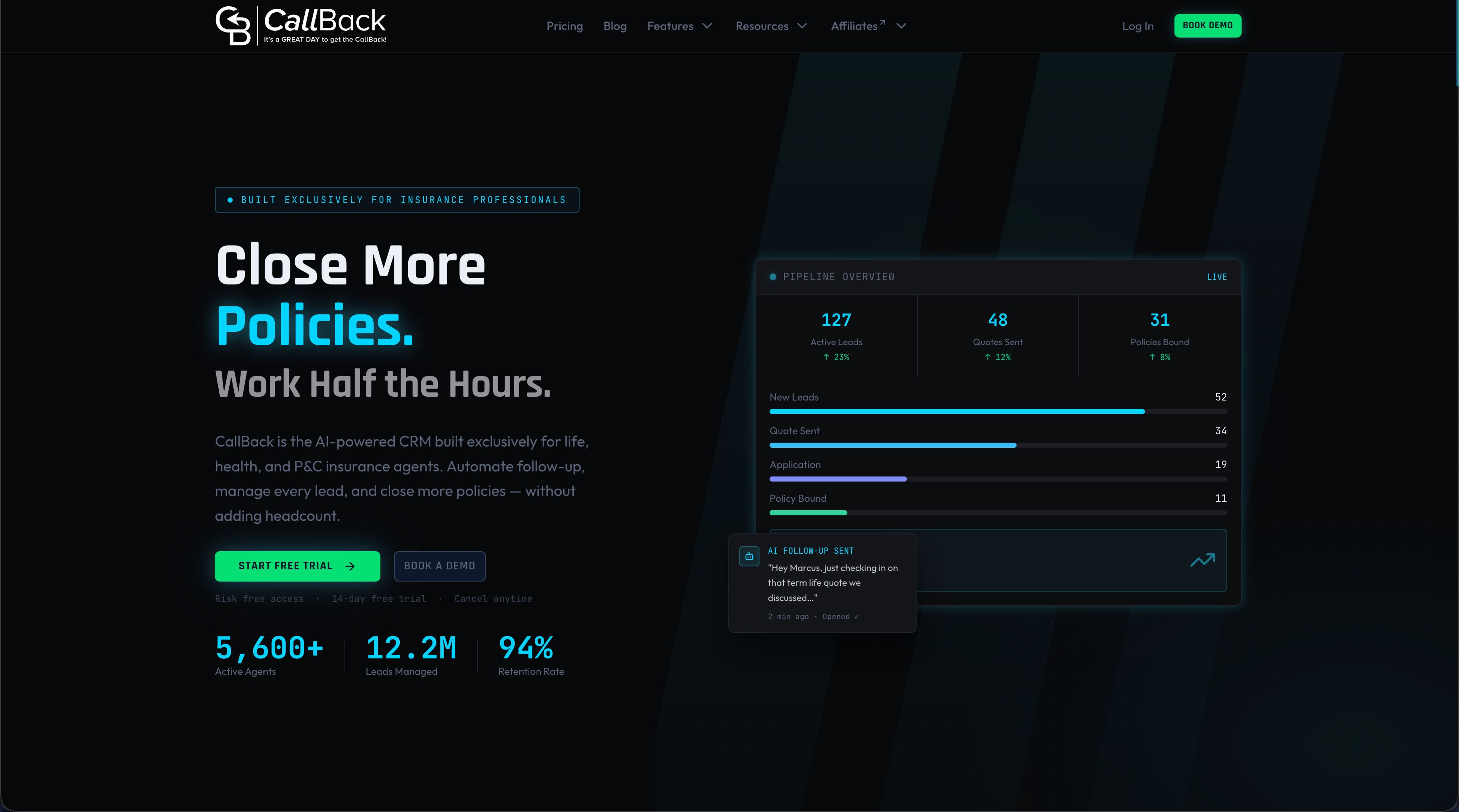
Agents who want to see tiered follow-up running on their own leads can start from the CallBack home page and begin the free trial.
FAQ
How is lead prioritization different from lead scoring?
Lead scoring assigns a number to each lead based on intent and fit. Prioritization uses that number to decide who gets contacted first, how fast and through which channel. Scoring is the measurement. Prioritization is the action it triggers.
What makes an insurance lead high intent?
A high-intent lead shows several signals together: a quote or appointment request, a working phone and email, a trigger event such as a new mortgage or a renewal date, and engagement such as a reply or a call back. Intent is judged as a pattern, and the lead must also be eligible for the product.
How fast should an agent contact a top-tier lead?
One published tier model calls Tier 1 leads within 2 minutes and follows up by voicemail, text and email within 5 minutes if there is no answer. Reported research links contact within 5 minutes to a much higher chance of qualifying the lead. Agents set their own windows based on staffing and lead volume.
Can AI rank insurance leads on its own?
AI can score leads, sort them and start follow-up automatically. The agent still verifies licensing, eligibility, carrier appetite and consent before quoting or binding. Reviewing results by tier each month keeps the model accurate.
How often should a scoring model be updated?
Review it monthly and recalibrate after about 90 days of the agency’s own results. Re-score individual leads whenever they take a meaningful action, because intent fades over time.
Sources
- Top Signals of Buyer Intent That Drive Conversion
- Get High Intent Insurance Prospects: 2026 Agent Playbook
- How to Read Insurance Shopper Intent in Quote Requests
- Lead Prioritization: Working Smarter, Not Harder
- Speed-to-Contact and Lead Response: Impact on Insurance
- Insurance agency KPIs: 12 metrics for better management
- Driving Policy Growth Through Predictive Insights for 20K+ Insurance Agents
- Lead nurturing explained: Boost conversions with effective strategies