

Permission to contact (PTC) is a beneficiary’s agreement to be contacted by a specific agent about Medicare plans. Without it, an agent may not call, text or leave a voicemail. With it, the agent may use only the channels and topics the beneficiary agreed to. The agent must also be able to prove the agreement later. That last part is where most agencies fall short, and it is a record-keeping problem a CRM is built to solve.
This article covers what counts as PTC, which outreach is allowed without it, how to collect and store it, what changed for contract year 2027, and how to personalize emails without implying consent that does not exist.
TL;DR
- PTC must name the agent, the plan types and the contact methods. It must be documented and kept for 10 years.
- Without PTC, only conventional mail, other print media and email (with an opt-out) are allowed as unsolicited contact. Calls, texts, voicemails and social media direct messages are not.
- CMS’s final rule of April 2026 removed the SOA waiting period for personal appointments and shortened call-recording retention to six years, effective October 1, 2026. The cold-call ban did not change.
- Personalization tokens in email are fine for greetings and plan-type references. They should never state or imply that the person asked to be contacted.
Table of Contents
- What permission to contact means
- What is allowed without permission
- How to obtain, record and honor permission
- Permission to contact versus Scope of Appointment
- What changed for contract year 2027
- Email: the one open channel, and how to personalize it
- A note on consumer scams
- Putting the routine in one place
- Our perspective
- FAQ
- Sources
What permission to contact means
A beneficiary gives PTC when they agree to let an agent contact them about Medicare plans. According to a carrier job aid on permission to contact and lead generation, consumers can give it through a paper or electronic business reply card, or by calling, texting or emailing the plan or a representative. The statement has to identify the licensed sales agent, the Medicare plan types and the permitted contact methods. Medicare Supplement forms must also say “This is a solicitation for insurance.”
The federal rule behind this is 42 CFR 422.2264, which governs beneficiary contact. The dividing line is simple. A contact is not unsolicited when the beneficiary consented to it or started it, for example by returning a call or by completing a business reply card that asks for contact.
Three details trip agents up:
- Scope. Permission covers the plan types and channels the person agreed to. A form that lists Medicare Advantage does not authorize a call about a different product line.
- Specific agent. Consent is tied to the named agent, not to the agency, the lead vendor or anyone who later buys the lead.
- Referrals. A referral from a current client does not create permission to contact the referred person. The referred person has to agree first.
What is allowed without permission
The regulation leaves very little room for unsolicited outreach. The only unsolicited channels permitted are conventional mail, other print media and email, and every email needs an opt-out option. Medicare.gov’s plan marketing rules add that plans and their representatives may not call or text unless the person is already a plan member or gave permission. They also may not visit a home uninvited, and may not offer cash, gifts worth more than $15 or free meals as an incentive to join a plan.
The prohibited list in the regulation includes:
- Door-to-door solicitation and approaching people in common areas
- Social media direct messages
- Cold calls, robocalls, text messages and voicemails
- Calls based on a referral
- Calls to confirm receipt of mailed information
- Calls to people who attended a sales event, without express permission
The second and third items catch many agencies. A mailer followed by a courtesy call to “make sure it arrived” is unsolicited contact. So is a text to a lead who never agreed to texts. Federal guidance for agents says the same: unsolicited text messages and voicemails are prohibited, and an agent may call a beneficiary who gave advance permission, such as through a business reply card or a Scope of Appointment, according to CMS’s Agent/Broker Dos and Don’ts.
Current clients are the exception that matters most. Agents may contact their own enrolled clients about other Medicare plan types or plan information. A client list is therefore a different workflow from a purchased lead list, and the two should not be mixed in one outreach sequence.
How to obtain, record and honor permission
Step 1: Capture it at the source
Permission can come from a business reply card, a web form, or an inbound call, text or email to the agent. On a web form, the consent language has to sit next to the submit button. It should name the agent or agency, list the plan types and list the contact methods. A single checkbox that says “I agree to be contacted” does not meet the content requirement in the job aid above.
Where it goes wrong: forms that bundle several advertisers into one consent, and vendor forms that never name an individual agent. Consent collected that way cannot be tied to the person who ends up calling.
Step 2: Store proof, not just a yes
The record should show who consented, the exact wording they saw, the date and time, the channel, the plan types and the contact methods agreed to. Lead platforms do not reliably keep these records permanently. An analysis of insurance lead generation compliance notes that agents must embed their own disclosure language and archive proof independently, since that record is what surfaces in a dispute.
The job aid requires PTC documentation to be kept for 10 years. A spreadsheet or inbox folder is hard to search at that scale. A CRM contact record that holds the consent text, timestamp and source next to the pipeline stage keeps the proof attached to the person. CallBack’s CRM is built for insurance pipelines, and the step-by-step approach to this is laid out in 5 CRM steps to prove CMS Medicare marketing compliance.

Step 3: Limit outreach to what was agreed
Each contact method needs its own permission. A person who agreed to a phone call has not agreed to texts. Tagging contacts by channel and plan type, and building automations that only fire for the matching tag, keeps follow-up inside the consent. CallBack supports automated follow-up by SMS, email and voicemail, and its workflows can be set up around those tags. For a worked sequence, see the 14-day, 9-touch insurance sequence and TCPA checklist and the 30 to 90 day compliant Medicare nurture.
Step 4: Respect the other federal and state rules
PTC does not replace the Telephone Consumer Protection Act (TCPA), Do-Not-Call rules or calling-hour limits. The job aid states that agents must follow TCPA, Do-Not-Call rules and federal and state calling hours, and must record sales calls. Where a lead was bought, one-to-one consent for the specific agent is the standard to work toward, and the lead should be checked against Do-Not-Call lists before any call.
Step 5: Watch the expiration date
Permission is not permanent. The job aid states that once it expires without renewal, only postal mail or email contact is allowed. Permission and the Scope of Appointment are limited to the products and scope the beneficiary agreed to, and they are treated as running 12 months under 42 CFR 422.2264. A CRM reminder set at 11 months gives the agent time to request renewed permission through an allowed channel such as email.
Permission to contact versus Scope of Appointment
The two are often confused. PTC answers the question “may this agent contact the person?” The Scope of Appointment (SOA) answers “what will be discussed in the appointment?” An SOA is a record of the plan types a beneficiary agreed to discuss before a meeting. An SOA can serve as evidence of advance permission, but each should be stored as its own record with its own date and scope.

What changed for contract year 2027
CMS issued a final rule on April 2, 2026, with changes applying to contract year 2027 materials beginning October 1, 2026. According to CMS’s Medicare OEP marketing guidelines for 2026, the changes:
- Permit marketing events directly after educational events, with notice and an opportunity to leave
- Permit personal appointments at any time after an SOA is completed
- Permit SOA collection at educational events
- Revise the third-party marketing organization (TPMO) disclaimer
- Reduce call-recording retention to six years
The TPMO disclaimer is the statement an agent working with a third-party marketing organization must give the beneficiary about the plans the organization does and does not represent. Agents should confirm the exact new wording and timing against the CMS document and their carrier’s materials.
Two practical points follow. First, the shorter recording retention applies to call recordings. The PTC documentation retention period in the carrier job aid is 10 years. Treat them as separate retention schedules in the CRM. Second, nothing in the changes opens up cold calling. Permission is still the gate for calls and texts.
Email: the one open channel, and how to personalize it
Email is allowed without prior permission, with an opt-out in every message. That does not make it unregulated. Content with plan premium, copay or benefit details is marketing material, which carriers and CMS review under their own rules. Commercial email also falls under the CAN-SPAM Act, which requires a working unsubscribe mechanism honored within 10 business days, a physical postal address and honest subject lines. Agents comparing email marketing platforms for healthcare providers will see that unsubscribe handling and audience segmentation are the features that matter most for this kind of outreach.
Personalization tokens that are safe
A personalization token is a placeholder, such as a first-name field, that fills in from the contact record when the message is sent. Safe uses:
- First name in the greeting
- County or state, when the content is about local plan options
- Plan type the person already holds with the agent, for current clients
- The agent’s own name, license number and contact details in the signature
Tokens to avoid
- Anything implying a request. A line such as “Thanks for asking about a call” is false for a person who never asked. It can also be read as a manufactured consent record.
- Medicare numbers or other sensitive identifiers. Email is not a secure channel, and a plan comparison needs only age and county.
- Health details. Medications or conditions pulled from a form do not belong in a subject line or preview text.
- Unfilled tokens. A blank first name signals a bulk list. Set a fallback value in the template.
Every email should also include the opt-out and the postal address as fixed template elements, not tokens that can fail. CallBack’s email marketing features and its guide on insurance email marketing cover templates and sending. The deliverability guide covers how messages reach the inbox. CallBack’s deliverability practices include unique message hashing, iMessage deliverability and carrier-approved verbiage.
A note on consumer scams
Agents are sometimes asked by clients how to tell a real call from a scam. Medicare itself does not call asking for personal information. The Iowa Insurance Division advises that anyone asked to confirm a Medicare number by phone should hang up and call 1-800-MEDICARE, which is available 24 hours a day. Agents who follow the permission rules above are also easy to tell apart from scam callers: they name themselves, state why they are calling and refer to something the person requested.
Putting the routine in one place
CallBack is an all-in-one platform for insurance agents, agencies and IMOs. It combines CRM, SMS and email, funnels, websites, workflow automation and AI assistants. Consent capture, channel tags and follow-up automations sit in the same system, so the proof of permission and the outreach are not split across tools. The Professional plan costs $97 per month, and Enterprise plans with 10, 25 or 60 full CRM accounts cost $297, $397 and $497 per month. SMS, email and AI usage are billed separately at wholesale rates, as shown on the fees page. Agents can start on the Professional plan, and agencies with several licensed agents can review the Enterprise plans.
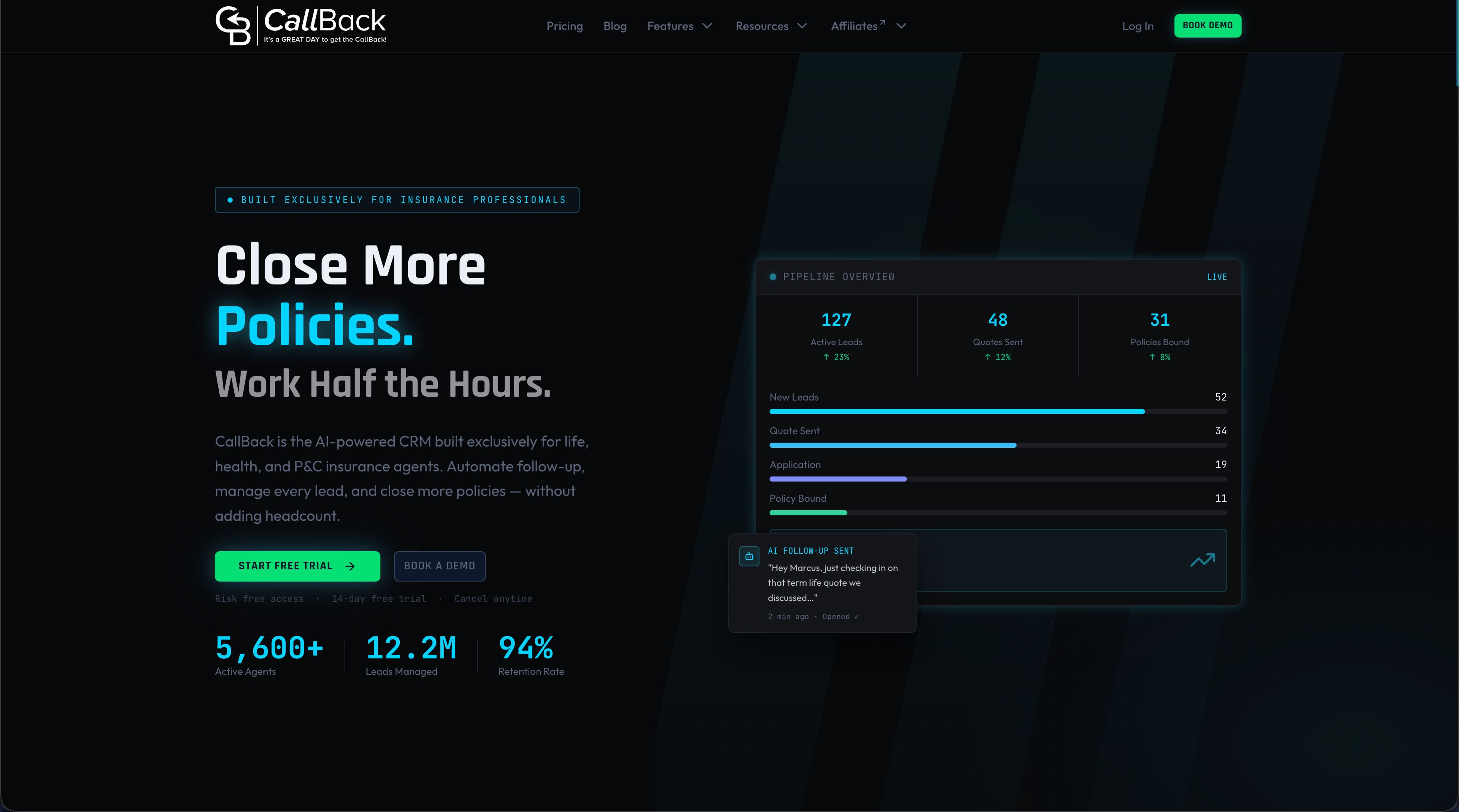
For agencies with many agents, per-agent consent records matter most, since consent belongs to the individual agent. Separate accounts keep each agent’s contacts and records apart.
Our perspective
Most permission problems we hear about are not about intent. They are about records. An agent gets a real yes on a call, then cannot find the date, the channel or the plan types six months later.
We built CallBack around insurance workflows because follow-up and compliance are the same job. If the consent sits on the contact record, the automation can read it. A text sequence should only start for a contact tagged for text. A call task should only appear for a contact tagged for calls.
Cold calling is the wrong habit for Medicare. It is risky and it is slow. Permission-based follow-up by SMS, email and voicemail, sent quickly after a person asks, gets better results and keeps the file clean. Automating the repetitive work lets the agent spend time on conversations that were invited.
Kyle
FAQ
Can an agent call a lead who filled out an online form?
Only if the form gave valid permission. It must name the agent, the plan types and the phone as a contact method. A form that does not meet those points does not authorize a call, and the lead should receive only mail or an email with an opt-out.
How long must permission to contact records be kept?
The carrier job aid states that PTC must be documented and saved for 10 years. Call recordings follow a separate schedule. From October 1, 2026, CMS’s rule reduces the call-recording retention period to six years.
Does a referral from a current client count as permission?
No. A referral does not create permission to contact the referred person. The referred person must agree first, for example by contacting the agent or completing a reply card. Agents may send mail or an email with an opt-out in the meantime.
Can agents send unsolicited emails about Medicare plans?
Yes, under 42 CFR 422.2264, email is one of the permitted unsolicited channels, along with mail and other print media. Each message needs an opt-out. Messages that include premium, copay or benefit details are marketing material and fall under carrier and CMS review requirements.
Sources
- 42 CFR 422.2264, Beneficiary contact (eCFR)
- Marketing rules for Medicare health and drug plans (Medicare.gov)
- Permission to Contact and Lead Generation Job Aid
- Agent/Broker Dos and Don’ts (CMS)
- Medicare OEP Marketing Guidelines 2026 (CMS)
- Insurance Lead Generation: Channels, Laws, and Compliance
- Medicare Fraud on the Rise During Annual Open Enrollment (Iowa Insurance Division)
- 7 Best Email Marketing Platforms for Healthcare Providers in 2026