

TL;DR:
- Insurance CRM integrations include direct API, middleware, and native systems, each suited to different agency sizes and technical capabilities. Proper data mapping and automation are essential for effective workflows, while native integrations offer the fastest deployment for smaller agencies. Agencies must select the right integration type based on their size, data complexity, and resource availability for optimal results.
Insurance CRM integrations are defined as the technical connections that sync data between a CRM platform and core insurance systems such as policy management, claims, billing, and marketing automation. The types of insurance company CRM integrations you choose directly determine how accurately your agency tracks customers, automates renewals, and eliminates duplicate data entry. Three primary approaches dominate in 2026: direct API, middleware/iPaaS, and AMS-native integrations. Each carries distinct trade-offs in cost, maintenance, and speed of deployment. Understanding those trade-offs is the first step toward building an insurance CRM setup that actually works.
1. What are the types of insurance company CRM integrations?
The three core integration types are direct API connections, middleware or iPaaS layers, and native integrations built into agency management systems. Direct API is the most precise but requires the most developer effort. Middleware sits between systems and routes data without custom code for every connection. AMS-native integrations come pre-built into platforms that already manage policies and commissions. Knowing which type fits your agency’s size and technical capacity is more important than chasing feature lists.
2. Direct API integrations: precision with a maintenance cost
A direct API integration is a custom-coded link between your CRM and a carrier or insurance system. It sends and receives data in real time, with no intermediary layer translating the request. Carrier API integration allows quoting, policy changes, status checks, and eDocs to flow directly from the CRM, cutting turnaround time and rework significantly.
The precision of direct APIs is their biggest strength. Your team gets live policy status, real-time endorsement updates, and instant claims data without switching systems. That speed matters most for high-volume agencies writing multiple lines across several carriers.
The trade-off is maintenance. Every time a carrier updates its API, your integration may break. That means you need developer resources on standby or a vendor with a dedicated integration team. Implementation projects for direct API setups typically run 1–3 months and carry monthly costs that can exceed $300 per agent.
Key scenarios where direct API wins:
- Real-time quoting across multiple carriers from a single CRM screen
- Immediate policy change confirmations sent to the customer record
- Live claims status updates triggering automated customer notifications
- eDocs delivery and e-signature workflows tied directly to carrier systems
Pro Tip: Before building a direct API connection, request the carrier’s API documentation and versioning policy. Carriers that update APIs without backward compatibility will cost you more in maintenance than the integration saves.
3. Middleware and iPaaS solutions for scalable CRM integrations
Middleware and iPaaS (Integration Platform as a Service) act as an intermediary layer that routes and transforms data between your CRM and multiple insurance systems. Instead of building a separate direct connection to every carrier or platform, you connect each system once to the middleware layer. Middleware and iPaaS solutions reduce custom development needs and increase compliance control across diverse insurance stacks.
This model is preferred by mid-to-large agencies managing data from multiple carriers, billing platforms, and marketing tools simultaneously. The middleware layer handles protocol differences, data format conversions, and error logging automatically. That means your team spends less time troubleshooting broken connections and more time using the data.
Compliance is another strong argument for middleware. Insurance agencies operating under state regulations or handling sensitive health and financial data benefit from centralized data routing with built-in audit trails. Middleware platforms log every data transaction, which simplifies compliance reporting.
Agencies that benefit most from middleware:
- Multi-carrier agencies with five or more carrier data feeds
- Agencies integrating CRM with billing, claims, and marketing automation simultaneously
- Teams without dedicated in-house developers
- Agencies scaling quickly and adding new carrier relationships regularly
Pro Tip: When evaluating iPaaS options, check whether the platform has pre-built connectors for your specific carriers and AMS. Generic connectors work, but insurance-specific connectors cut setup time significantly.
4. Native AMS integrations: fastest path to policy and billing data
Native integrations are built directly into agency management systems that already include CRM functionality. These connections come pre-configured to exchange policy, commission, and billing data without custom coding. Native AMS integrations offer the fastest implementation timeline of the three primary approaches.
The speed advantage is real. Because the AMS vendor controls both the CRM layer and the integration logic, updates happen on the vendor’s schedule without breaking your workflows. Multi-carrier agencies that prioritize carrier data exchange over deep CRM customization get the most value from this model.
The limitation is flexibility. Native integrations are designed for the vendor’s standard workflows. If your agency has unique commission structures, non-standard policy types, or specialized reporting needs, you may hit walls that direct API or middleware approaches would not create.
| Feature | Native AMS | Direct API | Middleware/iPaaS |
|---|---|---|---|
| Implementation speed | Fastest (days to weeks) | Slowest (1–3 months) | Moderate (weeks to months) |
| Customization level | Low to moderate | High | High |
| Maintenance burden | Low (vendor-managed) | High | Moderate |
| Compliance handling | Vendor-dependent | Manual | Built-in audit trails |
| Best for | Smaller to mid-size agencies | High-volume, tech-resourced agencies | Mid-to-large, multi-carrier agencies |
Common use cases for native AMS integrations:
- Agencies wanting immediate access to policy and renewal data in the CRM
- Teams with limited IT resources that need a managed integration environment
- Brokers focused on commission tracking and carrier data exchange as primary CRM functions
5. Common insurance systems that integrate with CRMs
Insurance CRMs commonly integrate with policy management, claims management, underwriting, billing, marketing automation, document management, and communication tools. Each connection eliminates a specific category of duplicate work and data error. The right combination depends on where your agency loses the most time.

Policy management integration pulls active policy data, renewal dates, and coverage details directly into the customer record. Your agents see the full picture without logging into a separate system. That single change reduces the average time spent per customer interaction.
Claims management integration gives agents live claim status without calling the carrier. When a claim updates, the CRM can trigger an automatic customer notification. That keeps clients informed and reduces inbound status calls to your team.
Billing integration connects payment status, premium amounts, and lapse warnings to the CRM. An agent seeing a lapsed payment flag on a customer record can act immediately, before the policy cancels. That kind of proactive contact is only possible when billing data flows into the CRM in real time.
Marketing automation integration connects customer lifecycle data to outreach campaigns. Renewal dates, policy types, and cross-sell opportunities feed directly into CRM and marketing workflows, triggering personalized emails and SMS messages at the right moment. Callbackcrm is built specifically for this type of insurance workflow, connecting CRM data to email, SMS, and automation sequences without manual list management.
Telephony and communication integration logs every call, records outcomes, and links conversations to the customer record automatically. Agents stop taking manual notes and start focusing on the conversation.
Pro Tip: Prioritize integrations in the order they affect your highest-volume daily tasks. If your team spends most of its time on renewals, start with policy management and billing integrations before adding claims or underwriting.
6. Why data mapping determines whether integrations actually work
Connecting two systems is not the same as making them work together. Data mapping during integration is the process of explicitly defining which field in System A corresponds to which field in System B. Without it, you get dirty data that breaks automated triggers and corrupts reporting.
A common failure point is the customer name field. One system stores “First Last” and another stores “Last, First.” Without a mapping rule, the CRM creates duplicate records or mismatches policy data to the wrong customer. That error cascades into broken renewal reminders, incorrect billing alerts, and failed compliance reports.
Automated, insurance-specific workflows triggered by integrated data create true efficiency. Renewal triggers, policy reminders, and lapse warnings only fire correctly when the underlying data is clean and properly mapped. Agencies that skip this step during implementation spend months cleaning up records instead of using the automation they paid for.
The fix is straightforward: build a data dictionary before you connect any systems. Document every field you plan to sync, its format, and its source system. Review it with both your CRM vendor and your integration partner before the first data transfer runs.
Key takeaways
The most effective insurance CRM setup combines the right integration type with clean data mapping and automated workflows triggered by real-time insurance data.
| Point | Details |
|---|---|
| Three integration types exist | Direct API, middleware/iPaaS, and AMS-native each suit different agency sizes and technical resources. |
| Data mapping is non-negotiable | Explicitly mapping fields between systems prevents dirty data that breaks automation and reporting. |
| Workflows multiply integration value | Connecting systems without automating renewal triggers and policy reminders leaves most of the efficiency gain on the table. |
| Native AMS is fastest to deploy | Pre-built connections reduce setup time to days or weeks, best for agencies with limited IT support. |
| Middleware suits multi-carrier agencies | Centralized data routing with built-in compliance logging fits agencies managing five or more carrier feeds. |
What I’ve learned about picking the wrong integration type first
The most common mistake I see insurance agencies make is choosing a CRM based on its feature list, then realizing too late that it cannot connect cleanly to their carrier data. The Single Customer View is the real goal of any insurance CRM integration project. Agencies that chase dashboards and UI before solving the data unification problem end up with a fragmented mess across three systems instead of one.
My honest recommendation: start with the data, not the features. Map out every system your agency uses today, identify where customer records live in more than one place, and pick your integration type based on that gap. A direct API is overkill for a 10-agent agency that just needs policy renewal data in the CRM. A native AMS integration is too rigid for a 50-agent shop writing 12 lines across 20 carriers.
The agencies I’ve seen get this right share one habit. They automate insurance-specific workflows immediately after integration goes live. They do not wait to see if the data is clean. They build the renewal trigger, run it for 30 days, and fix the mapping errors the automation surfaces. That approach turns integration from a technical project into a revenue driver within the first quarter.
One more thing: budget for maintenance from day one. Direct APIs break when carriers update their systems. Middleware connectors need monitoring. Even native AMS integrations require attention when the vendor releases a major update. The agencies that treat integration as a one-time project always end up rebuilding it 18 months later.
— Kyle
Callbackcrm’s approach to insurance CRM integration
Insurance agencies that want connected marketing and sales workflows without building custom integrations from scratch have a direct path with Callbackcrm.
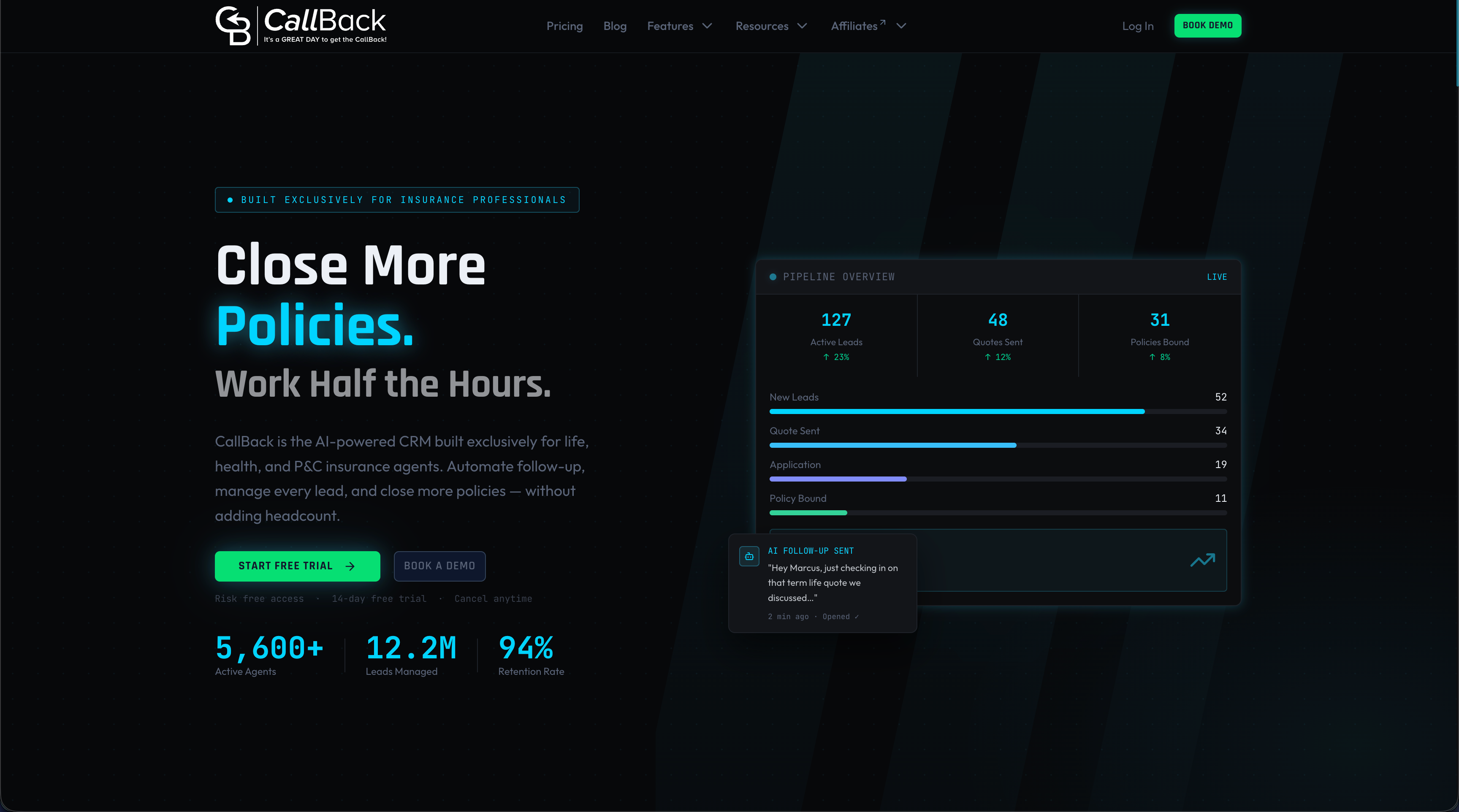
Callbackcrm connects policy data, billing triggers, and customer lifecycle events to email marketing automation sequences built specifically for insurance workflows. Renewal reminders, cross-sell campaigns, and lapse warnings all run automatically once the CRM data is in place. The platform also supports SMS, AI-assisted outreach, and lead scoring, so your team focuses on conversations rather than manual follow-up. For agencies looking to align their sales and marketing for better leads, Callbackcrm provides the integration layer and the automation tools in one platform.
FAQ
What are the three main types of insurance CRM integrations?
The three primary types are direct API integrations, middleware/iPaaS integrations, and AMS-native integrations. Each differs in implementation speed, customization depth, and maintenance requirements.
How long does an insurance CRM integration take to implement?
Implementation timelines range from days for native AMS integrations to 1–3 months for direct API projects, depending on the number of systems involved and the complexity of data mapping required.
Why does data mapping matter in insurance CRM integrations?
Poor data mapping creates duplicate records and mismatched policy data, which breaks automated workflows like renewal reminders and billing alerts. Explicit field mapping before the first data transfer prevents these errors.
What insurance systems should integrate with a CRM first?
Start with policy management and billing integrations, since these affect the highest-volume daily tasks. Claims, underwriting, and marketing automation integrations add value once the core data foundation is clean.
Is middleware better than direct API for insurance agencies?
Middleware is better for agencies managing multiple carriers and lacking dedicated developer resources. Direct API is better when real-time precision and deep customization are required and technical resources are available to maintain the connection.