

TL;DR:
- Cloud security in CRM involves multiple layers of encryption, access control, and monitoring to protect customer data. Proper operational practices like immediate offboarding and regular third-party audits are essential to prevent breaches and maintain compliance. AI integration introduces new risks that require contractual controls and ongoing governance to manage data exposure effectively.
Cloud security in CRM is defined as the set of technologies, policies, and controls that protect customer data stored and processed in cloud-based customer relationship management systems. The role of cloud security in CRM goes far beyond basic password protection. The average cost of a CRM-related data breach is $4.44 million, with customer churn rising 15–30% after a public incident. Regulations like GDPR, CCPA, HIPAA, and PCI DSS impose strict data handling requirements, and GDPR alone can fine organizations up to 4% of global annual revenue. For business professionals managing CRM platforms, understanding how cloud security works is not optional. It is the foundation of customer trust and regulatory survival.
What is the role of cloud security in CRM?
Cloud security protects CRM systems by combining encryption, access control, and continuous threat monitoring into a layered defense. Layered cloud CRM security can reduce breach risk by up to 70%, addressing both external attackers and internal threats. That figure matters because 86% of breaches originate from external attackers, while misconfigured internal access accounts for a significant share of the remainder.

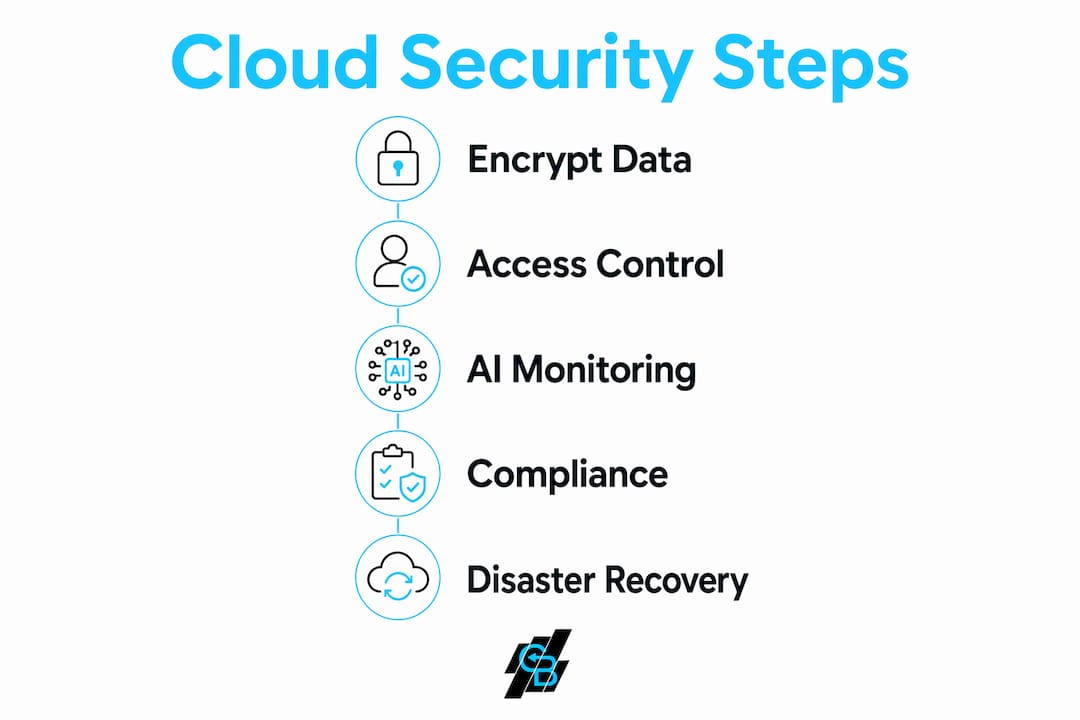
The core technologies work together. Encryption keeps data unreadable if intercepted. Access controls limit who can read or modify records. Monitoring detects unusual behavior before it becomes a breach. No single layer is sufficient on its own. The strength of cloud security in CRM comes from how these layers interact.
Encryption: AES-256, TLS 1.3, and key management
Industry standards require AES-256 for data at rest and TLS 1.3 for data in transit, with automated key rotation every 90 days. AES-256 is the same encryption standard used by the U.S. federal government for classified data. TLS 1.3 eliminates several vulnerabilities present in older transport protocols, making interception during data transfer significantly harder.
For organizations in highly regulated industries, Bring-Your-Own-Key (BYOK) or Hold-Your-Own-Key (HYOK) models give customers direct cryptographic control over their CRM data. These models prevent even the cloud vendor from accessing plaintext data. The tradeoff is a modest performance reduction, since encrypted data operations are more resource-intensive.
Role-based access control, MFA, and Zero Trust
Role-based access control (RBAC) assigns permissions based on job function, not individual preference. The principle of least privilege means each user gets only the access their role requires. Multi-factor authentication (MFA) adds a second verification step, blocking credential-stuffing attacks that target stolen passwords.
Zero Trust architecture takes this further. It treats every access request as untrusted by default, regardless of whether the request comes from inside or outside the corporate network. This model is especially relevant for CRM platforms accessed by remote sales teams and field agents.
AI-powered anomaly monitoring
AI monitoring in CRM security means the system learns normal user behavior and flags deviations automatically. An agent who suddenly downloads 10,000 contact records at 2:00 AM triggers an alert. This kind of detection catches threats that static rule-based systems miss entirely.
Pro Tip: Integrate your CRM audit logs with an enterprise SIEM (Security Information and Event Management) tool. Native CRM audit logs are often siloed, and centralizing them enables cross-system anomaly detection that isolated streams cannot provide.
How does cloud security support CRM compliance?
Cloud security is the technical backbone of regulatory compliance for CRM platforms. GDPR, CCPA, HIPAA, and PCI DSS each impose specific requirements on how customer data is collected, stored, accessed, and deleted. Meeting those requirements without proper cloud security controls is not possible.
Regulatory retention rules are concrete. HIPAA requires audit logs to be retained for six years, and PCI DSS requires five years. Immutable audit logs, meaning logs that cannot be altered or deleted, satisfy both requirements and provide defensible evidence during regulatory audits. Breach containment averages 287 days, which makes continuous log availability critical for forensic investigations.
Vendor contracts are an underappreciated compliance tool. A well-drafted CRM vendor agreement specifies data residency requirements, breach notification timelines, and the customer’s right to audit the vendor’s security practices. Without these clauses, organizations may find themselves legally exposed when a vendor-side incident occurs.
The compliance steps that matter most:
- Confirm data residency. Verify that your CRM vendor stores data in jurisdictions that satisfy your regulatory obligations, particularly for GDPR’s data transfer restrictions.
- Require immutable audit logs. Confirm that logs cannot be modified by administrators or the vendor, and that retention periods match your regulatory requirements.
- Negotiate breach notification SLAs. GDPR requires notification to supervisory authorities within 72 hours of discovering a breach. Your vendor contract must reflect that timeline.
- Secure audit rights. Your contract should give you the right to review the vendor’s security certifications, such as SOC 2 Type II or ISO 27001, and to conduct periodic audits.
- Review data processing agreements. Under GDPR, a Data Processing Agreement (DPA) is legally required when a vendor processes personal data on your behalf.
Pro Tip: Review your CRM compliance requirements annually. Regulations update, and a contract clause that satisfied GDPR in 2023 may not cover new guidance issued since then. Schedule a formal review every january.
What are the best practices for securing CRM in the cloud?
Operational discipline separates organizations that avoid breaches from those that suffer them. Technical controls matter, but they fail when day-to-day security practices are inconsistent. The most common breach vector in cloud CRM is not a sophisticated attack. It is a stale user account belonging to a former employee.
Offboarding SLAs should be measured in hours, not days. When an employee leaves, their CRM access must be revoked immediately. Delays create windows where disgruntled or compromised accounts can exfiltrate data. Quarterly access reviews catch accounts that were never properly offboarded or that accumulated permissions beyond their original role.
API security and third-party integrations
CRM platforms connect to dozens of third-party tools: marketing automation, billing systems, communication platforms, and analytics dashboards. Each integration is a potential entry point. API keys must be rotated regularly, scoped to the minimum permissions required, and rate-limited to prevent abuse.
Third-party app audits should happen at least annually. An integration that was approved two years ago may have changed its data handling practices, introduced new vulnerabilities, or been acquired by a different company with different security standards.
Backup and disaster recovery
| Security Practice | Recommended Standard | Why It Matters |
|---|---|---|
| Data backup frequency | Daily, with immutable snapshots | Prevents ransomware from destroying recovery options |
| Disaster recovery testing | Quarterly restoration drills | Confirms backups are actually recoverable |
| Offboarding SLA | Access revoked within hours | Closes the most common internal breach vector |
| API key rotation | Every 90 days minimum | Limits exposure from compromised credentials |
| Third-party app audit | Annual review | Catches vendors with changed security postures |
Immutable snapshots are backups that cannot be overwritten or deleted, even by administrators. Ransomware attacks specifically target backup systems to force ransom payment. Immutable snapshots eliminate that leverage. Quarterly restoration drills confirm that backups actually work when needed, not just when created.
How does AI in CRM create new cloud security challenges?
AI-powered CRM features introduce a category of risk that traditional security frameworks were not designed to address. When a CRM vendor uses AI to generate lead scores, draft outreach messages, or predict customer behavior, that AI model must be trained on data. The question of whose data trains the model, and how that data is protected, is now a front-line security concern.
Vendor contracts must explicitly restrict data usage for AI training and provide customers with audit rights over AI processes. Without these clauses, a vendor could use your customer data to improve models that also serve your competitors. This is not a hypothetical risk. It is a documented concern that security leaders are addressing through contract governance in 2026.
The key AI security considerations for CRM buyers:
- Data training restrictions. Contracts must state that your CRM data cannot be used to train general-purpose AI models without explicit consent.
- Prompt and model versioning. Vendors should document which AI model version processed your data and when, creating an auditable trail.
- Anomaly detection for AI behavior. Monitor for unusual patterns in AI-generated outputs, such as unexpected data access by automated processes.
- Audit rights for AI processes. Your contract should give you the right to review how AI features interact with your data, not just how human users do.
“AI integration in CRM requires new contractual and technological governance to manage data risks. Technical controls alone are insufficient when the vendor’s AI pipeline can access sensitive customer records without explicit restrictions in the service agreement.”
The AI features in CRM platforms that drive the most value, such as predictive lead scoring and automated outreach, also carry the highest data exposure risk. Governance must match capability.
Key Takeaways
Cloud security is the non-negotiable foundation of CRM data protection, requiring encryption, access control, compliance alignment, and AI governance to prevent breaches that average $4.44 million in cost.
| Point | Details |
|---|---|
| Encryption standards | Use AES-256 at rest and TLS 1.3 in transit, with key rotation every 90 days. |
| Access control discipline | Apply RBAC and least privilege, and revoke departing user access within hours. |
| Compliance documentation | Immutable audit logs and vendor contracts with breach notification SLAs are legally required. |
| AI governance | Contracts must restrict vendor AI training on your CRM data and provide audit rights. |
| Operational reviews | Quarterly access audits and annual third-party app reviews close the most common breach vectors. |
Why the shared responsibility model is the part most teams get wrong
The shared responsibility model is the most misunderstood concept in cloud CRM security. Cloud vendors secure the infrastructure. You secure the configuration. That distinction sounds simple, but most breaches stem from misconfigured user access, not from infrastructure failures. The vendor’s data center may be locked down perfectly while your CRM has 47 former employees with active logins.
I have seen organizations invest heavily in encryption and MFA while completely ignoring offboarding procedures. A sales rep leaves in march, and their account stays active until someone notices six months later. That is not a vendor failure. That is an operational failure, and it is entirely preventable.
The secure cloud CRM guide for SMBs covers this well, but the core principle applies at any scale. Security configuration is your responsibility, not your vendor’s. Treat it that way.
The AI governance piece is where I expect the most organizations to fall short in 2026. Vendors are moving fast, and contract language often lags behind product features. If your CRM vendor added an AI assistant in the last 12 months, go back and read your service agreement. The data usage clauses were almost certainly written before that feature existed. Renegotiate them. The GDPR compliance implications alone make this worth the legal cost.
The organizations that get CRM security right treat it as an ongoing operational practice, not a one-time setup task. Quarterly reviews, annual audits, and contract renewals are the rhythm that keeps security current. Set those calendar reminders now.
— Kyle
Callbackcrm’s approach to secure CRM data management
Callbackcrm is built on Google Cloud infrastructure, which means the encryption, access controls, and uptime guarantees of one of the world’s most audited cloud environments sit underneath every customer record you manage.
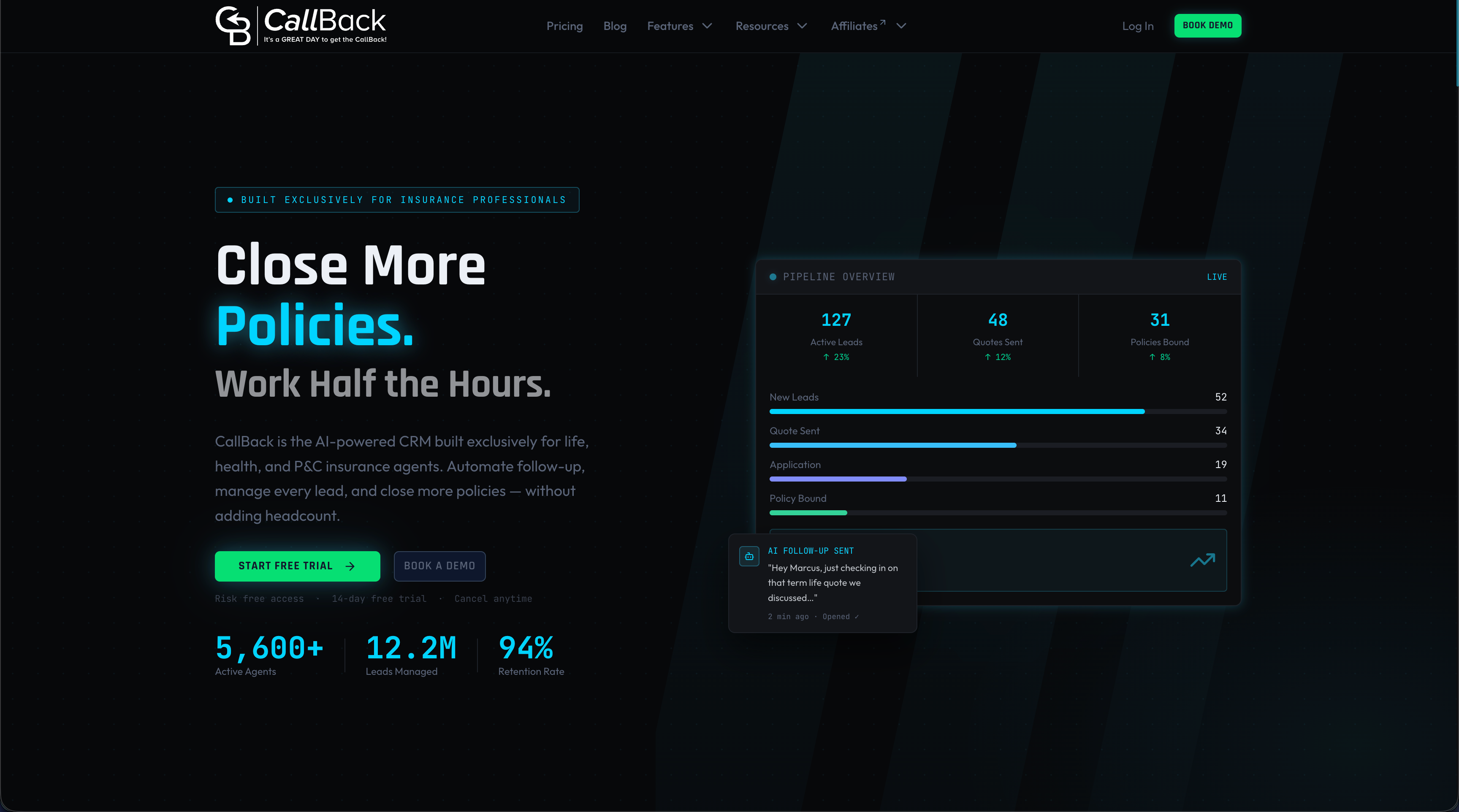
For insurance agents and agencies handling sensitive policyholder data, that foundation matters. Callbackcrm combines built-in access controls, AI-powered automation, and compliance-aware data handling into a single platform. You get the SMS marketing features and outreach tools your sales team needs, without sacrificing the security your compliance team requires. The free trial and pricing page lets you evaluate the full platform, including its security architecture, before committing. See how Callbackcrm handles your data the right way from day one.
FAQ
What is the role of cloud security in CRM?
Cloud security in CRM protects customer data through encryption, access controls, and continuous monitoring. It also ensures compliance with regulations like GDPR, HIPAA, and PCI DSS.
How does cloud security reduce CRM breach risk?
Layered cloud security combining Zero Trust architecture, MFA, and AI anomaly monitoring can reduce breach risk by up to 70% compared to basic perimeter defenses.
What encryption standards apply to CRM data?
AES-256 is the required standard for data at rest, and TLS 1.3 applies to data in transit. Automated key rotation every 90 days is the current industry benchmark.
Why do AI features in CRM create new security risks?
AI features may use customer data to train models, creating exposure if vendor contracts do not explicitly restrict that usage. Audit rights and data training clauses must be negotiated before deployment.
How often should CRM access permissions be reviewed?
Quarterly access reviews are the recommended standard. User accounts for departed employees should be revoked within hours of offboarding, not days, to close the most common internal breach vector.