

AI meeting notes turn a recorded or transcribed conversation into a summary, a list of decisions and a set of action items. For an insurance agent, the useful part is not the summary itself. It is what happens next: the note is attached to the right client, the follow-up is assigned, and the next message goes out on time. Notes that sit in a separate app tend to stay there. Notes that live in the CRM, next to the pipeline and the follow-up workflow, get used. CallBack is an AI-powered CRM and sales automation platform built for insurance agents, agencies and IMOs, and this guide explains how AI notes work, how to check them, which privacy rules apply and where the notes should end up.
TL;DR
- AI note takers follow one pipeline: capture audio, transcribe it, label speakers, summarize with a language model, then send the result somewhere.
- Summaries lose details. Negations, conditional promises and anything said only in chat can disappear, so the transcript stays the record and a person reviews the output.
- Recording consent depends on state law. Calls that cross state lines should follow the stricter state, and the tool should be announced at the start.
- Social Security numbers, health details and bank data need a written policy before they go near any AI tool.
- The note belongs in the CRM, on the client record, with an owner and a due date on every action item.
Table of Contents
- How AI meeting notes work
- What good notes look like in an insurance conversation
- How accurate the notes are, and how to check them
- Recording consent and disclosure in the United States
- Client data: what stays out of AI tools
- Where the note should live
- A routine for agencies
- How CallBack fits
- Our perspective
- FAQ
- Sources
How AI meeting notes work
Every AI note taker runs a similar sequence. According to an explainer on the AI note-taking pipeline, the tool captures audio, transcribes it, labels who is speaking, and passes the transcript to a language model. The model writes a summary, decisions and action items. The notes are then sent to email, a chat tool, a notes app or a CRM.
The steps in plain terms:
- Capture. A bot joins the call, or the tool records the device audio. Phone calls come in through a dialer or a recorded line.
- Transcription. Speech recognition turns audio into text.
- Speaker labels. The tool separates voices. When it only receives one mixed audio stream, it may output “Speaker 1” and “Speaker 2” until someone names them.
- Summary. The language model picks out topics, decisions and commitments, then writes shorter text. This is a judgment about what mattered, not just a shorter copy of the transcript.
- Delivery. The notes go to the people and systems that need them.
The same pipeline sits behind the other terms agents search for. An AI call summary is this process applied to a phone call. Automatic meeting minutes are the same output placed in a fixed template. Meeting transcription and summary is the first two steps plus the fourth.
Built-in options exist inside video platforms too. Google’s help page for its Meet feature says “Take notes for me” needs an eligible Workspace edition or Google AI plan, saves a document with key takeaways and action items in the organizer’s Drive, and lets administrators require explicit consent from participants before notes, recording or transcription run. Those settings matter for agencies that hold carrier calls and client calls on the same account.
What good notes look like in an insurance conversation
A generic summary says what was discussed. An insurance note has to support a later decision, a compliance review or a hand-off to another agent. The Professional Insurance Agents of Connecticut-style guidance published by PIIAC, an insurance professional group, recommends starting with the process: identify the manual tasks, decide where a person reviews the work, and then have AI produce a short summary, decisions, follow-up tasks with owners and due dates, and the information still needed from the client.
A useful note for a sales or service call carries these items:
- Who and what. Client name, policy or application reference, and the product under discussion, such as final expense, Medicare, term life or an annuity.
- Decisions. What the client agreed to, in the client’s words where possible.
- Open questions. Items the client implied but did not confirm. These should be listed as questions, not decisions.
- Action items. One owner and one due date each. “Send the quote” is incomplete. “Agent sends the quote by Thursday” is usable.
- Information still needed. Beneficiary details, medical history forms, prior coverage, signatures.
- The basis for a recommendation. For product types where a suitability or best-interest rule applies, the note should record what was recommended and why. State rules differ, so an agency’s compliance contact should confirm the requirement.
Some carriers also set their own documentation or call-recording rules on top of state law. Agencies should check with the carrier’s compliance contact before standardizing on a recording setup.
How accurate the notes are, and how to check them
AI notes are a strong first draft. They are not a finished record. Errors in the chain only move forward: a misheard name in the transcript becomes a wrong owner in the summary, then a wrong name in the follow-up email and the CRM. One walkthrough of the process points out that the language model cannot tell a misheard word from a real one, and that invented deadlines or owners are possible.
Three failure types deserve attention in insurance calls:
- Dropped negations. “Not renewing” can become “renewing.” A single missing word changes the file.
- Hedges turned into plans. “We might look at the rider” can appear as “agent to add the rider.”
- Lost conditions. A test from the training company KodeKloud, published in August 2026, found that an extractor reading the raw transcript caught all 55 commitments, while one reading only the AI summary caught 39 of 55, or 71%. Conditional commitments were the ones most often lost.
Two more problems come from audio. Speaker labels get worse when people talk over each other, which can put a decision under the wrong name. A law firm’s guidance on meeting assistants also notes that accents, non-native English and unusual pitch can reduce accuracy. That is a practical concern for agents who serve multilingual communities.
A five-minute review
Right after the call, while memory is fresh:
- Check every name, policy number, dollar amount and date.
- Confirm each action item has one owner and one due date.
- Look for negations and conditions in the transcript wherever the summary states a commitment.
- Add anything said only in a chat window or on a shared screen, since it may never reach the audio.
- Remove sensitive details that do not belong in a note that others will read.
When the summary and transcript disagree, the transcript and recording decide. PIIAC’s guidance defines the human in the loop as a qualified person who reviews AI work before it influences any client communication, coverage discussion or decision. That review is the control that makes the rest of the routine safe.
Recording consent and disclosure in the United States
Federal law generally allows recording when one party to the conversation consents. A number of states require every party to consent, and a state-by-state guide lists them. Insurance agents often work across state lines, so a call between an agent in one state and a client in another can fall under the stricter rule. The safe default is to follow the stricter state and treat every call as all-party consent.
An AI tool adds a second question: who else receives the audio. Recent litigation, including an August 2026 case against a note-taking vendor, has turned on whether a vendor that keeps conversations to improve its models counts as a separate listener. The practical response is contractual. The same law firm advises organizations to limit vendors from training models on meeting data, to define retention and secure deletion, and to assume recordings and transcripts can be requested in litigation and preserved under a legal hold.
Disclosure should be plain and early. The U.S. Chamber of Commerce recommends that AI note taking be made obvious: announce it in the meeting, add a notice to invitations, and ask participants to acknowledge the recording policy before joining. For an agent, a one-line opening works: “This call is recorded and transcribed so I can send you an accurate summary. Is that all right?” If the client says no, the agent takes manual notes.

Client data: what stays out of AI tools
Insurance conversations contain the most sensitive data there is: health history, Social Security numbers, bank accounts, beneficiary details. A September 2026 InsuranceNewsNet article warns that HIPAA, the Gramm-Leach-Bliley Act and state cybersecurity rules still apply when AI is used. Uploading a client’s medical records to a public AI tool can violate authorization requirements, and a transcription tool that holds health or nonpublic personal information from a recorded call may be an unauthorized third party. The author’s test is simple: if the answer to whether the tool is covered, needs the information and will protect it is “probably not” or “I don’t know,” the action risks noncompliance.
An AI governance template for insurance agencies from the consultancy Integrated AI sorts data into tiers. Social Security numbers, birth dates tied to a name, health information and bank or card data are in the top tier: not entered into any AI tool unless the policy owner approves a specific workflow in writing and a business associate agreement or equivalent contract is in place. Business names, loss runs and carrier quotes can go into approved tools once individual identifiers are removed or replaced with placeholders.
A vendor review before rollout should record:
- where data is stored and how long it is kept;
- whether the tool trains on client data, and whether that can be turned off;
- security certifications and admin controls;
- whether the vendor signs a business associate agreement and a data-processing agreement.
The NAIC Insurance Data Security Model Law, where a state has adopted it, covers licensed producers and requires due diligence in choosing third-party service providers. Smaller licensees may be exempt from parts of it. State rules vary, so agencies should confirm what applies to them with their state department of insurance or counsel.
Where the note should live
Most AI note takers produce a good summary and then leave it in their own dashboard. For an agent with a hundred open files, that is another place to look. The decision that matters is where the final note lives. It should be the client record.
Three reasons support that:
- Follow-up depends on it. An action item that sits in a notes app does not trigger a text, an email or a task. In a CRM, the same item can start an automated sequence.
- Compliance needs one place. Regulators and errors-and-omissions carriers may ask for complete, retrievable records of client interactions. One system is easier to search and retain than five.
- Handoffs work. When a client moves from a sales agent to a service team, the history is on the record.
This is the case for using a CRM built for agents rather than a standalone note taker. The note, the pipeline stage and the next message belong together. A related read on an AI-powered outreach workflow for insurance sales shows how a logged conversation can feed the next touch, and integrating CRM and marketing covers why one record for both sides avoids duplicate entry.
Proposals follow the same logic. A call ends with a request for a quote, and the quote should be built from what the client said. See AI-powered proposal management for insurance agents for that step.
A routine for agencies
This routine adapts the five-step workflow in a guide to AI meeting notes and privacy to an agent’s day.
- Before the call. Decide whether to record. Skip recording for conversations that will turn on health details unless the agency has an approved workflow.
- Open the call. Name the tool and give the client a chance to object.
- During the call. State decisions and actions aloud with names and dates: “I will send the application Tuesday, and you will return the signed form by Friday.” Clear speech produces better notes.
- Right after. Run the five-minute review above and send the summary only to the people who need it.
- Same day. Move each action item into the CRM with an owner and a due date, and set the next follow-up.
For agencies, a pilot is a sensible start. PIIAC suggests treating AI like a junior assistant and trying it with two or three people, judging accuracy, boundaries, consistency, permissions and usability before wider rollout. Retention should be set agency-wide: how long recordings and transcripts are kept, and who deletes them.
Notes for marketing and agency leadership meetings
Not every meeting is a client call. Agency owners and IMO teams hold campaign reviews, carrier calls and training sessions, and the notes there are about decisions, feedback and owners. The role of AI in marketing strategies gives context for those meetings. The same rule holds: each decision gets an owner and a date, and the campaign task goes where the team already works.
How CallBack fits
CallBack is an all-in-one platform for insurance agents, agencies and IMOs. It combines CRM and pipeline management with automated follow-up by SMS, email and voicemail, workflow automation, AI assistants, and tools for proposals and contracts. Outreach across channels is centralized in one place, so a conversation and the next step stay together instead of spreading across apps. It runs on secure Google Cloud hosting, and support is available around the clock.
Plans are published. Professional is $97 per month. Enterprise is $297 per month for 10 full CRM accounts, $397 per month for 25 and $497 per month for 60. The Unlimited AI Employee Bundle is $127 per month. Phone numbers are $2.30 per month each, and SMS, email and AI usage are billed at wholesale rates listed on the fees page.
Agents can start from the Professional plan, and agencies with several licensed producers can look at the Enterprise plans.
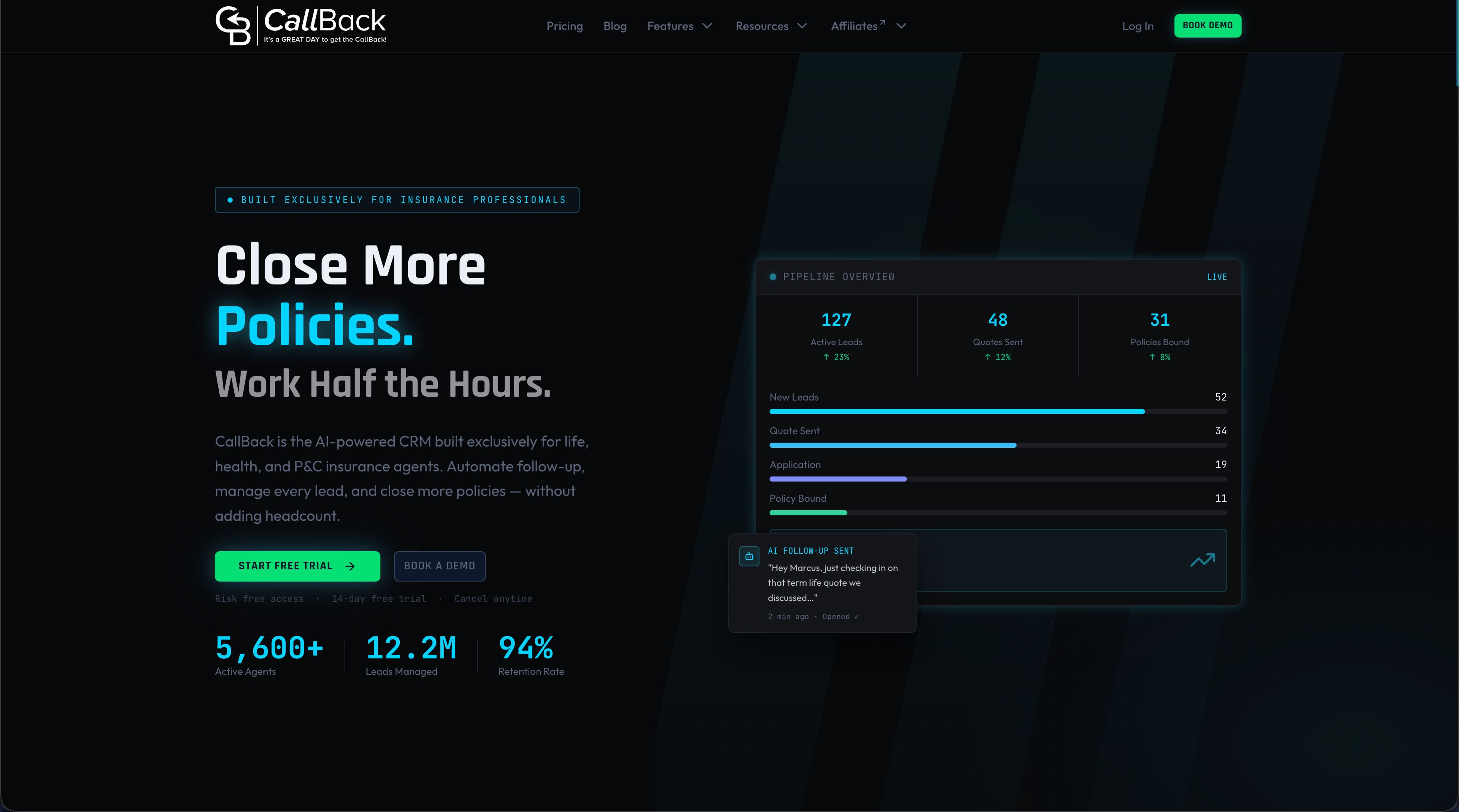
For agents who want to see how AI fits the wider sales process, the CallBack blog covers AI customer engagement strategies for insurance agents.
Our perspective
We build CallBack around one idea: the conversation is only the start of the work. An agent finishes a call and needs three things to happen. The client record is updated, the follow-up is scheduled, and the next message goes out. Every extra app between those steps is a place where a note gets lost.
That is why we think notes belong in the CRM. When an action item lives on the client record, it can drive a workflow. A text, an email or a voicemail can follow without the agent retyping anything. Our AI assistants and automation are designed to take over manual data entry and follow-up so agents spend their time with clients.
We also think review should stay with a person. AI drafts fast. The licensed agent confirms the names, numbers and conditions, because the agent is the one accountable to the client and the carrier.
Insurance has its own pipelines, products and compliance habits: final expense, mortgage protection, Medicare, annuities, indexed universal life. A system built for those workflows needs less setup than a generic tool, and that is what we aim to deliver.
Kyle
FAQ
Is there an AI that can take meeting notes?
Yes. Many tools record or transcribe a call, then produce a summary and action items. Video platforms also include built-in options, such as Google Meet’s note feature on eligible plans. The tool matters less than the routine around it: disclosure, review, and storing the final note on the client record.
Can ChatGPT transcribe meeting notes?
A general chat assistant can summarize a transcript if one is pasted in, but client data raises the stakes. Health information, Social Security numbers and bank details should not go into a public AI tool without an approved policy and the right contract in place. Agents should use tools their agency has reviewed and approved.
How do AI meeting notes work?
The tool records the audio, converts speech to text, labels the speakers, and has a language model write a summary with decisions and action items. The result is then sent to email, chat or a CRM. Each step can introduce errors, so a person should review the output before acting on it.
Do clients have to agree to AI note taking?
Recording consent depends on state law, and a number of states require everyone on the call to agree. For calls between states, the stricter rule is the safe one. Announcing the tool at the start of the call and giving the client the chance to object is a sound habit in every state.
Are AI summaries accurate enough to rely on?
They are a strong first draft, not a final record. Summaries can drop negations, turn maybes into commitments and lose conditional promises. A quick review against the transcript, with the transcript treated as the record, catches most problems.
Sources
- How do AI meeting notetakers work? The pipeline, explained
- Take notes for me in Google Meet
- Microsoft Copilot for Insurance Agencies: Where to Start, PIIAC
- How AI meeting notes work, step by step
- Extract Action Items From a Meeting Transcript With AI, KodeKloud
- Permission to Record: Considerations for AI Meeting Assistants
- AI Meeting Recording Laws by State
- A Complete Guide to Managing Notetaking Bots in Meetings, U.S. Chamber of Commerce
- Protecting client data in the age of AI, InsuranceNewsNet
- AI Governance Policy Template for Insurance Agencies, Integrated AI
- AI meeting notes: tools, privacy and a workflow that works
- Role of AI in Marketing Strategies