

Unified communications integrated with a CRM puts every call, text, email, meeting and attachment into one client timeline, so agents stop repeating questions and start each conversation prepared. For insurers, that timeline has to meet NAIC and GLBA expectations for protecting customer data. We built CallBack for insurance teams.
TL;DR:
- Insurers should require TLS signaling, SRTP voice encryption, role based access, detailed audit logs, deliberate recording retention, and verified E911 location accuracy.
- Connect telephony and CRM through APIs or CTI screen pops, then align identity controls and normalize calls, texts, transcripts, recordings, and outcomes into one timeline.
- Pilot a small producer or claims group after discovery and network testing, then migrate in stages; scrutinize promises to complete complex integrations within three months.
- Set baselines before launch for first response time, claims handling time, first contact resolution, and timeline completeness, then monitor missing logs and routing failures.
Table of Contents
- What does unified communications plus CRM mean for insurance operations?
- Which benefits should insurance teams expect?
- What security and regulatory requirements must insurers plan for?
- How do integrations actually connect?
- What does a realistic implementation roadmap look like?
- How do you measure success after integration?
- Why insurance-specific design shortens time to value
- How CallBack supports your unified communications and CRM goals
- FAQ
- Sources
What does unified communications plus CRM mean for insurance operations?
A unified timeline is channel-agnostic. Calls, SMS, emails, chat transcripts, meeting notes, attachments and outcome tags all land in one client record, no matter which tool created them. Vendors describe this as connecting UC systems such as hosted call centers and voice to CRM records, so calls and their metadata flow into the client’s history.
In daily work, that looks like this:
- Pre-call preparation: the agent sees the last text, the last quote and the open question before dialing.
- Claims intake handoffs: the adjuster inherits the full intake conversation instead of restarting it.
- Policy servicing continuity: a renewal call picks up where the last service call ended.
- Producer handoffs: a reassigned client arrives with context, not a blank record.
UCaaS, the cloud delivery model behind most of these setups, connects voice, messaging, meetings and contact-center channels in a single managed environment.
Which benefits should insurance teams expect?
The gains come from one mechanism: fewer context gaps. When history is complete, follow-up is faster, leads route to the right producer, and outcomes are tracked against the pipeline instead of living in someone’s memory.
- Sales: quicker follow-up and better routing mean fewer leads go cold between touches. Our sales automation workflow guide shows how we set this up.
- Claims and service: intake moves faster, repeat inquiries drop, and priority routing can send a returning client back to the same agent.
- Operations: agents recover time otherwise spent hunting for context, and audit trails get clearer.
- Customer experience: interactions feel consistent, whichever channel the client chooses.
Kin Insurance consolidated multiple tools into one CRM to unify communications in a single timeline, enable priority-based routing and speed response without engineering involvement.
Reporting improves too. Syncing touchpoints and call metrics into CRM records strengthens dashboards and team performance tracking. Omnichannel thinking helps here, and this guide to unifying customer experience across channels explains why consistency across touchpoints drives growth.
What security and regulatory requirements must insurers plan for?
Insurance communications carry personal data, claim history and financial details. CRM systems used by agencies should align with the NAIC Insurance Data Security Model Law and GLBA, with documented safeguards and role-based access control.
Plan for these controls:
- Encrypted signaling and media: TLS for signaling, SRTP for voice media.
- Role-based access control: agents see only the records their job requires.
- Audit trails: detailed logs that feed your SOC or SIEM, so suspicious queries of client data get flagged.
- Recording and location: set call-recording retention deliberately and confirm E-911 location accuracy.
- Secure document exchange: a secure message center gives encrypted exchange with API connectors for existing workflows.
- Identity governance: consider SSO and MFA as part of your security planning.
Pro Tip: Test your audit logs before launch by pulling one client’s full history and confirming every call, text and file access appears.
How do integrations actually connect?
Most insurers combine a few patterns. Here is the order we usually plan them in:
- API-first connections: connect the phone system to the CRM so events can be shared between them.
- CTI and telephony connectors: these link the dialer or phone-system adapter to the client record, so a screen pop shows context as a call arrives.
- Identity integration: one identity provider handles SSO, MFA, role mapping and audit logging across both systems.
- Data normalization: channel metadata, transcripts, recordings and outcomes map into a canonical timeline format, so a text and a call sort side by side.
- Secure message center: sensitive documents move through encrypted exchange instead of regular email attachments.
- Operational readiness: link recordings to their records, confirm E911 routing, and check QoS and WAN readiness for remote adjusters.
What does a realistic implementation roadmap look like?
Run it in phases: discovery and network baseline, a pilot with a small producer or claims group, then staged migration and full rollout. Phased deployment with operational metrics reduces migration risk. Pick pilot workflows carefully; our list of insurance CRM workflows worth automating first is a good starting point.

Treat an unusually short schedule for a complex integration as a red flag. A small core build can move quickly, but connecting to AMS and claims systems usually takes much longer.
Before go-live, confirm:
- Network QoS and failover tests passed
- Identity provider integration works end to end
- Compliance mapping is complete
- Call-recording retention settings are set
- Training and help desk plans are in place
Pro Tip: Capture one early KPI win from the pilot group, such as faster first response, and share it with the rest of the team before full rollout.
How do you measure success after integration?
Pick a few metrics before launch and record a baseline:
- Close rate on pipeline stages
- Time to first response across channels
- Average handling time for claims
- First-contact resolution for service requests
- Contact history completeness, the share of interactions that appear in the timeline
- Agent time saved per day on prep and handoffs
To instrument them, capture channel metadata, link each timeline to pipeline and claims records, and surface exceptions. Build dashboard alerts for missing audit logs, routing failures and unexpected retention changes. Our CRM workflow examples show how we tie these to automation steps.
Why insurance-specific design shortens time to value
Generic tools make you build insurance logic yourself. We take the opposite route: our pipelines are shaped around insurance work, from final expense and Medicare to property and casualty. We focus on message deliverability and use AI automation for follow-up. A simpler setup may help a pilot get started sooner. My view is that the rollouts that stall are the ones that start with the phone system instead of the client record.
— Kyle
How CallBack supports your unified communications and CRM goals
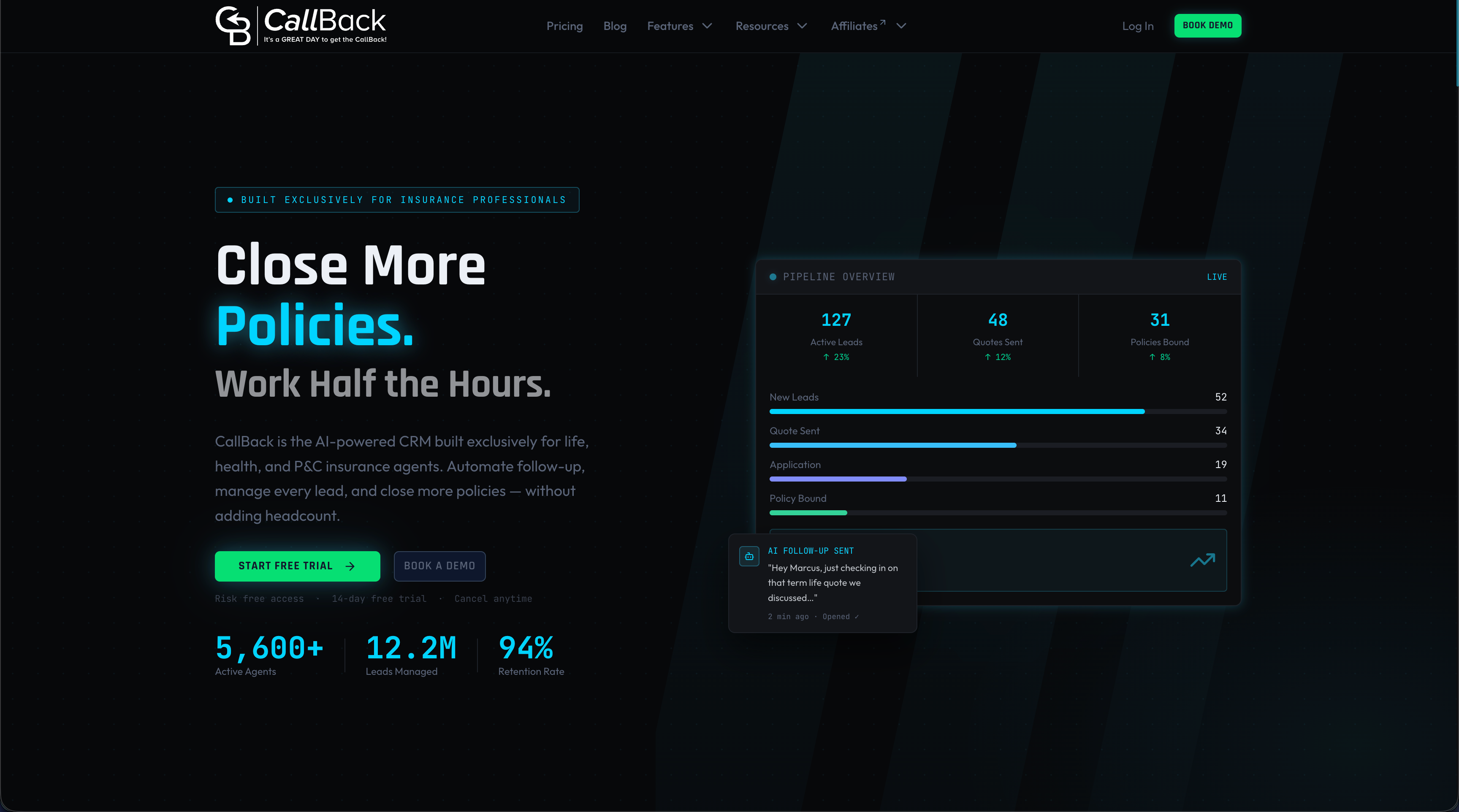
If you want to see this in practice, we centralize client history in one CRM and run outreach by SMS, email and phone. AI-assisted follow-up handles routine touches, and we integrate with dialers, calendars and websites. Browse the features page to see what is included, then start on the Professional plan at 97 USD per month, or choose an Enterprise plan if your agency needs multiple CRM accounts.
FAQ
What CRM do insurance agents use?
Agents use CRMs built around insurance pipelines, policy tracking and follow-up automation. We built CallBack for this work, covering lead management, SMS and email outreach, and workflow automation in one place.
What is CRM in insurance companies?
It is software that keeps client records, interactions, quotes and policy activity in one system. Insurers align it with the NAIC Insurance Data Security Model Law and GLBA so personal and claim data stays protected.
How long does an insurance CRM and UC integration take?
It depends on scope. A small core build can be fast, while integrations with AMS and claims systems usually take much longer. A plan promising complex integration in under three months deserves a closer look.
Why do insurers add unified communications to a CRM?
It keeps policyholder context intact as conversations move among agents, adjusters and service teams. UCaaS preserves that context when paired with compliance and identity controls.
Sources
- Content
- Apex Technology Guides Newark Insurers to Secure UCaaS | TMC Insight
- Modernizing Your Communications
- Kin Insurance Case Study
- 5 Benefits of Integrating Your UCaaS Platform with CRM …