

Native CRM integration is the best way to connect a website form to an insurance CRM, because it routes leads in real time with the least ongoing maintenance. A webhook or a middleware tool like Zapier or Make is the right backup when native integration does not support the fields you need. CSV import should stay reserved for migrations, recovery, or situations where real-time delivery is not possible.
TL;DR:
- Native integration is preferred for real-time lead routing with minimal maintenance, but it may limit custom fields or logic support.
- Webhook and middleware tools handle complex fields and multi-system data transfer but require retry logic to avoid duplicate leads.
- CSV import remains a fallback method for bulk uploads or recovery, not suitable for live, ongoing data capture.
- Accurate form fields and separate consent timestamps are critical to ensure valid lead data and compliance with regulations like FTC and CMS.
- Automated CRM workflows should prioritize fast lead assignment, scoring, and de-duplication using external IDs within a short time window for optimal follow-up.
Table of Contents
- Integration methods: native, webhook, or CSV import
- Form design for insurance: fields, consent, and mapping to CRM records
- Routing and automation inside the CRM
- Testing, monitoring, and fallbacks for production reliability
- Compliance and consent essentials for insurance lead operations
- Operations perspective: common pitfalls and a phased rollout
- How CallBack CRM brings these integration patterns together
- Sources
- FAQ
Integration methods: native, webhook, or CSV import
Three integration paths cover almost every insurance agency’s needs: native integration, webhook or middleware, and CSV import. Each one fits a different situation, and the right choice depends on speed, reliability, and how many fields the form needs to carry.
Native integration connects the form builder directly to the CRM using a built-in connector. It delivers leads in real time and needs the least upkeep once it is set up, which is why it is the first option to check. The tradeoff is flexibility: native connectors sometimes cap the number of custom fields or lack support for conditional logic.
Webhook and middleware setups route form submissions through a platform such as Zapier or Make before they land in the CRM. This method handles more complex field mapping and can push data to several systems at once. The added layer means more potential failure points, so the setup needs retry logic and idempotency keys to avoid duplicate records, a method one WordPress lead-operations plugin documents as a way to prevent repeated submissions from creating repeated leads.
CSV import is a fallback, not a strategy. It works for bulk migrations, for recovering from an outage, or for agencies still waiting on API credentials from a carrier or vendor system. It is never real-time, and it depends on someone running the import consistently.
A short marketing automation checklist helps narrow the choice:
- Confirm whether your CRM and form builder have a native connector that supports every field you plan to collect.
- If not, test whether a webhook or middleware tool can map the missing fields without excessive custom coding.
- Reserve CSV import for situations where API access is not yet available or where you need a one-time data transfer.
Form design for insurance: fields, consent, and mapping to CRM records
A website form only helps the CRM when it captures the right fields in a structure the CRM can use immediately. Priority fields matter because they drive routing and qualification the moment a lead arrives.
- Contact details (name, phone, email, ZIP code): ZIP code in particular supports geographic assignment rules.
- Product interest (auto, home, life, Medicare, and so on): this field determines which pipeline or producer receives the lead.
- Household or policy context (current carrier, renewal date, number of drivers or dependents): this supports lead scoring and qualification.
- Preferred contact method and time: this reduces wasted outreach attempts.
- Consent fields, captured separately for marketing contact and service-related contact, each with its own timestamp.
Consent should never be a single checkbox covering every purpose. Separate marketing consent from service consent, and store the timestamp and the exact language shown to the consumer at the time of submission. This record matters if a consumer later disputes contact or revokes permission.
Avoid collecting Social Security numbers, driver’s license numbers, or other sensitive identifiers directly through a lead form. When a document upload is genuinely necessary, use a secure upload field rather than an open text box or email attachment.
Mapping tips that prevent downstream cleanup: use canonical field names across every form so “phone” is always “phone,” assign an external_id to each submission for deduplication, and, for agencies working with ACORD-based carrier systems, map form fields to the corresponding ACORD data points before the first lead ever arrives.
Pro Tip: Build one master field-naming sheet before building your second form, not after.
Routing and automation inside the CRM
Once a lead lands in the CRM, automation should turn it into action within minutes, not after someone checks a queue. Assignment rules typically use ZIP code, product interest, round-robin distribution, or current producer capacity to decide who gets the lead.
Lead scoring adds priority on top of assignment. Signals worth weighting include renewal date proximity, household size, and whether the consumer selected a high-intent product like Medicare or life insurance.
A typical automation flow looks like this:
- A new lead triggers a task for the assigned producer within minutes of submission.
- An automated SMS or email confirms receipt and sets expectations for a callback.
- A quote workflow opens automatically when product interest and consent are both present.
- Any uploaded documents attach to the lead record rather than sitting in a separate inbox.
Duplicate handling deserves its own rule set. Use an external_id tied to the original submission and an upsert pattern so a resubmitted form updates the existing record instead of creating a second one. This lead generation workflow tutorial walks through how structured form data can trigger categorization and follow-up without manual sorting.
Pro Tip: Set your duplicate-detection window to match your average follow-up time, not a default 24 hours.
Testing, monitoring, and fallbacks for production reliability
An integration that works in testing can still fail quietly in production, so a short validation routine before and after launch matters. Run end-to-end sandbox tests for every path you plan to use, submitting test leads through the actual form and confirming they arrive with every field intact.
For webhook and middleware setups, build in retries with idempotency keys so a failed delivery attempt does not create a duplicate lead on retry. A dead-letter queue, where failed submissions land for manual review, prevents silent data loss.
Monitoring should flag two specific failure types: field-mapping errors, where a value lands in the wrong CRM field, and delivery failures, where a submission never arrives at all. An alert on either one should reach a real person, not just a log file.
For CSV import, run a dry-run against a test environment before loading production data, and keep a validation template that checks required fields, correct date formats, and consistent phone number formatting before the real import runs.
- Test each integration path with a real submission, not just a sample payload.
- Confirm retry and idempotency behavior by intentionally triggering a failed delivery.
- Review a CSV dry-run against your validation template before any production import.
Compliance and consent essentials for insurance lead operations
Lead capture forms sit inside an enforcement environment that takes consent seriously. The FTC’s warning letters to healthcare plan marketers and lead generators describe deceptive lead-generation practices and Telemarketing Sales Rule obligations that affect how many organizations can contact a consumer from a single form submission.
The FTC has issued formal warnings to lead generators over practices tied to how consumer contact data gets shared and used, underscoring why consent language needs to be specific rather than generic.
Separately, the CMS model consent form for Marketplace agents, brokers, and web-brokers documents how to record consumer consent, purpose limitation, and confirmation that the consumer reviewed their application information. Purpose limitation matters because a consumer who consents to one type of contact has not consented to every type.
Practical controls include separate consent checkboxes for marketing versus service communication, a timestamp on every consent record, and a visible way for a consumer to revoke consent later. Store and transmit lead data over encrypted connections, and limit who inside the agency can export raw lead data.

Operations perspective: common pitfalls and a phased rollout
A recurring problem in agency tech stacks is the e-form that captures a lead beautifully but never back-populates the canonical CRM record, leaving two versions of the same client in two systems. One integration case study describes building a canonical data model specifically to stop this kind of drift.
The safer rollout sequence starts with a CSV lane to ship value immediately, then adds the API or webhook lane once credentials and testing are in place. Agencies that skip straight to a full API build often wait weeks on vendor access before capturing a single lead.
— Kyle
How CallBack CRM brings these integration patterns together
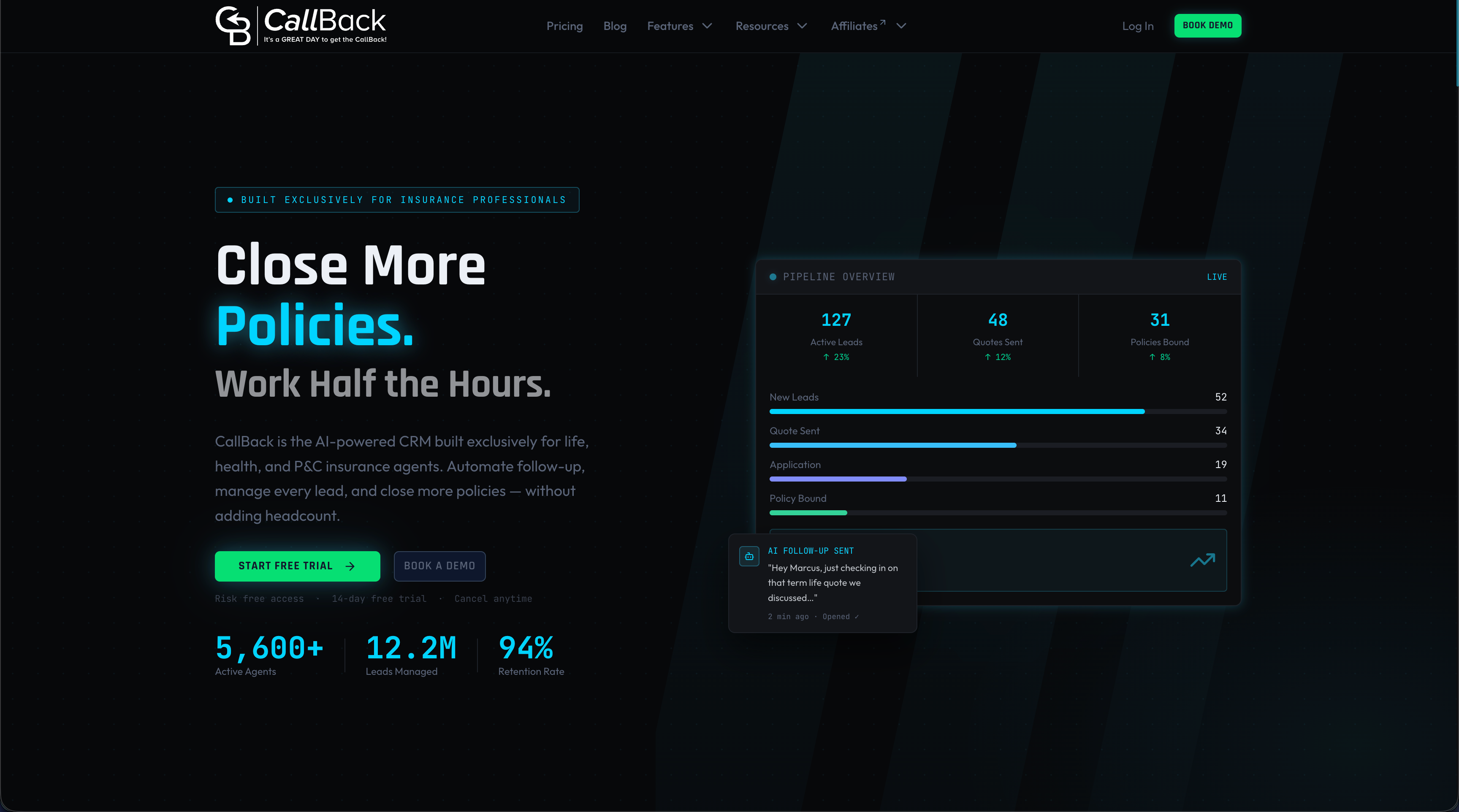
CallBack CRM pairs its funnel and website builder with webhook intake, so a form submission can route straight into a pipeline without a separate middleware subscription. Lead scoring runs through the platform’s AI assistants, and data moves through secure Google Cloud hosting rather than an unencrypted export file.
A practical trial path: build a test form inside the funnel builder, verify that assignment rules route a sample lead to the right producer, then turn on the automation workflow for follow-up messages. The Professional plan runs USD 97 per month and gives one agency a full environment to test this sequence before committing further. Agencies managing multiple producers can review Enterprise options with several full CRM accounts available.
Sources
- Site2CRM – AI lead operations (WordPress plugin)
- Healthcare plan marketers and lead generators warning letters (FTC)
- CMS model consent form for Marketplace agents, brokers, web-brokers, and agencies
- AMS360 ACORD forms and remote access: how to automate | Rex Automaton
FAQ
What is a CRM for insurance?
A CRM for insurance is software that stores client and lead records, tracks policy and renewal details, and automates follow-up tasks for agents and agencies. It centralizes contact history so a producer can see every interaction with a lead or client in one record rather than across separate spreadsheets and inboxes.
What are CRM forms?
CRM forms are web forms built to capture lead or client information directly into a CRM database, rather than sending an email that someone has to re-enter manually. They typically include fields for contact details, product interest, and consent, mapped to specific fields in the CRM record.
What is the best CRM for insurance?
The best CRM for insurance depends on agency size and workflow needs, since general-purpose CRMs and insurance-specific platforms both have a place. CallBack CRM is built around insurance sales workflows, with automated follow-up and pipeline tools designed for agents rather than adapted from a generic sales template.
How much does AgencyBloc AMS+ cost?
Pricing for AgencyBloc AMS+ is not publicly listed and is not part of CallBack CRM’s published offerings. Agencies comparing options can request a quote directly from the vendor or review CallBack CRM’s published plans for a transparent price comparison.