

Insurance CRM automation centralizes policyholder data and automates insurance-specific workflows, including renewals, endorsements, and FNOL triage, to cut manual work and improve retention. It does this by connecting your book of business to date-driven triggers instead of relying on an agent remembering to check a spreadsheet. The single most useful move for any agency evaluating this technology is to pick a CRM that is policy-aware, connects to your AMS and carrier portals, and supports agentic AI alongside workflow orchestration. CallBack CRM fits that description and works well as a pilot option for agencies testing automation on a defined slice of their book.
Three automation wins tend to show ROI fastest:
- Renewal automation: sequences that trigger outreach and remarketing packages in advance without a producer lifting a finger.
- FNOL and claims triage: incoming loss reports get classified and routed automatically, so simple claims move without waiting in a queue.
- AMS integration: policy data flows between your CRM and agency management system instead of getting retyped twice.
Key Takeaways
Insurance CRM automation works best when agencies pair policy-aware software with a narrow, renewal-focused pilot before expanding to claims and underwriting workflows.
| Point | Details |
|---|---|
| Choose insurance-aware software | Pick a CRM that models policies natively, parses ACORD forms, and integrates with your AMS. |
| Pilot the renewal pipeline first | Renewals are predictable and low-risk, making them the fastest path to measurable ROI. |
| Track the right KPIs | Monitor time-to-bind, renewal retention, touchless claim rate, and lead response time. |
| Watch for vendor red flags | Avoid platforms that require AMS replatforming or offer no audit trail for automated actions. |
| Test with CallBack CRM | CallBack CRM offers policy-aware fields, renewal automation, and a scoped pilot for agencies ready to test outcomes on a defined book segment. |
Table of Contents
- What Is Insurance CRM Automation, Exactly?
- What Core Automation Features Should Insurance Buyers Expect?
- How Does Automation Handle Policy and Claims Data Across Systems?
- What Business Benefits and KPIs Does Automation Actually Improve?
- How Do You Implement CRM Automation Without Disrupting Operations?
- What Questions Should You Ask CRM Vendors Before Buying?
- What Do Real Insurance Automation Workflows Look Like?
- What Security and Compliance Controls Should You Require?
- How Does CallBack CRM Deliver Insurance CRM Automation?
- Why Agencies That Adopt Agentic AI Early Tend to Win
- Try Insurance CRM Automation With a Focused CallBack CRM Pilot
- Sources
What Is Insurance CRM Automation, Exactly?
A CRM earns the “insurance automation” label when it models policies, not just contacts. Generic sales CRMs track a lead through a pipeline and stop there. An insurance-aware system understands that a client record has a policy number, an effective date, an expiration date, and a renewal clock that starts ticking the moment the policy binds.
That distinction shows up in how the software behaves. A policy-aware CRM triggers a renewal sequence automatically several weeks before expiration. It flags an endorsement request and routes it to the right underwriter. It can parse an ACORD form and pre-fill a rater or AMS record instead of asking someone to type client data into three systems. Generic automation tools commonly stumble on these document- and domain-specific tasks, because they were never built to read a loss run or reconcile a commission statement.
Agencies that treat the CRM as the single system of record for the entire client lifecycle, from lead to renewal to claim, see less silent attrition from missed renewal alerts than agencies that split that data across a spreadsheet, an AMS, and a separate marketing tool.
The core data elements an insurance CRM has to handle without breaking:
- Policy numbers and carrier identifiers
- Effective and expiration dates for every line of coverage
- ACORD forms and structured intake documents
- Loss runs and claims history
- Commission schedules tied to each policy
If a CRM can’t touch all five without a workaround, it’s a general-purpose sales tool wearing an insurance costume.
What Core Automation Features Should Insurance Buyers Expect?
The feature list that separates a real insurance CRM automation platform from a repurposed sales tool is longer than most vendors admit during a demo. Renewal automation sits at the top, but it’s not the only piece that matters.
Lead capture and routing needs to happen the moment a prospect fills out a quote form, not the next morning when someone checks email. Opportunity tracking should reflect an insurance sales cycle, which moves differently than a software sale. Marketing automation has to handle drip campaigns segmented by line of business. Endorsement routing needs to get a change request to the right person without a phone call. Claims and FNOL triage should classify severity before a human ever opens the file. And commission reconciliation, the part almost nobody talks about at trade shows, has to catch discrepancies between what a carrier statement says and what the agency actually earned.
| Feature | Primary owner | What “automated” looks like |
|---|---|---|
| Renewal automation | Sales/service | Renewal sequences trigger outreach and open remarketing packages in the AMS |
| Lead capture and routing | Sales | New quote requests auto-assign based on line of business or territory |
| Endorsement routing | Service/underwriting | Change requests classify and route without manual triage |
| FNOL/claims triage | Claims | Inbound loss reports sort by severity and route simple payments automatically |
| Commission reconciliation | Finance | Statement data ingests and flags variances against expected commission |
| Marketing automation | Sales/marketing | Segmented campaigns fire based on policy type, renewal date, or life event |
Each of these maps to a different department, which is exactly why insurance CRM automation projects fail when only the sales team gets a say. A renewal sequence that ignores underwriting rules creates more rework than it saves. A commission reconciliation feature that finance never tests goes unused within a quarter.
Here’s a concrete example of expected behavior: a policy hits 90 days from expiration, the CRM automatically opens a remarketing workflow, pulls the current policy data into a comparison template, and queues a producer task with the client’s contact preferences already attached. No spreadsheet. No sticky note on a monitor.
How Does Automation Handle Policy and Claims Data Across Systems?
Automation is only as reliable as the integrations underneath it. An insurance CRM that can’t talk to your agency management system, carrier portals, and document management system is a nice dashboard sitting on top of manual work everyone still has to do by hand.
The integration targets that matter most for most agencies:
- Agency management systems (AMS) for policy records and billing
- Carrier portals for quoting, binding, and policy servicing
- Claims systems for FNOL intake and status updates
- Document management systems (DMS) for policy documents and loss runs
- E-sign tools for applications and endorsement authorizations
- Telephony and calendar systems for call logging and scheduling
- Marketing channels (email, SMS) for client communication
A typical data flow looks like this: a broker submission arrives by email, the CRM parses the ACORD form attached to it, pre-fills the relevant fields in the rater or AMS, and routes anything that doesn’t match a clean pattern to a human for review. That last step matters more than vendors like to admit. Automation should flag exceptions, not bury them.
| Integration point | Data exchanged | Risk if missing |
|---|---|---|
| AMS | Policy numbers, dates, billing status | Duplicate data entry, stale renewal dates |
| Carrier portal | Quotes, binders, policy changes | Manual rekeying, quote delays |
| Claims system | FNOL status, adjuster notes | Slower claim resolution, client frustration |
| DMS | Policy PDFs, loss runs, ACORD forms | No audit trail, compliance gaps |
| E-sign | Signed applications, endorsements | Bottlenecks on time-sensitive changes |
Before signing anything, get a straight answer on field mapping strategy and whether the vendor uses direct API connections or robotic automation that mimics screen clicks. Robotic automation is often faster to stand up, but it’s also more fragile when a carrier portal changes its layout without warning. Ask about credentials too. Automation running under a shared login with broad access is a liability during any audit, and least-privilege access should be table stakes, not an upsell.
What Business Benefits and KPIs Does Automation Actually Improve?
The business case for insurance CRM automation isn’t abstract. It shows up in specific numbers agencies can track month over month. Time-to-bind drops when quote data flows automatically instead of getting rekeyed. Renewal retention improves when a client never has to wonder if their policy is about to lapse because a producer forgot to follow up.
The KPIs worth tracking on a monthly dashboard:
- Time-to-bind: how long from initial quote request to bound policy
- Renewal retention rate: proportion of policies that renew without lapse
- Touchless claim rate: percentage of claims resolved with no manual intervention
- Average handle time: how long a service request takes from open to close
- Lead response time: minutes (not hours) between inquiry and first contact
- Revenue per producer: total book revenue divided by producer headcount
Pro Tip: Track touchless claim rate separately from overall claims volume. A rising touchless rate on simple claims frees adjusters to spend more time on complex files, which usually shows up as better loss ratios before it shows up as a headline productivity number.
A CRM’s highest return on investment often comes from post-sale automation, meaning renewals, endorsements, and claims servicing, rather than from lead capture alone. Integrating policy data directly into the CRM cuts the context switching that eats a producer’s day: checking the AMS for a renewal date, checking email for the last client message, checking a spreadsheet for commission status. Every one of those checks is a small tax on productivity, and it adds up across a book of a few hundred policies.
How Do You Implement CRM Automation Without Disrupting Operations?
Rolling out insurance CRM automation works best as a phased project, not a weekend migration. Agencies that try to flip every workflow on at once usually end up rolling half of it back within a month because nobody had time to learn the new system while still servicing existing clients.
- Discovery and data audit: Inventory your current data, identify duplicate or stale records, and decide what actually needs to migrate versus what gets archived.
- Configuration and mapping (weeks 3 to 6): Map fields between your old system and the new CRM, set up policy types, and configure user permissions.
- Workflow building and pilot (weeks 7 to 10): Build your first one or two automated workflows (renewal sequences are the standard starting point) and run them against a small book segment.
- Full rollout and training: Expand to the full book, train every producer and service rep, and start tracking adoption metrics weekly.
The checklist that keeps this timeline honest includes data clean-up before migration (garbage in, garbage out applies here more than almost anywhere else), a clear field mapping document, a defined pilot book segment, SLA targets for each automated workflow, an E&O review of any workflow that touches coverage decisions, structured user training, and an adoption tracking mechanism that shows who’s actually using the new tools.
Pro Tip: Tie automation usage to compensation where you can. Agencies that link a small piece of producer bonus structure to CRM adoption see faster uptake than agencies that just mandate a policy and hope. Mobile access matters here too. A mobile CRM app that lets agents log activity from a client’s driveway removes a friction point that kills adoption faster than almost anything else.

Starting with the renewal pipeline instead of trying to automate everything at once tends to produce the fastest visible ROI, since renewals are predictable, date-driven, and touch nearly every policyholder eventually.
What Questions Should You Ask CRM Vendors Before Buying?
Every vendor demo looks polished. The questions that separate a genuinely insurance-aware platform from a relabeled sales CRM are the ones that force a vendor to show, not tell.
Ask these during any serious evaluation:
- How does your system model policies and renewal dates, and can you show me a live example?
- Can you parse ACORD forms natively, or does that require a third-party add-on?
- Which AMS platforms and carrier portals do you integrate with out of the box?
- How does your audit trail work when an automation makes a change to a client record?
- What are your data residency and deployment options?
The red flags that should end a conversation quickly:
- The vendor can’t produce a sample policy data model on the spot.
- Implementation requires replatforming your existing AMS.
- There’s no human-in-the-loop checkpoint anywhere in the automated workflow.
- The system provides no audit log for what an automation actually did and when.
On pricing, look past the sticker price on the subscription tier. Ask directly about usage-based costs for SMS and AI features, since those get billed separately from most base plans. Ask about implementation fees, what happens when you exceed included message or automation volumes, and get a real total cost of ownership estimate you can compare against expected headcount savings. A platform that looks cheap on the homepage can get expensive fast once SMS and AI usage scale with your book.
What Do Real Insurance Automation Workflows Look Like?
Reading a feature list is one thing. Seeing how a workflow actually runs end to end is what convinces most agency owners a platform will work for their team.
Renewal workflow. Trigger: 90 days before policy expiration. Required integrations: AMS and carrier portal. Automated steps: the CRM pulls current policy data, pre-fills a remarketing comparison, and sends the first client touchpoint. Human checkpoint: the producer reviews the remarketing package before it goes out and makes the final call on any coverage changes. Expected outcome: renewal outreach starts weeks earlier than a manual process typically allows.
FNOL triage. Trigger: inbound claim notification by email or portal. Required integrations: claims system and DMS. Automated steps: the system classifies claim type and severity, initiates a simple payment for straightforward claims, and routes anything complex to an adjuster. Human checkpoint: any claim above a defined dollar threshold or involving a coverage dispute gets human review before payment. Expected outcome: routine claims close faster, freeing adjuster time for files that actually need judgment.
Endorsement processing. Trigger: client requests a policy change. Required integrations: AMS and e-sign. Automated steps: the request gets classified by type, the AMS record updates, and the underwriter receives an alert if the change affects rating. Human checkpoint: underwriter sign-off on any endorsement that changes premium or coverage limits. Expected outcome: fewer endorsement requests sitting in an inbox for a week.
Commission reconciliation. Trigger: monthly carrier statement arrives. Required integrations: AMS and accounting system. Automated steps: statement data ingests and compares against expected commission by policy. Human checkpoint: finance reviews flagged exceptions before closing the books. Expected outcome: discrepancies surface in days instead of during an annual audit.
| Workflow | Expected time savings | Touchless rate potential | Primary owner |
|---|---|---|---|
| Renewal sequence | Hours per week per producer | High for standard renewals | Producer/service |
| FNOL triage | Faster claim open-to-close | High for simple claims | Claims |
| Endorsement processing | Days off turnaround | Moderate | Service/underwriting |
| Commission reconciliation | Days off monthly close | Moderate | Finance |
What Security and Compliance Controls Should You Require?
Automation that touches client data and coverage decisions needs guardrails, or it becomes a liability instead of an asset. This is the section most agencies skip during a demo and regret skipping during their first E&O review.
The controls to insist on before rolling anything into production:
- Human-in-the-loop checkpoints at every judgment point, especially underwriting and claims decisions.
- Decision logs that record what the automation did, when, and based on what data.
- Audit-ready data lineage so you can trace a record back to its source.
- PII filtering so sensitive data doesn’t leak into logs or third-party AI training sets.
- Role-based access control tied to actual job function, not a blanket admin login.
- Encryption in transit and at rest for all client and policy data.
Where underwriting or claims judgment is required, the automation should present structured evidence and recommend an action rather than auto-executing a risky change. That distinction, recommend versus execute, is what keeps a smart workflow from becoming an uncontrolled one.
| Requirement | Ask the vendor | Why it matters |
|---|---|---|
| SOC 2 Type II | Can you provide a current report? | Confirms independently audited security controls |
| Data residency | Where is data physically hosted? | Affects compliance with state and carrier requirements |
| Model data usage | Is client data used to train shared AI models? | Prevents your book data from training a competitor’s model |
| Audit log access | Can we export full run history? | Needed for E&O and DOI review |
Beyond certifications, get specific contract language on audit log access, data retention timelines, a clear no-data-for-training clause for any AI vendor, and defined SLAs for run-time reliability. A platform trial’s terms should spell out exactly what happens to your data if you cancel, and that’s worth reading before you sign anything, not after.
How Does CallBack CRM Deliver Insurance CRM Automation?
CallBack CRM is built around the same policy-aware framework this whole guide describes: renewal automation, AMS-connected workflows, and agentic AI features layered on top of a system agents actually want to open every day.
The feature set that matters most for agencies evaluating a pilot:
- Policy-aware fields and pipelines that track renewal dates and coverage details natively.
- SMS and email automation for renewal cadences and client outreach without manual sends.
- Funnel and website builders for capturing and qualifying new leads before they ever reach a producer.
- AI assistants that help draft outreach and flag high-value prospects.
- Integrations with dialers, calendars, and third-party tools your team already uses.
- Reporting and analytics dashboards for tracking the KPIs covered earlier in this guide.
- Secure hosting on Google Cloud with mobile and desktop app access for field use.
A sensible pilot runs in five steps: pick a defined book segment (a single line of business works well), map your policy fields into the platform, build one renewal workflow and one FNOL-style triage workflow, run the pilot for 30 to 60 days, and measure against the KPIs already on your dashboard.
Pro Tip: Resist the urge to automate your entire book on day one. A focused pilot on 50 to 100 policies gives you clean before-and-after data. Watch for fewer manual entries per renewal, faster time from renewal trigger to first client outreach, and a measurable jump in remarketing packages actually delivered on time.
Related resources worth reviewing before a pilot: a lead generation workflow tutorial that walks through capture and qualification automations, and a guide on automating lead generation for insurance agents that covers nurturing sequences complementary to the renewal workflows described here.
Why Agencies That Adopt Agentic AI Early Tend to Win
Agentic AI paired with robotic process automation doesn’t replace the judgment calls that make an agency valuable. It removes the tactical grind sitting on top of that judgment. An underwriter shouldn’t spend an hour rekeying loss run data before they can even start assessing risk. An adjuster shouldn’t lose a morning sorting simple claims from complex ones by hand. Automation earns its keep by clearing that work away, not by making the harder decisions itself.
The mistake I see agencies make is treating automation as an all-or-nothing bet. They either avoid it entirely because a vendor demo felt too slick, or they try to automate every workflow simultaneously and burn out their staff learning five new systems in a month. Neither approach works. The agencies that actually see results start narrow, on renewals specifically, because renewals are predictable and low-risk to automate. They build confidence with one workflow before touching claims or underwriting, where the cost of a bad automated decision is much higher.
There’s also a cultural piece that gets underweighted in most vendor pitches. Adoption fails when producers feel automation was imposed on them rather than built with their input. The agencies that succeed loop in a couple of frontline producers during the pilot phase, let them flag what feels clunky, and adjust before full rollout. That’s not a technology problem. It’s a change management problem wearing a technology costume, and no amount of agentic AI fixes it if leadership skips that step.
Try Insurance CRM Automation With a Focused CallBack CRM Pilot
Instead of committing to a full platform swap before you know how automation performs on your own book, CallBack CRM offers a practical way to test renewal automation and one custom workflow on a defined segment before scaling further.
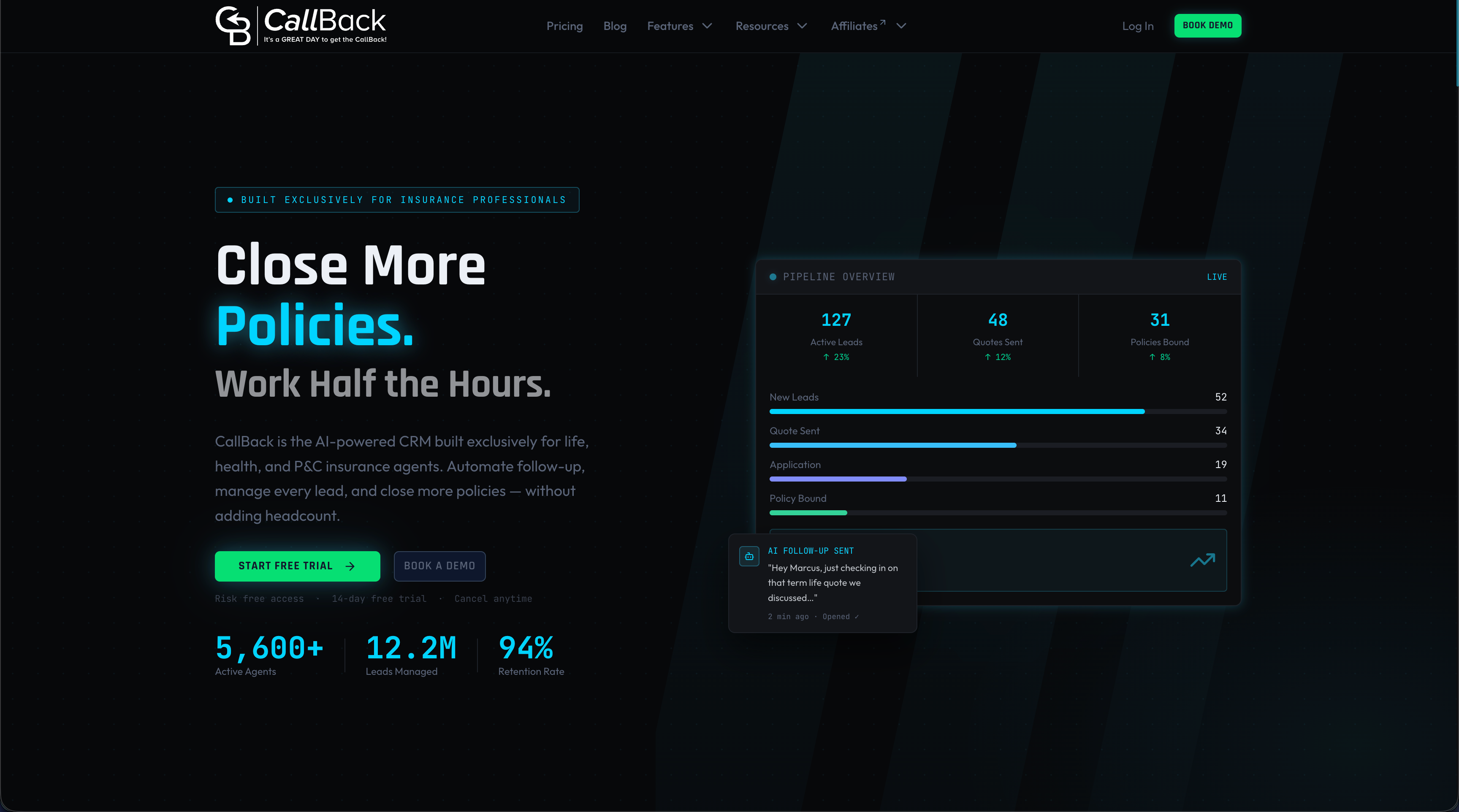
The pilot focuses on your renewal pipeline plus one additional custom workflow you choose, and it includes configuration support to map your existing policy fields, an integration check against your current AMS and carrier tools, and a KPI tracking template so you’re measuring the right numbers from day one instead of guessing after the fact. A typical pilot runs 30 to 60 days, tracked against time-to-bind, renewal outreach speed, and touchless rates on whatever second workflow you select. If SMS-based renewal reminders are part of your strategy, CallBack’s SMS marketing features are worth reviewing alongside the CRM setup.
To get started, look at CallBack’s website and funnel builder tools, which include current trial and pricing details, and set up a pilot scoped to a single book segment. Sign up for a trial and configure your first renewal workflow this week.
Sources
Agencies wanting to go deeper on specific integration patterns or automation mechanics can start with these:
- Insurance automation with agentic AI and RPA | UiPath