

TL;DR:
- Insurance lead types vary by exclusivity, freshness, and source, directly affecting contact and conversion rates. Exclusive leads cost more but yield better results, while aged leads require multi-touch follow-up strategies. Managing different lead streams with proper segmentation and verification improves agency profitability and compliance.
Types of insurance leads are defined as categorized groups of potential customers that agents target based on how leads are sold, their age, and the prospect’s level of interest. The industry standard term for this classification system is “lead type taxonomy,” and it directly determines your contact rates, conversion rates, and cost per acquisition. Agents who treat all leads as interchangeable waste budget and burn out their sales teams. Understanding the distinctions between exclusive, shared, aged, live transfer, and referral leads is the single most important factor in building a profitable insurance lead generation strategy in 2026.
1. What are the types of insurance leads by exclusivity?
Exclusivity is the most consequential variable in insurance lead generation. Shared leads are sold simultaneously to 3–8 agents at once, meaning you are competing the moment the lead enters your pipeline. Exclusive leads go to one agent only, eliminating that competition entirely. Semi-exclusive leads fall in between, with distribution limited to a defined number of agents within a specific time window.

The performance gap between these models is significant. Contact-to-quote rates average 8–14% for shared leads, 15–22% for semi-exclusive leads, and 25–35% for exclusive leads. That gap reflects the reality that a prospect who has already spoken with three other agents is far less likely to engage with a fourth.
Pricing follows the same logic. Exclusive leads cost more upfront, but the ROI calculation often favors them when you factor in agent time and close rates. Shared leads are cheaper per unit but require a faster, more aggressive follow-up system to compete.
- Exclusive leads: Highest cost, lowest competition, best for agents with strong closing skills
- Shared leads: Lowest cost, highest competition, best for high-volume agencies with fast dialing capacity
- Semi-exclusive leads: Middle ground, useful for testing new verticals without full exclusive pricing
Pro Tip: Ask every vendor exactly how many agents receive each lead and whether the exclusivity window has a defined end date. Fake exclusivity claims are common, and a lead sold as “exclusive” may become shared after 24 or 48 hours.
2. How lead freshness affects contact rates and conversions
Lead freshness refers to how recently a prospect submitted their information. Real-time leads, also called instant leads, are delivered to agents within seconds or minutes of form submission. Aged leads are originally generated real-time leads resold after 30, 60, or 90 days at discounted prices following initial non-contact or non-conversion.
The contact rate difference between fresh and aged leads is substantial. A prospect who filled out a Medicare supplement form this morning is in a very different mental state than one who did so 60 days ago. Aged leads require persistent, multi-touch outreach across phone, email, and SMS to generate results.
| Lead Type | Typical Age | Relative Price | Best Use Case |
|---|---|---|---|
| Real-time leads | Under 5 minutes | Highest | Medicare, life, auto |
| Aged leads (30 days) | 30 days | Moderate discount | Final expense, Medicare |
| Aged leads (60–90 days) | 60–90 days | Deepest discount | High-volume campaigns |
Aged leads work best in final expense and Medicare campaigns where prospects often need multiple touchpoints before committing. They are a poor fit for term life leads, where intent fades quickly.
Pro Tip: Build a dedicated aged lead sequence in your CRM with at least 8–12 touches spread over 30 days. Single-call attempts on aged leads waste the discount advantage entirely.
3. Why live transfer and referral leads convert at the highest rates
Live transfer leads are warm, pre-qualified prospects transferred directly to an agent by phone after a call center confirms basic eligibility and interest. The prospect is on the line and ready to talk. That pre-qualification step is what separates live transfers from every other lead type in terms of immediate conversion potential.
Pricing reflects that quality. Live transfer costs in 2026 range from $40–$90 per lead in the Medicare vertical and $80–$180 in the life insurance vertical, representing a 30–60% premium over shared internet leads. That premium is justified when your close rate on live transfers significantly outpaces other lead types.
Referral leads are the gold standard. A referral comes from an existing client who recommends your services to someone in their network. No paid media, no vendor, no competition. The trust transfer from the referring client dramatically shortens the sales cycle.
- Live transfers: High cost, high intent, requires agents available to take calls immediately
- Referral leads: Lowest cost per acquisition, highest trust, requires a systematic ask process
- Compliance note: TCPA regulations require express written consent for marketing calls, making documentation critical for live transfer vendors
Live transfers carry operational risk if exclusivity is not guaranteed in writing. Assume a live transfer is being routed to multiple agents unless your contract explicitly states otherwise.
4. How prospect warmth defines your lead nurturing strategy
Prospect warmth is a classification system that describes how close a potential buyer is to making a purchase decision. Cold prospects are unaware of their need or your product. Warm prospects are aware and researching. Hot prospects are ready to buy and actively comparing options.
Each warmth level demands a different approach:
- Cold prospects respond to awareness content: educational blog posts, social media ads, and SEO-driven landing pages. The goal is to move them to warm, not to close immediately.
- Warm prospects respond to comparison content and direct outreach: email sequences, retargeting ads, and webinars. This is where most lead generation for insurance agents focuses its effort.
- Hot prospects respond to speed and specificity: a live transfer, a same-day callback, or a referral introduction. Delay at this stage costs you the sale.
Warmth maps directly onto lead type. Aged leads are typically cold or warm by the time you contact them. Real-time internet leads are warm. Live transfers and referrals are hot. Matching your nurturing tactic to the warmth level is what separates agents who convert at 20% from those who convert at 8%.
Segmenting your pipeline by warmth also improves KPI accuracy. When you blend hot referrals with cold aged leads in a single funnel, your average conversion rate tells you nothing useful about either group.
5. Comparing insurance lead types: cost, quality, and best use cases
Choosing the right mix of lead types depends on your agency size, budget, and the insurance products you sell. No single lead type is optimal for every situation. The table below summarizes the key variables agents use to evaluate their options.
| Lead Type | Relative Cost | Contact-to-Quote Rate | Best Product Lines |
|---|---|---|---|
| Exclusive internet | High | 25–35% | Life, Medicare, auto |
| Shared internet | Low | 8–14% | Auto, home, health |
| Semi-exclusive | Medium | 15–22% | Final expense, Medicare |
| Live transfer | Very high | 40%+ | Medicare, final expense |
| Aged leads | Very low | Variable | Final expense, Medicare |
| Referral | Near zero | Highest | All lines |
Smaller agencies with one to three agents do best with exclusive or semi-exclusive leads. The higher per-unit cost is offset by not needing a large dialing team to compete. Larger agencies with dedicated call centers can extract value from shared leads at volume, where the lower cost per lead compensates for the lower contact rate.
For Medicare Advantage and final expense campaigns, a blended approach works well. Use real-time exclusive leads for your primary pipeline and aged leads as a secondary campaign to fill agent downtime. For buying insurance leads in the life vertical, live transfers justify the cost when agents are trained to close on the first call.
Pro Tip: Track separate KPIs for each lead stream: contact rate, appointment set rate, and close rate. Blending these metrics across lead types hides which sources are actually profitable and which are draining your budget.
Key takeaways
The most effective insurance lead strategy combines exclusive or semi-exclusive leads for primary pipeline volume with aged leads for secondary outreach and referrals as the long-term foundation.
| Point | Details |
|---|---|
| Exclusivity drives contact rates | Exclusive leads produce 25–35% contact-to-quote rates versus 8–14% for shared leads. |
| Lead freshness determines tactics | Real-time leads need speed; aged leads need multi-touch sequences of 8–12 contacts. |
| Live transfers command premium pricing | Medicare live transfers cost $40–$90 each, justified by significantly higher close rates. |
| Warmth segmentation improves KPIs | Separating cold, warm, and hot leads by stream reveals true performance per lead type. |
| Compliance is non-negotiable | TCPA requires express written consent for marketing calls across all lead types. |
What I’ve learned from years of watching agents buy the wrong leads
Most agents lose money on leads not because they chose the wrong type, but because they never verified what they were actually buying. I have seen agents pay exclusive pricing for leads that were being sold to four other agents simultaneously. The vendor called it “exclusive” because the lead was new. The contract said nothing about distribution limits.
My advice is direct: get the distribution number in writing before you spend a dollar. Ask the vendor how many agents receive each lead, what the exclusivity window is, and what happens to the lead after that window closes. If they cannot answer those questions specifically, walk away.
The second mistake I see constantly is blending KPIs. An agency runs shared leads and live transfers in the same pipeline and reports a blended close rate of 12%. That number is useless. The live transfers might be closing at 35% and the shared leads at 4%. Separating KPIs by lead stream is not optional if you want to scale intelligently.
Finally, do not ignore regulatory compliance. TCPA documentation requirements apply regardless of which lead type you buy. If your vendor cannot show you the consent language the prospect agreed to, you are carrying legal risk you did not price into your lead cost.
— Kyle
How Callbackcrm helps agents manage every lead type
Callbackcrm is built specifically for insurance agents who need to manage multiple lead streams without losing prospects between the cracks. The platform’s AI-powered lead scoring automatically prioritizes hot prospects, while its automated email and SMS sequences handle aged lead nurturing without manual follow-up.
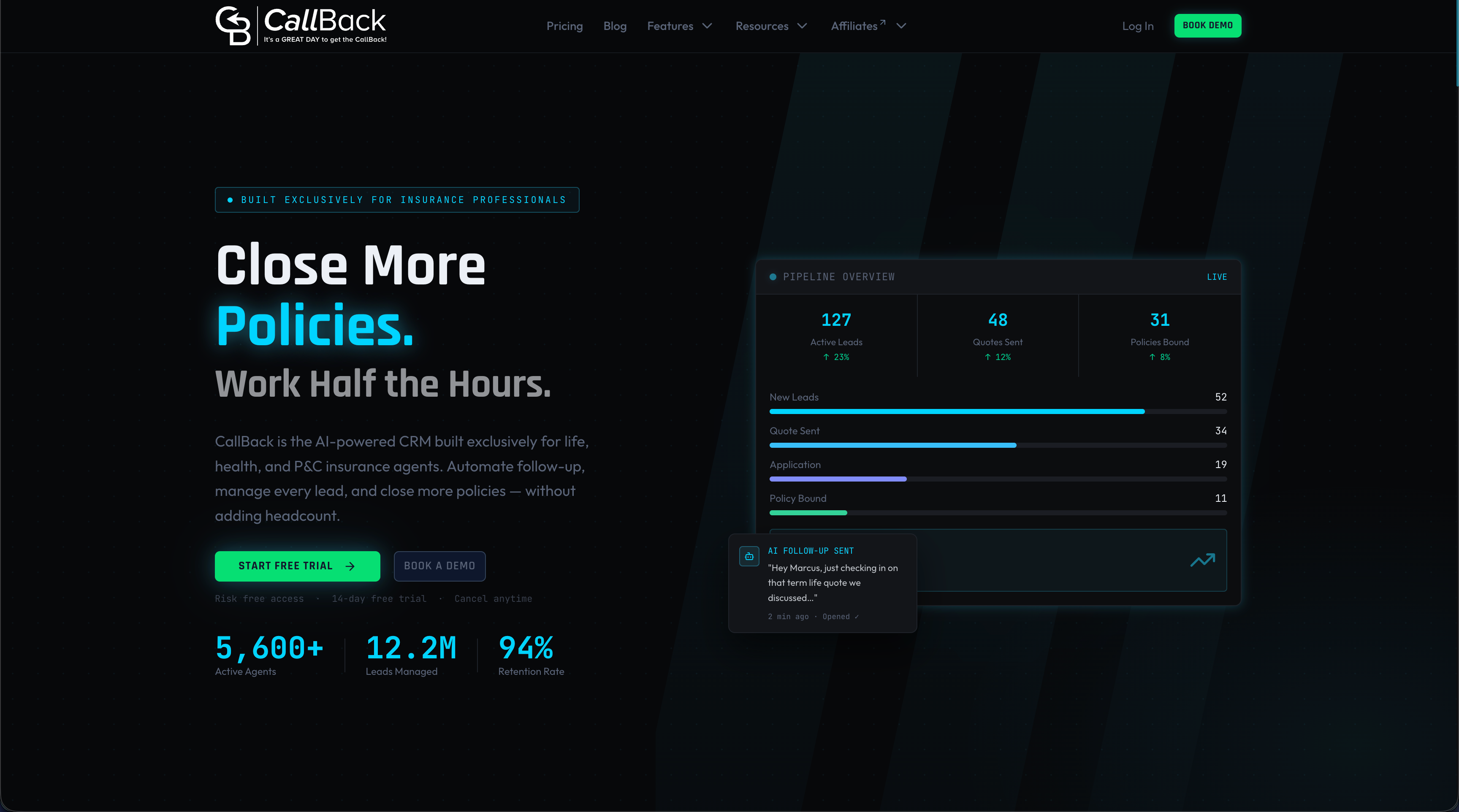
Agents using Callbackcrm can segment their pipeline by lead type, track separate KPIs for each stream, and run multi-channel outreach from a single dashboard. The platform’s AI-driven features cover CRM management, email automation, funnel building, and social media, replacing the patchwork of tools most agencies currently use. If you are managing exclusive leads, shared leads, and aged leads simultaneously, Callbackcrm gives you the structure to run each stream correctly.
FAQ
What is the difference between exclusive and shared insurance leads?
Exclusive leads are sold to one agent only, while shared leads go to 3–8 agents simultaneously. Exclusive leads produce contact-to-quote rates of 25–35% compared to 8–14% for shared leads.
Are aged insurance leads worth buying?
Aged leads work well for final expense and Medicare campaigns when agents use a multi-touch follow-up sequence of 8–12 contacts. They are not effective with single-call outreach strategies.
How do I verify that a lead is truly exclusive?
Ask the vendor in writing how many agents receive each lead and what the exclusivity window is. Fake exclusivity claims are common, so verbal assurances are not sufficient.
What are live transfer leads and how much do they cost?
Live transfers are pre-qualified prospects transferred by phone to an agent in real time. Costs range from $40–$90 for Medicare leads and $80–$180 for life insurance leads in 2026.
How does prospect warmth affect my lead strategy?
Cold prospects need awareness content, warm prospects need comparison and nurturing sequences, and hot prospects need immediate contact. Matching your outreach tactic to warmth level is what drives conversion rate differences across lead generation methods.