

Every insurance agent knows the struggle of juggling endless administrative tasks while chasing new leads. As client expectations climb and competition stiffens, finding ways to cut costs and improve engagement becomes urgent. Modern AI assistants have grown far beyond simple chatbots, offering contextual understanding and task management that free your team from repetitive work and let you focus on real relationship building.
Table of Contents
- Defining AI Assistants And Core Functions
- Main Types Of AI Assistants Today
- How AI Assistants Streamline Sales Tasks
- Key Benefits And Challenges For Insurance Agents
- Mistakes To Avoid When Adopting AI Tools
Key Takeaways
| Point | Details |
|---|---|
| AI Assistants Enhance Efficiency | AI assistants automate routine tasks, allowing agents to focus on sales activities and customer relationships. |
| Types of AI Assistants Cater to Specific Needs | Different AI assistants, such as sales and scheduling types, target particular workflows to maximize productivity for insurance agencies. |
| Data Quality and Transparency Are Crucial | Maintaining high-quality data and ensuring transparency in AI decisions is essential for building trust and compliance with regulations. |
| Monitor AI Performance Continuously | Ongoing evaluation of AI systems is necessary to address biases and maintain effectiveness as market conditions and customer behaviors evolve. |
Defining AI Assistants and Core Functions
An AI assistant is a software system that understands human language and performs tasks automatically, moving beyond simple question-and-answer exchanges. Unlike traditional chatbots that follow rigid scripts, modern AI assistants interpret context, learn from interactions, and adapt their responses to individual users.
Virtual assistants have evolved from basic query-response tools into intelligent systems capable of contextual understanding and task management, supporting both personal and professional workflows. For insurance agents, this means AI systems that truly understand your business challenges rather than offering generic responses.
Core functions define what makes an AI assistant valuable in your daily operations:
- Natural language processing lets agents converse naturally without special commands or awkward syntax
- Task automation handles routine work like data entry, appointment scheduling, and lead qualification
- Information retrieval instantly accesses customer details, policy information, and compliance requirements
- Decision support analyzes patterns to recommend next actions and identify high-value opportunities
- Learning and personalization improves performance over time by adapting to your agency’s specific processes
Think of an AI assistant as a knowledgeable team member who never sleeps. It handles repetitive tasks while you focus on relationship building and complex negotiations. The system learns your terminology, understands your customer base, and becomes more valuable each month.
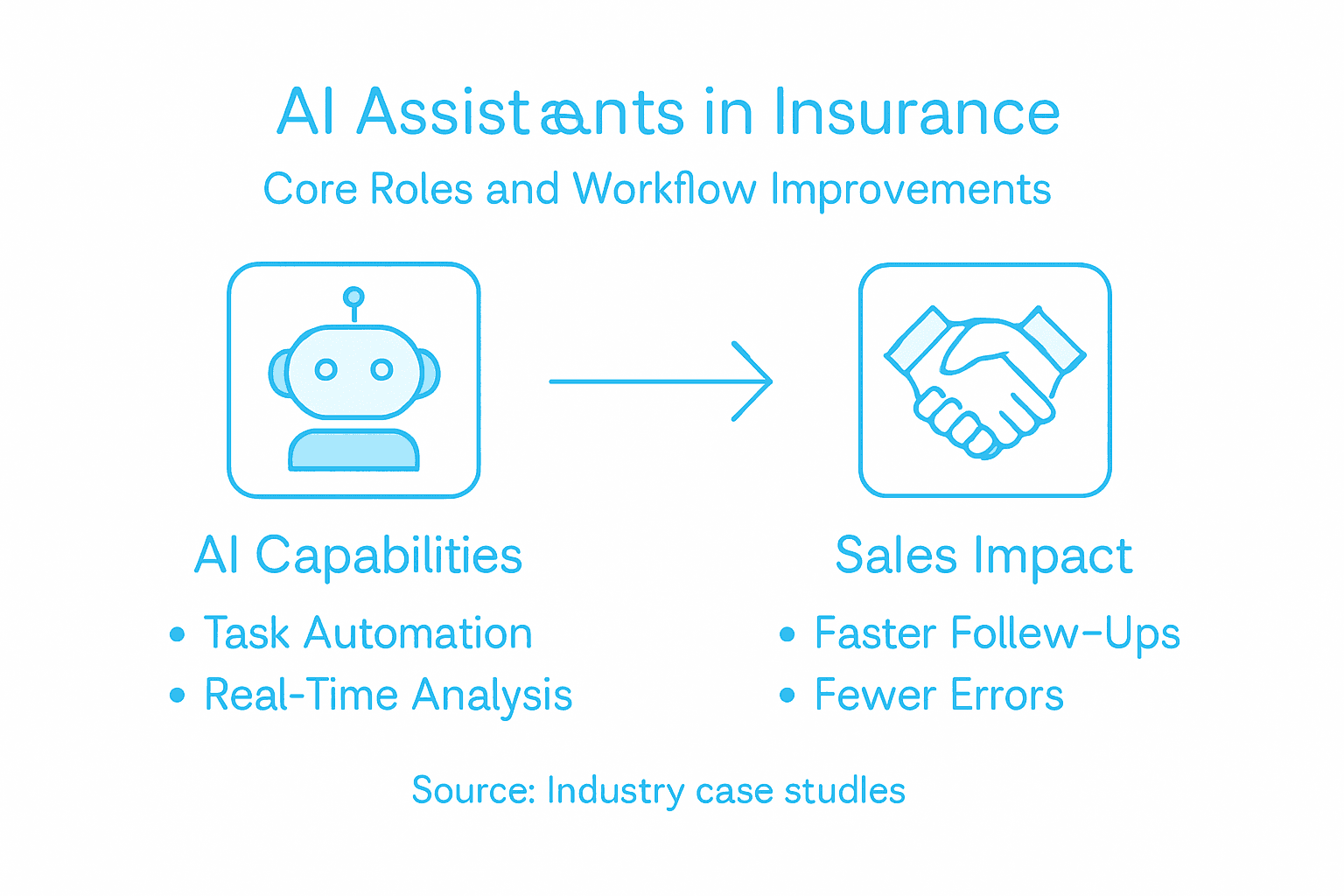
AI technologies support task automation across administrative workflows, from grading customer interactions to managing feedback loops. This collaborative approach means your team works alongside AI, not against it, augmenting human judgment with data-driven insights.
For insurance professionals, AI assistants excel at identifying leads that match your ideal customer profile, preparing personalized outreach, and flagging when prospects are ready to buy. They reduce the administrative burden that currently steals time from actual selling.
The best AI assistant becomes invisible—it works so seamlessly with your existing tools that you forget you’re using automation.
The difference between basic automation and true AI assistance comes down to understanding. Basic systems follow programmed rules; AI assistants understand context, nuance, and your specific business goals. Your assistant learns that a 45-year-old professional with three dependents has different insurance needs than a 25-year-old entrepreneur.
Pro tip: Start by identifying your most time-consuming repetitive task—lead follow-up, quote generation, or data entry—and measure how much time your team currently spends on it weekly. This baseline shows you exactly how much productivity an AI assistant can unlock for your agency.
Main Types of AI Assistants Today
AI assistants aren’t one-size-fits-all. Different types are purpose-built to handle specific workflows, and understanding these categories helps you choose the right tool for your insurance operation.
Customer service assistants field incoming inquiries around the clock, answering common questions about coverage, claims, and policy details. They triage complex issues to human agents, freeing your team from repetitive support questions. For insurers, these handle the volume while your people handle the nuance.
Sales assistants work alongside your agents, not against them. They interact with customers and support sales representatives by qualifying leads, scheduling consultations, and preparing personalized recommendations. Think of them as your tireless inside sales support team.
The main types you’ll encounter include:
- Sales AI assistants qualify leads and prepare outreach based on customer profile and behavior
- Scheduling assistants automate appointment setting without back-and-forth emails
- Writing assistants generate proposal text, email copy, and policy summaries
- Analytics assistants analyze customer data to identify cross-sell and upsell opportunities
- Consumer assistants (like Siri or Alexa) handle everyday queries for personal users
Each type serves a specific purpose in your sales pipeline. A scheduling assistant saves 5-10 hours monthly on calendar management. A sales assistant qualifies 30-50 leads daily that your team would otherwise miss.
Here’s a comparison of main types of AI assistants and their unique uses for insurance agencies:
| AI Assistant Type | Primary Workflow Supported | Key Benefit for Insurance Agents |
|---|---|---|
| Customer Service | 24/7 client inquiries | Reduces repetitive questions workload |
| Sales | Lead qualification & outreach | Increases closed deals |
| Scheduling | Appointment management | Cuts manual calendar tasks |
| Writing/Content Creation | Document generation | Speeds up proposals and emails |
| Analytics-Driven | Data analysis and insights | Improves upsell and cross-sell rates |
| Consumer (Alexa, Siri) | Personal user queries | Boosts brand awareness |
Writing and content creation assistants generate professional documents at scale. They draft personalized emails, create proposal summaries, and edit copy for brand consistency. Your agents focus on closing while AI handles the writing.
Analytics-driven assistants analyze customer behavior patterns to recommend next actions. They flag when a prospect is most likely to buy, which policies suit their profile, and what objections they typically raise.
The most effective assistant type depends entirely on your biggest time bottleneck—whether that’s lead qualification, scheduling, writing, or data analysis.
Consumer assistants like Alexa or Google Assistant handle personal queries from your customers outside your control. While useful for brand awareness, they’re less relevant to your sales process than purpose-built sales and customer service assistants.
Pro tip: Map your current sales process and identify which stage consumes the most team time, then prioritize an AI assistant specifically designed for that bottleneck—whether it’s qualification, scheduling, or proposal generation.
How AI Assistants Streamline Sales Tasks
AI assistants eliminate the busywork that consumes your team’s valuable selling time. Instead of manual data entry and email tag, your agents focus on conversations that close deals.

Automation handles the repetitive work that drains your pipeline. Data entry, appointment scheduling, and initial outreach run on autopilot while your team concentrates on relationship building. AI sales assistants automate routine tasks like meeting scheduling and follow-up outreach, freeing agents to spend more time on high-value interactions.
Here’s what gets streamlined:
- Lead qualification happens automatically, flagging prospects ready to buy
- Data entry flows directly from conversations into your CRM without manual input
- Email sequences trigger based on customer behavior, not manual scheduling
- Meeting scheduling eliminates back-and-forth confirmations
- Proposal generation creates personalized documents in minutes
Your team spends less time on administrative tasks and more time closing. A typical agent might spend 15-20 hours weekly on non-selling activities. AI handles most of that.
Real-time insights guide your conversations. As a prospect talks, the AI analyzes their needs and recommends which policies match their profile. You’re not guessing anymore—you have data backing your recommendations.
The system analyzes customer data to provide actionable insights, helping you prioritize leads by likelihood to buy. You immediately know which prospects deserve your best attention and which need more nurturing.
Lead prioritization means your top performers work the hottest prospects. Instead of equal attention across all leads, your system ranks opportunities by conversion probability. A 10-year-old teacher with three kids has different buying signals than a 25-year-old freelancer.
When you eliminate administrative friction, your team’s conversion rate often improves by 20-40% simply because they’re having more quality conversations.
Conversation enhancement happens in real-time. The AI suggests talking points, flags objections before they’re raised, and recommends next steps based on the customer’s responses. Your agents sound more prepared and knowledgeable.
Workflow optimization removes bottlenecks throughout your process. What is sales automation and why it matters becomes clear when you see your team suddenly handling 50% more prospects without adding headcount.
Pro tip: Start by measuring how much time your top-performing agent spends on non-selling tasks this week, then multiply that by your full team size to see the true cost of manual work—this number usually surprises agency leaders.
Key Benefits and Challenges for Insurance Agents
AI assistants offer substantial advantages to insurance agents, but they’re not without friction. Understanding both sides helps you implement wisely and avoid costly mistakes.
The Benefits
Administrative burden disappears. Your team stops drowning in data entry, scheduling conflicts, and repetitive emails. AI automation of routine tasks frees agents to focus on what they do best—building relationships and closing deals.
Benefits you’ll see quickly include:
- More selling time through automation of administrative work
- Better accuracy in risk assessment and customer data
- Faster claims processing that improves customer satisfaction
- 24/7 customer availability even when your office is closed
- Lower operational costs from reduced manual labor
- Personalized customer interactions that build loyalty
Your team transitions toward a consultative role. Rather than gathering information and processing paperwork, agents provide expert guidance backed by AI-driven insights. The customer experience improves because agents have better data and more time to talk.
Cost reduction matters immediately. You handle more customers with the same headcount. A single agent using AI efficiently can manage 40-50% more accounts because administrative work shrinks dramatically.
The following table contrasts key benefits and challenges of adopting AI assistants in an insurance agency:
| Aspect | AI Assistant Benefit | Associated Challenge |
|---|---|---|
| Efficiency | More time for sales and consulting | Need for data quality and reliability |
| Customer Service | 24/7 support and faster claim handling | Explaining automated decisions |
| Personalization | Tailored communications and offers | Managing privacy and regulatory rules |
| Costs | Reduced operational and staffing expenses | Training and technology adoption hurdles |
| Growth | Higher capacity per agent | Risk of over-reliance on automation |
The Challenges
Not everything is smooth. Data quality issues and regulatory compliance present real obstacles that require planning and oversight.
Key challenges you’ll face:
- Data quality problems if your existing customer data is incomplete or inconsistent
- Regulatory compliance requirements that vary by state and insurance type
- Ethical considerations around how AI uses customer information
- Transparency demands from customers who want to understand AI decisions
- Technology adoption among team members resistant to change
- Vendor dependency if you rely on external AI platforms
Explainability becomes critical. When an AI assistant flags a prospect as high-risk or recommends a specific policy, you need to explain why—to regulators and to customers. Black-box decisions erode trust.
Your team needs training and adjustment time. Agents accustomed to traditional workflows must learn new processes. Some will embrace the change; others will resist. Plan for a transition period where productivity dips slightly before climbing higher.
The agents who thrive with AI aren’t those who fight it—they’re those who treat AI as a tool that amplifies their strengths, not replaces them.
Data security matters more than ever. With AI analyzing customer information constantly, you need robust cybersecurity and clear data governance policies. One breach damages customer trust permanently.
Pro tip: Before implementing AI, audit your customer data quality across your top 100 accounts—if you find missing fields, outdated information, or inconsistencies, fix those first so the AI learns from clean data and produces reliable recommendations.
Mistakes to Avoid When Adopting AI Tools
Many insurance agents jump into AI adoption without a plan. Learning from common pitfalls saves you time, money, and customer trust.
Don’t skip data preparation. Your AI is only as good as the data it learns from. If your customer records contain gaps, duplicates, or outdated information, the AI will make poor recommendations and waste your team’s time correcting errors.
Common adoption mistakes include:
- Ignoring continuous monitoring after deployment, assuming the system runs perfectly forever
- Failing to address algorithmic bias that might unfairly target or exclude customer segments
- Lacking transparency in how AI reaches decisions about risk or recommendations
- Removing human oversight entirely, replacing judgment with automation
- Poor integration with existing systems, creating data silos
- Inadequate team training that leaves your staff confused and resistant
Model monitoring matters continuously. Neglecting continuous model monitoring causes performance to degrade silently over time. Markets change, customer behavior shifts, and your AI needs adjustment. Set up monthly reviews to track accuracy and catch problems early.
Algorithmic bias is invisible until it damages your business. If your training data overrepresents certain demographics or income levels, your AI might recommend policies unfairly or miss qualified prospects from underrepresented groups.
Transparency isn’t optional. Regulators demand explainability. Customers want to understand why they received a specific recommendation or were flagged as high-risk. A black-box AI system creates compliance problems and erodes trust when customers question decisions they can’t understand.
Don’t eliminate human judgment. Maintain human oversight to preserve fairness and compliance, especially for high-stakes decisions about policy approval or claims denial. Your agents should review AI recommendations, not blindly execute them.
The worst AI adoption mistake is replacing skilled agents with automated systems—instead, use AI to make your agents 10 times more effective.
Technology integration requires planning. If your CRM, email platform, and AI assistant can’t communicate, you’ve created manual work instead of eliminating it. Ensure all systems connect before deployment.
Underestimating change management kills adoption. Your team won’t instantly embrace new workflows. Plan for training, feedback sessions, and a gradual rollout that lets agents build confidence with smaller accounts before handling their full book.
Pro tip: Run a 30-day pilot with three willing team members using AI on just 10% of their prospects, measure the results against their historical baseline, and use that data to convince skeptical agents of the value before company-wide rollout.
Unlock the Power of AI Assistants with CallBack CRM to Transform Your Insurance Sales
The challenge insurance agents face today includes endless repetitive tasks that limit selling time and overwhelm teams with data entry, scheduling, and lead qualification. Understanding that AI assistants bring natural language processing and task automation to your workflow is just the first step. To truly boost productivity and close more deals, you need a platform built to integrate these AI capabilities with your existing sales processes. CallBack CRM offers precisely this by combining AI-powered lead scoring, automated customer outreach, and seamless CRM management tailored for insurance professionals.
Discover how you can reclaim your team’s time and increase conversion rates by automating the manual tasks draining your agency. With CallBack CRM you gain 24/7 intelligent customer engagement, real-time insights that personalize every interaction, and robust automation workflows that handle lead qualification and appointment scheduling. Don’t settle for outdated sales methods when AI assistants can multiply your team’s effectiveness today. Start transforming your insurance sales by exploring everything CallBack CRM offers now at https://callbackcrm.com and experience the future of insurance sales automation.
Frequently Asked Questions
What is the primary function of an AI assistant in insurance sales?
An AI assistant in insurance sales automates routine tasks such as lead qualification, appointment scheduling, and data entry, allowing agents to focus on building relationships and closing deals.
How do AI assistants enhance the sales process for insurance agents?
AI assistants streamline administrative tasks, provide real-time insights, and prioritize leads based on likelihood to buy, resulting in more efficient selling and higher conversion rates.
What types of AI assistants are most beneficial for insurance agencies?
Sales assistants, customer service assistants, scheduling assistants, writing assistants, and analytics-driven assistants are tailored to specific workflows in insurance sales, each providing unique benefits like lead qualification and document generation.
What are some challenges insurance agents may face when adopting AI assistants?
Challenges include ensuring data quality, maintaining regulatory compliance, managing algorithmic bias, and providing adequate training for staff to effectively use the new technology.