

Retirement seminar marketing works when it is run as a repeatable system: a defined audience, a promotion schedule, fast follow-up and a funnel that is measured at every step. Most seminars fail at the follow-up, not at the event. CallBack CRM puts the follow-up, reminders and pipeline tracking in one platform built for insurance and retirement professionals, so each registrant and each no-show gets a next step.
TL;DR
- Seminars work because they are a small first step. Prospects hear how an agent thinks before they agree to a one-on-one meeting.
- Choose one audience and one problem, such as Social Security timing, taxes or income, before choosing a venue.
- Promote in layers: mail first, then digital reminders, then confirmations by text and email.
- Judge the channel over many events. Track registrations, show rate, appointments, clients and cost per client.
- Follow up within two days, and book appointments within two weeks.
Table of Contents
- Why seminars still work
- Choose the audience, topic and format
- Promote the seminar in layers
- Run the event so it leads to appointments
- Follow up within two days
- What it costs and what to measure
- Compliance basics
- Put the system in one place
- Our view
- FAQ
- Sources
Why seminars still work
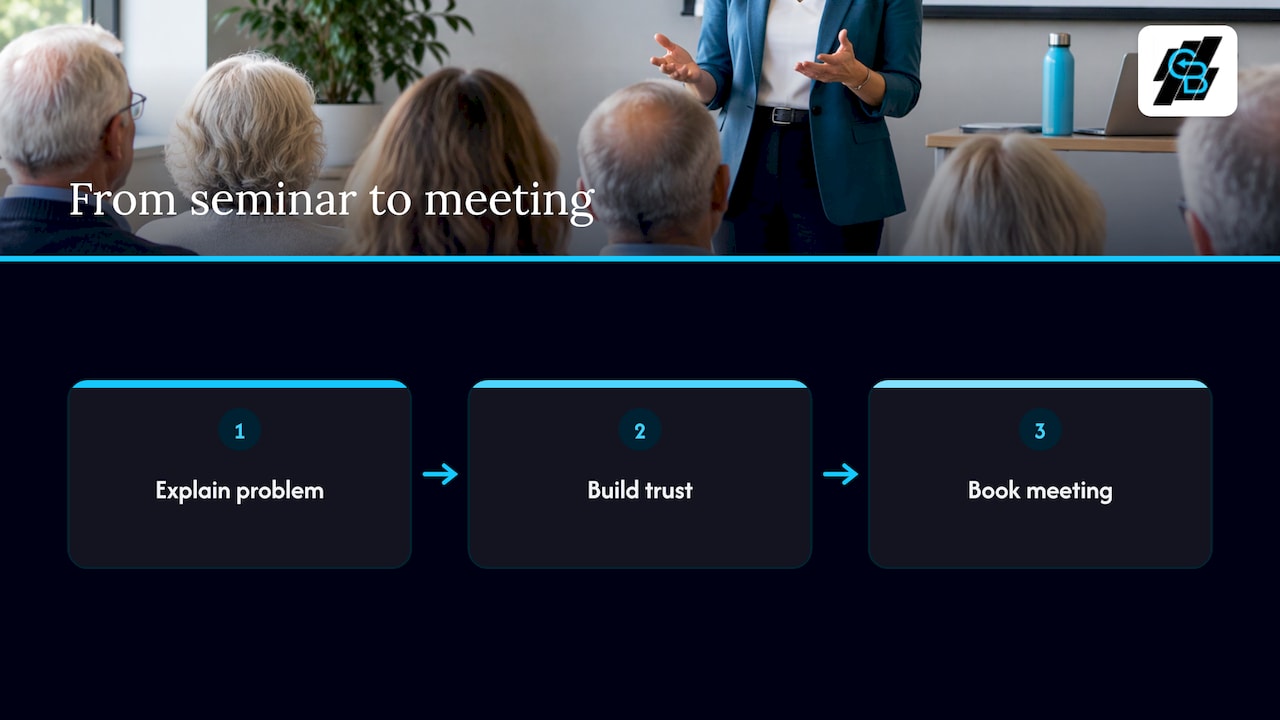
Most people are not ready to meet an unknown advisor one-on-one. A seminar lowers the ask. Attendees hear the presenter explain a problem, decide whether they trust the presenter, and book a meeting when ready. ConvertSource describes this as teaching first and inviting the right people to a meeting afterward.
There is also evidence that education changes behavior. An NBER working paper studied 85 employer-provided retirement seminars held in 2008 and 2009. Financial literacy and knowledge of retirement program rules were significantly higher afterward. The employees with the largest knowledge gains were the most likely to change their planned retirement age and Social Security claiming age. For an agent, that means a good seminar gives attendees a reason to act on a plan.
The channel is not a one-night event. In a RIABiz profile, Patrick Horan said most advisors who give seminars quit because they judge them on one or three nights. He described a discipline with consistent scheduling and follow-up within 24 to 48 hours. Agents who treat seminars as a system get the data to improve them.
Choose the audience, topic and format
Start with who the room is for. A retirement planner, an annuity agent, an IUL agent and a Medicare agent each serve a different person. A narrow audience is easier to mail, easier to speak to and easier to convert. Pick a defined group, such as people within five years of retirement in one county, or small business owners near a sale.
Then pick one problem that the group already worries about. The seminar should teach the problem, not pitch a product. Common topics include:
- Social Security timing and retirement income
- Taxes in retirement
- Income during market volatility
- Estate planning
- Medicare enrollment for people turning 65
Ask invitees for their questions at registration. This lets the presenter build the talk around what people want to know.
In person or virtual
In-person seminars build relationships and credibility faster. Webinars cost less, are faster to set up and can be recorded and reused. The comparison below uses the case study that ConvertSource summarizes from a Kitces case. Check the linked write-up for details before copying the numbers.
| In-person seminar | Webinar | |
|---|---|---|
| Case cost | About $7,000 for two evenings | About $1,400 for one event |
| Attendance | 48 attendees | 76 live attendees from 377 registrants |
| Appointments | 5 | 6 scheduled calls |
| Strength | Better conversion per person | Better results per dollar |
The same source notes that in-person seminars carry costs for every seat, filled or not, and reach only people within driving distance. Many agents run both: a webinar to build the list, and a smaller in-person event for the people who respond. CallBack’s guides on compliance-ready webinars for insurance agents and evergreen webinars cover the virtual side.
Promote the seminar in layers
A single invitation rarely fills a room. Use more than one channel and more than one touch.
Direct mail
Mail is still the base of most retirement seminar programs, because the audience is older and tends to respond to print. The Horan Capital profile reports that 10,803 invitations in September 2010 cost $11,570 and produced 157 responses. Responses on direct mail for financial services are often low single digits at best, so list quality matters more than design.
Every mailer needs the date, time, place, topic, a clear registration method and a phone number. A QR code with a printed web address gives readers two ways to register.
Digital follow-through
Digital channels work best when they support the mail. Send a registration page link by email. Run social ads to the same zip codes. Time any digital reminder for after the mail lands, since mail can take several days to arrive. Thrive Financial Services reported in a Kitces interview that Facebook campaigns of $2,500 to $3,500 per two-night seminar produced 45 to 130 registrations. That is one firm’s result from 2020, and results differ by market.
Search also brings in people who are already looking. SEO for financial advisors covers how to keep a steady stream of search visitors going to the registration page between events.
Confirmations and reminders
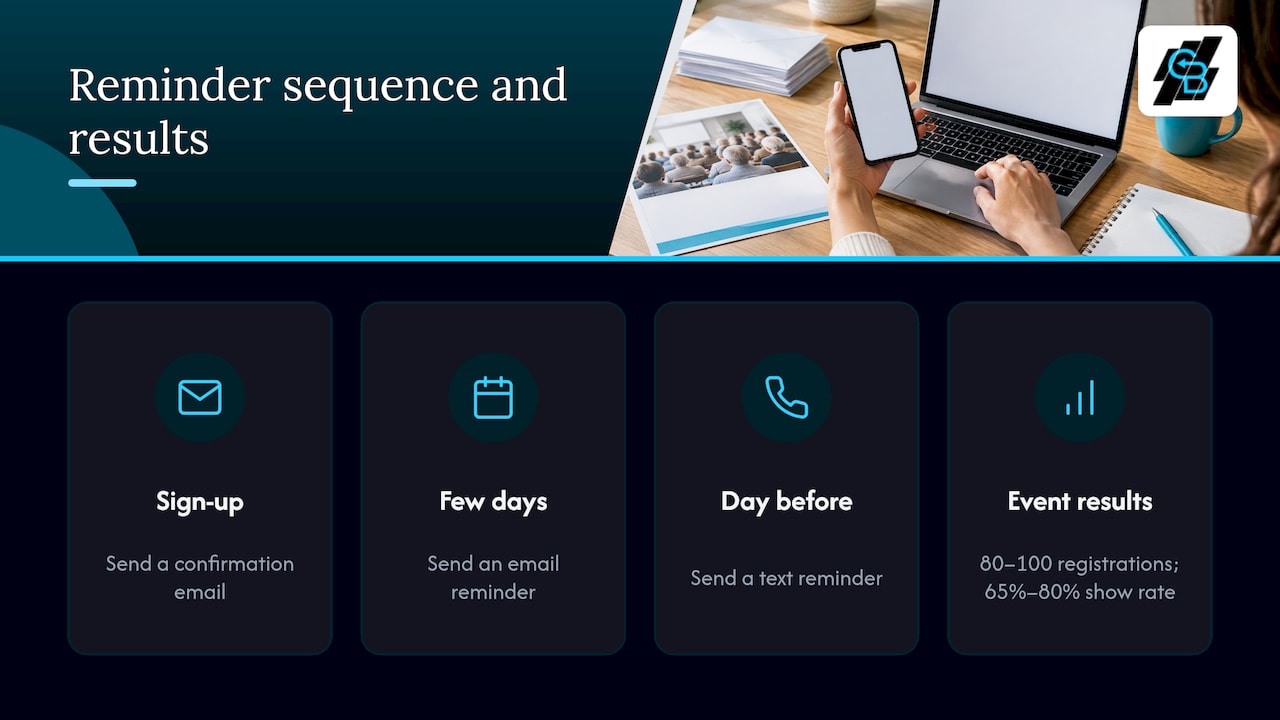
Registration is not attendance. Plan for a confirmation email at sign-up, a reminder a few days out, and a text the day before. A financial advisor interviewed by WealthManagement said his team contacted registrants three to four times before each event. His free educational events averaged 80 to 100 registrations and a 65% to 80% show rate.
This is where an automation platform saves time. CallBack CRM sends automated follow-up by SMS, email and voicemail, and its workflow automation can run a reminder sequence for each registrant without manual entry. Its SMS delivery uses unique message hashing, iMessage deliverability and carrier-approved verbiage, so reminders reach the phone.
Run the event so it leads to appointments
Plan the event before promoting it. Set the purpose, the attendance goal, the action you want attendees to take, the topic, the date options and the venue. Arrive early, test the equipment, and prepare handouts and a sign-in sheet. For a virtual event, set up the audience tools and the recording.
End the talk with one clear next step: a short, no-cost review meeting. Book it while people are in the room if possible. A Kitces interview with David Brooks reports that fall-off rose when meetings were scheduled beyond the next two calendar weeks, and that by the third week it was 50% higher. That is one practitioner’s experience, but it supports a simple rule: offer slots inside the first two weeks.
Follow up within two days
Most of the return comes after the event. A workable routine:
- Within two days, thank every attendee and send what was promised.
- Contact every no-show with a low-pressure offer: a short meeting or a spot at the next event.
- Send a reminder for each booked appointment.
- Record attendance, requests, referrals and feedback on each contact.
- Move each person to a pipeline stage so no one sits unassigned.
Steps 1 to 3 are timing problems. A person who registered, did not attend and received no message is a lost lead. CallBack’s pipeline and workflow automation handle these steps for each contact, and its mobile app lets an agent update a record from the room. For templates and timing, see CallBack’s guide to webinar follow-up emails and the broader overview of lead generation for retirement planners.
For final expense and other insurance lines that rely on long nurture cycles, the six-stage final expense funnel shows how automated contact can carry a lead from first response to appointment.
What it costs and what to measure
Published numbers vary widely. Use them to set a range, then replace them with your own.
| Source | Cost | Result |
|---|---|---|
| Brooks, via Kitces | About $7,000 for 10,000 mail pieces plus $1,400 to $1,600 per dinner, about $11,000 total | Six to nine clients in some cases; about a 72% stick rate and a 40% to 45% closing ratio reported |
| Horan Capital, via RIABiz | $11,570 for 10,803 invitations (2010) | 157 responses, 102 attendees, 47 appointments, nine new clients |
| WealthManagement | Dinner seminars of $10,000 to $15,000 each; free educational events of $5,000 to $6,000 | 80 to 100 registrations, 65% to 80% show rate |
These cases come from advisors, and some are older. Treat them as examples of what is possible, not promises.
Track the funnel
Track each step as its own number:
- Households mailed or reached
- Registrations
- Attendees (show rate)
- Appointments booked and kept
- Clients and premium or assets written
- Total cost divided by each step
A simple worked example: $6,000 of event spend produces 60 registrations ($100 each), 36 attendees (about $167 each) and 9 kept appointments (about $667 each). If better reminders lift attendance from 36 to 42, cost per attendee drops to about $143 with no change to the mailer. This example is from OPVII’s guide; it shows how a small gain at one step lowers cost at every step after it. Reporting inside one CRM makes these numbers available without a spreadsheet.
Compliance basics
Rules depend on who the presenter is and what is sold. Registered investment advisers are subject to the SEC Marketing Rule, and invitations, slides and handouts can count as advertising. Insurance agents follow state insurance advertising rules and carrier requirements. Medicare events have separate rules that distinguish educational events from sales events, so state clearly in the invitation which one it is.
General practice for every seminar:
- Describe the event honestly. If it will include a sales presentation, say so.
- Avoid exaggerated or unsupported claims in the invitation and the talk.
- Keep copies of the invitation, slides and handouts.
- Check gift and meal limits for registered representatives. A September 2025 Federal Register notice described a FINRA proposal to raise the Rule 3220 gift limit from $100 to $300. Confirm the current limit with FINRA before the event.
Confirm requirements with your compliance officer, carrier or state insurance department before sending the first mailer.
Put the system in one place
CallBack CRM is an AI-powered CRM and marketing platform for insurance agents, agencies and IMOs. It includes pipeline management, automated SMS, email and voicemail follow-up, email and SMS marketing, funnel and website builders for registration pages, webinars, workflow automation, and reporting. The Professional plan is $97 per month. Enterprise plans start at $297 per month for 10 full CRM accounts, $397 for 25 and $497 for 60. The Unlimited AI Employee Bundle is $127 per month. Phone numbers are $2.30 per month each, and other usage fees are listed on the fees page.
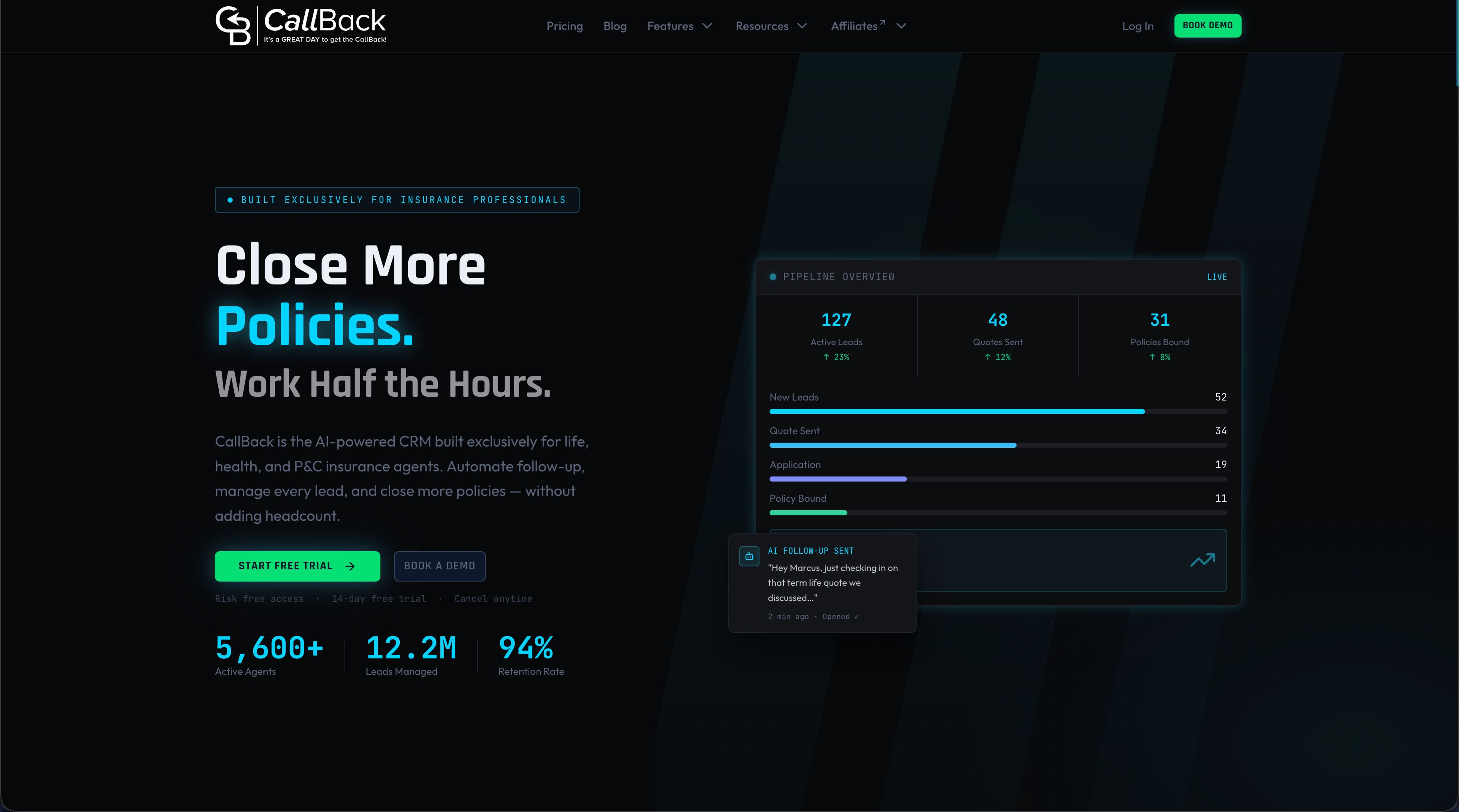
Agents who want to see how a seminar funnel would look in the platform can start with the Professional plan or review the automation features. Agencies with several producers can compare the Enterprise plans.
Our view
Most seminar programs do not fail on the day. They fail in the week after, when registrants who did not show up and attendees who did not book are not contacted again.
We built CallBack for insurance sales, where speed of follow-up decides who gets the appointment. Our approach is to put the registration page, the reminders, the text and email follow-up and the pipeline in one system, so every contact has a next step.
A seminar is a lead source with a cost per client. When each step is recorded, an agent can tell which mailer, topic and reminder sequence works, and repeat it. That is how a seminar becomes a routine.
Kyle
FAQ
Are retirement seminars legit?
Yes, when they are honest about their purpose. Regulators have long warned against seminars presented as education that are really sales pitches. State the purpose in the invitation, avoid exaggerated claims and follow your carrier and state rules.
What are good topics for a retirement seminar?
Choose a problem the audience already has. Social Security timing, retirement income, taxes, estate planning and Medicare are common. Ask registrants for their questions in advance and build the talk around them.
Is a webinar better than an in-person seminar?
It depends on the goal. Webinars cost less, take less time to prepare and can be reused. In-person events build trust faster and tend to convert better per attendee. Many agents use webinars to build a list and hold in-person events for the most engaged contacts.
How do I measure seminar ROI?
Track cost and results at every step: registrations, show rate, appointments, clients and revenue. Divide total spend by each count. Compare events over several months, not one night, so a single weak turnout does not decide the channel.
Sources
- Golden Years or Financial Fears? Decision Making After Retirement Seminars (NBER)
- The art and science of how one RIA grew assets 125% (RIABiz)
- Financial Advisor Seminars vs Webinars (ConvertSource)
- Cost-Effective Seminar/Webinar Marketing Using Facebook Ads (Kitces)
- Organically Growing To $800M AUM With Educational Marketing (Kitces)
- How Free Estate Planning Seminars Turned Into $25 Million (WealthManagement)
- Retirement Seminar Marketing: Fill The Room (OPVII)
- FINRA Rule 3220 notice (Federal Register)