

TL;DR:
- Most businesses now use CRM tools because they significantly improve conversion rates and customer retention through centralized data. Selecting a CRM that fits your team’s workflow and ensuring high user adoption are critical for realizing measurable ROI and long-term success. Effective CRM implementation transforms not just sales but the entire business operations through better collaboration, precise targeting, and real-time insights.
Most business owners assume CRM tools are glorified contact lists. They’re not. 91% of companies with more than 10 employees now run a CRM system, and they report a 300% increase in conversion rates tied directly to better follow-up and centralized data. If you’re still managing customers through spreadsheets, sticky notes, or disconnected inboxes, you’re not just behind. You’re actively leaving revenue on the table. This guide breaks down why invest in CRM tools matters for your bottom line, and how to make that investment actually work.
Table of Contents
- Key takeaways
- Why invest in CRM tools: the ROI case
- How CRM transforms your whole business, not just sales
- Choosing the right CRM: fit over features
- Putting your CRM investment to work
- My take on why most CRM investments fail before they start
- See how Callbackcrm puts this into practice
- FAQ
Key takeaways
| Point | Details |
|---|---|
| CRM drives measurable ROI | Businesses see an average return of $8.71 for every $1 spent on CRM investment. |
| Sales productivity jumps fast | CRM implementation improves sales productivity by 25-30% while cutting manual data entry by up to 90%. |
| Retention improves with context | Teams with CRM retain up to 27% more customers by responding faster with full interaction history. |
| Adoption makes or breaks success | Around 70% of CRM projects fail due to poor user adoption, not software quality. |
| Right fit beats most features | Free trials across departments help you find a CRM that matches actual workflows before you commit. |
Why invest in CRM tools: the ROI case
The most honest way to frame the benefits of CRM tools is through numbers. Not vague promises about “better relationships,” but actual, measurable outcomes your sales team will feel within the first quarter.
Start with productivity. CRM increases sales productivity by 25-30% and reduces manual data entry by up to 90%, saving individual team members five to eight hours every single week. That’s not small. For a five-person sales team, you’re recovering the equivalent of a part-time employee’s workload, every week, without adding headcount.
The revenue impact compounds from there:
- Conversion rates jump up to 300% when follow-up is timely and reps have full customer context at their fingertips
- Sales forecasting accuracy improves by 42% with CRM adoption, which means better hiring decisions, smarter inventory planning, and fewer revenue surprises
- Customer retention improves by 20-27% when teams deliver contextualized communication instead of generic outreach
- ROI averages $8.71 per dollar spent, with most businesses seeing returns within 12 months
The retention number deserves more attention than it usually gets. Most businesses obsess over acquiring new customers while underestimating how much a one-point improvement in retention is worth. If your average customer is worth $5,000 annually and you retain just 10 more of them each year, that’s $50,000 in recurring revenue you didn’t have to earn through new acquisition. CRM makes that happen by giving every team member the context they need to respond fast and personally.
Pro Tip: Track your team’s average follow-up time before implementing a CRM. After 90 days of consistent CRM use, measure it again. That single metric often tells the whole story of whether your investment is working.
How CRM transforms your whole business, not just sales
Here’s what most CRM articles miss: the advantages of CRM software extend well past the sales floor. When your sales, marketing, and support teams share a single source of customer truth, the entire business operates differently.

Think about the handoff problem. A lead becomes a customer, gets passed from sales to a support rep, and suddenly no one knows what was promised in the proposal. That friction costs you trust, and eventually clients. Shared CRM data across teams eliminates that handoff friction entirely, giving every department the same real-time picture of where each customer stands.
Beyond internal alignment, here’s how CRM reshapes operations across the business:
- Marketing precision: Segment your contacts by behavior, purchase history, or engagement level and stop wasting ad spend on audiences that will never convert. Your campaigns become targeted instead of broadcast.
- Real-time business intelligence: Leaders see pipeline health, deal velocity, and team performance without waiting for weekly reports. Decisions get made on current data, not last month’s numbers.
- AI-powered lead scoring: AI-powered CRM features like automated lead scoring and sentiment analysis increase lead generation by 44% and shift customer support from reactive firefighting to proactive outreach.
- Mobile access for field teams: Mobile CRM users are 150% more likely to exceed their sales goals. For insurance agents or any field-based sales professional, this isn’t a bonus feature. It’s the whole value proposition.
- Cross-department visibility: When marketing knows what objections sales hears every day, they write better content. When support sees the original sales conversation, they solve problems faster.
Understanding how these tools connect to a broader marketing strategy is worth exploring. Marketing automation for insurance agencies breaks down exactly how automation layers on top of CRM to reduce repetitive work across your entire customer lifecycle.
Pro Tip: Start your CRM rollout with one cross-functional use case, like eliminating the sales-to-support handoff problem. Solving a visible, painful problem fast builds internal buy-in faster than any training session.
Choosing the right CRM: fit over features
This is where most businesses get it wrong. They see a feature list, compare pricing tiers, and pick the tool with the most checkboxes. Then six months later, 70% of CRM projects fail because nobody actually uses it.
The most important word in CRM selection is fit. A CRM that perfectly matches your team’s workflow will outperform a technically superior platform that nobody logs into.
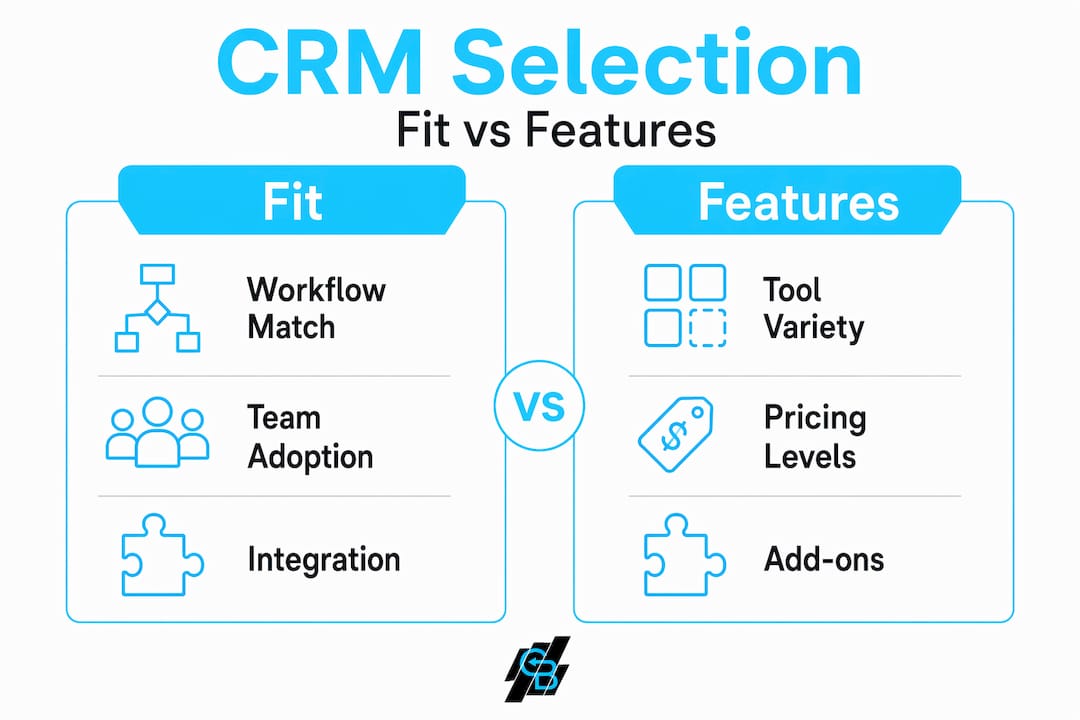
Here’s a comparison of the two main paths businesses take:
| Factor | Off-the-shelf CRM | Custom or specialized CRM |
|---|---|---|
| Upfront cost | Lower, subscription-based | Higher ($60K-$180K for custom builds) |
| Workflow alignment | Generic, requires adaptation | Built around your actual processes |
| Long-term cost | Escalating license fees | No per-user fees after development |
| Vendor risk | Lock-in to pricing changes | Full ownership of the platform |
| Time to value | Faster to deploy | Takes longer to build |
| Best for | Businesses with standard workflows | Complex, proprietary processes |
Custom CRM investments range from $60K to $180K upfront, but they eliminate escalating license fees and vendor lock-in over time. For mid-sized businesses with unique workflows, that math often favors going custom within three to five years.
For most growing businesses, though, the smarter move is to try multiple CRM free trials across departments before committing to anything. Here’s what to watch for during those trials:
- Does the interface feel natural for your reps, or does it add steps to their day?
- Can it integrate with your existing email, calendar, and marketing tools without a technical overhaul?
- Does your support team, not just sales, find it useful?
- How painful is the data migration process from what you’re using now?
The integration question matters more than most buyers realize. A CRM that doesn’t talk to your marketing automation platform creates a data island. You end up with customer records in two places and no clear picture of the full journey. Connecting these systems is the difference between a CRM as a contact list and CRM as an actual lead funnel that moves people from stranger to loyal customer.
Putting your CRM investment to work
Buying CRM software is not the investment. Using it consistently is. Here’s a practical sequence for getting real value from your CRM from day one:
- Commit to the 90-day window. Most teams underestimate how long it takes to build consistent habits. Require all customer interactions to be logged in the CRM for the first 90 days, no exceptions, before evaluating whether it’s working.
- Set three specific KPIs before launch. Pick something you can measure before and after: average follow-up time, monthly close rate, or customer retention percentage. Vague goals produce vague results.
- Invest in onboarding, not just setup. The biggest adoption killer is a team that learned the system in one afternoon and was never trained again. Schedule monthly check-ins for the first six months to address friction points before they become excuses to abandon the tool.
- Use the data to refine your approach. The advantage of CRM technology is not just storing data. It’s acting on it. Review pipeline reports weekly. Spot the deals that stall at the same stage and fix the process, not the rep.
- Collect feedback from every department. The sales team and the support team will have completely different frustrations. Both matter. CRM success is a team sport.
The most common mistake isn’t choosing the wrong CRM. It’s choosing the right one and under-using it. Businesses that treat their CRM as the operational backbone of their processes, not a place to dump contact info after calls, are the ones that see the retention and conversion numbers worth bragging about.
Pro Tip: Assign one internal CRM champion per department in the first 90 days. This person doesn’t need to be management. They just need to be curious and willing to help teammates troubleshoot. This alone reduces abandonment rates significantly.
My take on why most CRM investments fail before they start
I’ve watched businesses spend serious money on CRM platforms and get almost nothing back. The pattern is always the same. Leadership buys the software. IT sets it up. Sales gets a two-hour demo. And then everyone goes back to doing things the way they always did, just with a new login to ignore.
The uncomfortable truth is that CRM failures stem from adoption problems, not software problems. I’ve seen businesses on basic, affordable CRM platforms outperform competitors using enterprise-level tools at ten times the cost, simply because their teams actually used the system every single day.
What I’ve learned is that CRM is not a product you buy. It’s a behavior change you commit to. The CRM benefits for agents I find most compelling aren’t the feature lists. They’re the compounding effects of a team that never drops a follow-up, always knows what was promised, and can see exactly where every deal stands at any moment.
The businesses that win with CRM treat it as infrastructure, the same way they treat their phone system or accounting software. It’s not exciting. It’s not a quick fix. But over two to three years, it becomes the clearest competitive advantage you have, because your customer data gets richer, your processes get tighter, and your team gets faster.
My advice: choose the simplest CRM that solves your most painful problem today. Expand from there. Don’t buy for where you hope to be in five years. Buy for where you are right now, and make sure your team will actually use it tomorrow.
— Kyle
See how Callbackcrm puts this into practice
If you’re ready to stop debating CRM and start using one that’s built for the way modern sales teams actually work, Callbackcrm is worth a serious look.
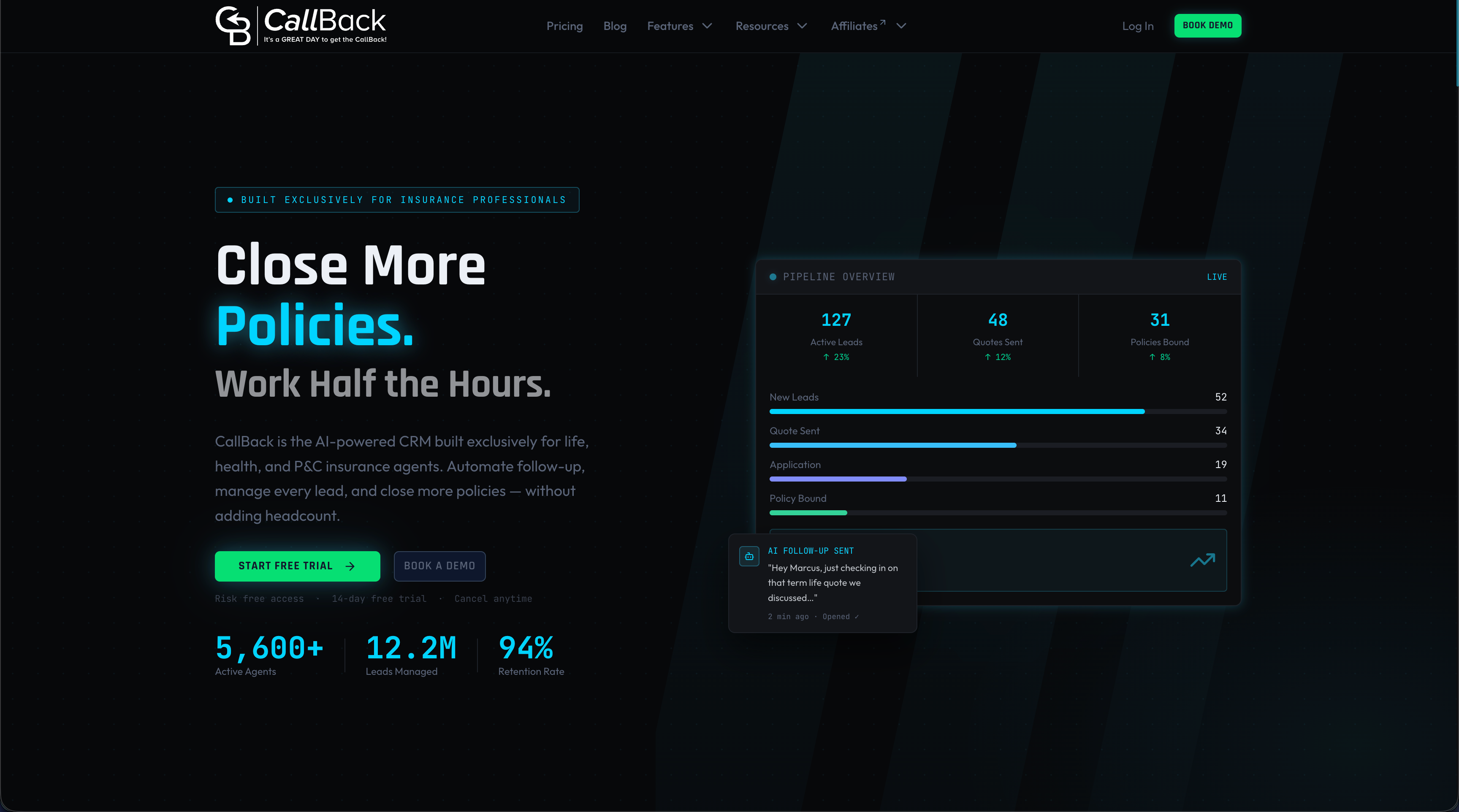
Callbackcrm is an all-in-one AI-powered platform designed specifically for insurance agents, agencies, and sales professionals who want to replace outdated outreach methods with intelligent automation. From CRM management and lead scoring to SMS marketing and segmentation, every feature is built to reduce the manual work that kills productivity and keeps your team focused on closing. The platform runs on Google Cloud, integrates with your existing tools, and offers 24/7 support so you’re never stuck. Explore the full suite of AI-powered CRM features and start a free trial to see how it fits your workflow before you commit.
FAQ
What is the average ROI of investing in CRM tools?
CRM delivers an average return of $8.71 per dollar spent, with most businesses seeing measurable returns within 12 months of adoption.
Why do so many CRM implementations fail?
Approximately 70% of CRM projects fail due to poor user adoption and cross-department misalignment, not because the software itself is defective.
How does CRM improve customer retention?
CRM systems improve retention by up to 27% by giving every team member complete context on customer interactions, enabling faster, more personalized responses at every touchpoint.
Should small businesses invest in CRM systems too?
Yes. The misconception that CRM is only for large companies is outdated. 91% of businesses with 10 or more employees now use CRM, and cloud-based options make entry-level pricing accessible for even small teams.
How do I choose between an off-the-shelf and a custom CRM?
Off-the-shelf CRM platforms work well for businesses with standard sales workflows and faster deployment timelines. Custom CRM development offers better long-term fit and lower total cost for mid-sized businesses with complex or proprietary processes.