

TL;DR:
- AI chatbots in insurance automate customer interactions, handle routine tasks, and connect to policy systems using advanced conversational AI. They range from simple rule-based scripts to fully autonomous agentic systems that process claims and verify users without human involvement. Proper deployment requires integration, compliance, clear escalation paths, and phased implementation to maximize efficiency and customer satisfaction.
AI chatbots in insurance are intelligent software tools that automate customer interactions, handle routine service tasks, and connect directly to policy systems in real time. The industry term for the most advanced versions is conversational AI, which uses natural language processing (NLP) and machine learning to hold dynamic, context-aware conversations. Tools built on models like those powering ChatGPT and Microsoft Copilot now operate across insurance websites, SMS channels, and contact center platforms. Understanding ai chatbots in insurance explained properly means going beyond the FAQ bot definition. These systems now execute transactions, authenticate policyholders, and flag fraud, all without a human agent in the loop.
What types of AI chatbots exist in insurance and how do they differ?
Insurance chatbot tools range from simple rule-based scripts to fully autonomous agentic AI systems. Each type serves a different operational need, and choosing the wrong one is a common and costly mistake.

Rule-based chatbots follow fixed decision trees. They answer predictable questions like “What is my deductible?” or “How do I file a claim?” They cannot handle anything outside their script, which limits their usefulness to basic FAQ support.
Conversational AI chatbots use NLP and machine learning to understand intent, maintain context across a conversation, and respond naturally. They adapt to how a policyholder phrases a question rather than requiring exact keyword matches.
Agentic AI chatbots go further. Conversational AI moves beyond FAQ bots by authenticating users, querying live policy data, and executing transactions in real time. An agentic system can process a first notice of loss (FNOL) claim from start to finish without human intervention.
Hybrid models combine rule-based logic for predictable tasks with conversational AI for complex dialogue. Most mid-sized carriers use hybrid systems to balance cost, control, and flexibility.
| Chatbot type | Core technology | Best use case | Backend integration |
|---|---|---|---|
| Rule-based | Decision trees | FAQs, basic routing | None required |
| Conversational AI | NLP, machine learning | Policy inquiries, renewals | Moderate |
| Agentic AI | NLP, ML, orchestration | Claims processing, FNOL | Deep integration |
| Hybrid | Combined | Mixed service environments | Flexible |

Pro Tip: Start with a conversational AI layer on top of your existing CRM before committing to a full agentic build. You get measurable results faster and lower your implementation risk.
What benefits do AI chatbots provide to insurance companies?
The financial case for AI chatbots in insurance is direct and well-documented. AI chatbots reduce query costs by approximately 95% compared to human agents, resolving routine questions for $0.50–$0.70 versus $8–$15 per query. Routine queries represent roughly 90% of inbound insurance contacts. That math alone justifies serious investment.
Operational speed is the second major gain. AI-driven claims processing has reduced resolution times by up to 75%, with Aviva saving over $82 million in 2024 through AI-assisted claims workflows. Containment rates for routine AI interactions approach 50%, meaning nearly half of all inquiries resolve without a human agent touching them.
Customer acquisition also improves. AI chatbots help reduce acquisition costs, which average $80 per lead, by delivering instant responses that keep prospects engaged rather than bouncing to a competitor. AI adoption among insurance carriers jumped from 8% to 34% in one year as of 2026. That acceleration reflects real competitive pressure, not just experimentation.
Key benefits insurance professionals report include:
- Faster claims resolution through automated FNOL intake and document collection
- 24/7 availability without adding headcount
- Fraud detection at 88% accuracy, outperforming many manual review processes
- Compliance support through consistent, auditable response logs
- Lead nurturing via instant follow-up on quote requests and policy inquiries
Pro Tip: Track three KPIs from day one: containment rate, average handle time, and cost per resolved query. These three numbers tell you whether your chatbot is delivering real ROI or just handling volume.
How do AI chatbots integrate into insurance workflows and ensure compliance?
Integration is where most insurance chatbot projects succeed or fail. A chatbot that cannot connect to your policy management system, CRM, or billing platform is just a FAQ page with a chat window. Effective AI chatbot strategy depends on backend integration to execute real-time workflows, not just answer queries.
Modern agentic platforms operate as orchestration layers. They authenticate the policyholder, pull live account data, execute approved transactions, and log every action for audit purposes. Modern agentic platforms integrate with existing CRMs with workflows deployed often in under two days. That speed lowers the barrier significantly for smaller agencies that cannot afford months-long IT projects.
Compliance is non-negotiable. NAIC guidance asserts that AI should augment, not replace, human judgment. Chatbots handle routine tasks, but human agents must remain available for empathy-driven and complex decisions. Insurers must also demonstrate explainability for every AI decision, meaning the system must produce a clear, auditable reason for any action it takes.
Insurers remain legally liable for all AI decisions. State regulators require auditability and human oversight, making “black box” AI a genuine legal risk. Any chatbot system you deploy must produce logs that a regulator can review.
Practical compliance requirements to build into your chatbot deployment:
- Explainability layer: Every AI decision must have a documented rationale
- Human escalation path: Complex or sensitive cases must route to a licensed agent
- Audit trail: Full conversation logs stored and retrievable for regulatory review
- Jurisdiction-specific rules: Claims handling rules vary by state and must be enforced at the system level
- Data security: Policyholder data must meet state privacy standards throughout the workflow
Pro Tip: Before selecting any AI chatbot vendor, ask specifically how their system handles escalation and what audit log format it produces. If the vendor cannot answer both questions clearly, that is a compliance risk you cannot afford.
What steps should insurance professionals take to deploy AI chatbots effectively?
Deployment without a plan produces chatbots that frustrate policyholders and burn budget. The agencies that see the strongest results treat chatbot deployment as a phased program, not a one-time technology purchase. Small and mid-sized agencies benefit from agentic AI platforms that give them 24/7 service capabilities previously available only to large carriers.
Follow these steps to deploy and scale effectively:
- Assess your use cases first. Identify which inbound query types consume the most agent time. Claims status, billing questions, and policy lookup are the highest-volume targets in most agencies.
- Match chatbot type to complexity. Simple FAQ volume calls for a rule-based or conversational AI tool. Full claims automation requires an agentic system with backend integration.
- Layer onto existing infrastructure. Deploy on top of your current CRM and contact center tools rather than replacing them. This cuts deployment time and cost significantly.
- Train your staff on collaboration. Agents need to understand when the chatbot escalates a case to them and how to pick up the conversation without losing context.
- Communicate clearly with policyholders. Tell customers they are interacting with an AI tool and that a human agent is available. Transparency builds trust and reduces friction.
- Run a pilot before full rollout. Test on one product line or one channel for 30 days. Measure containment rate, satisfaction scores, and escalation frequency before expanding.
- Build feedback loops. Review escalated conversations weekly. Every escalation is a signal that the chatbot needs a better response or a clearer handoff trigger.
Agencies that use AI-driven omnichannel support see stronger engagement because policyholders can reach the same intelligent system via web chat, SMS, or email without repeating their information.
Pro Tip: Pilot your chatbot on renewal reminders before claims. Renewals are lower-stakes, high-volume, and give you clean data on containment rates without the compliance complexity of claims handling.
Key takeaways
AI chatbots deliver the strongest results in insurance when they combine backend integration, clear escalation paths, and regulatory compliance from the start.
| Point | Details |
|---|---|
| Cost reduction is immediate | Chatbots resolve queries for $0.50–$0.70 versus $8–$15 for human agents. |
| Chatbot type must match the task | Rule-based tools handle FAQs; agentic AI handles full claims workflows. |
| Compliance is a hard requirement | NAIC rules require explainability, audit trails, and human oversight for all AI decisions. |
| Deployment can be fast | Agentic platforms can integrate with existing CRMs and go live in under two days. |
| Pilot before scaling | Test on one channel or product line first to measure containment and escalation rates. |
What I’ve learned about AI chatbots that most articles won’t tell you
The conversation around AI chatbots in insurance tends to focus on cost savings and speed. Those numbers are real. But the agencies I’ve seen struggle most are not the ones that picked the wrong technology. They are the ones that deployed a chatbot without deciding who owns the escalation.
Here is the uncomfortable reality: a chatbot that handles 50% of inquiries automatically is a win on paper. But if the other 50% escalates to agents who have no context from the AI conversation, you have not saved time. You have just moved the frustration to a different part of the process. The handoff is where the customer experience either holds together or falls apart.
The regulatory side also gets underestimated. Agencies assume that because a vendor says their system is compliant, the agency is covered. It is not that simple. The insurer is legally liable for every AI decision, and state regulators are actively developing audit expectations. Choosing a vendor with a clean audit log is not optional. It is a condition of operating.
The most encouraging shift I’ve seen is how quickly smaller agencies can now compete. A few years ago, 24/7 AI-assisted service was a large-carrier advantage. Today, automating lead generation and customer follow-up is accessible to a five-person agency with the right platform. That is a genuine change in the competitive structure of the industry, and it rewards the agencies willing to move first.
The agencies winning with AI chatbots are not the ones with the biggest budgets. They are the ones that defined their use cases clearly, built a real escalation process, and treated the chatbot as a team member with a specific job description rather than a magic solution.
— Kyle
Callbackcrm’s AI tools for insurance professionals
Callbackcrm is built specifically for insurance agents, agencies, and IMOs that want AI-powered customer engagement without the complexity of enterprise software. The platform includes AI assistants, automated workflows, CRM management, and omnichannel outreach across email, SMS, and web chat, all in one place.
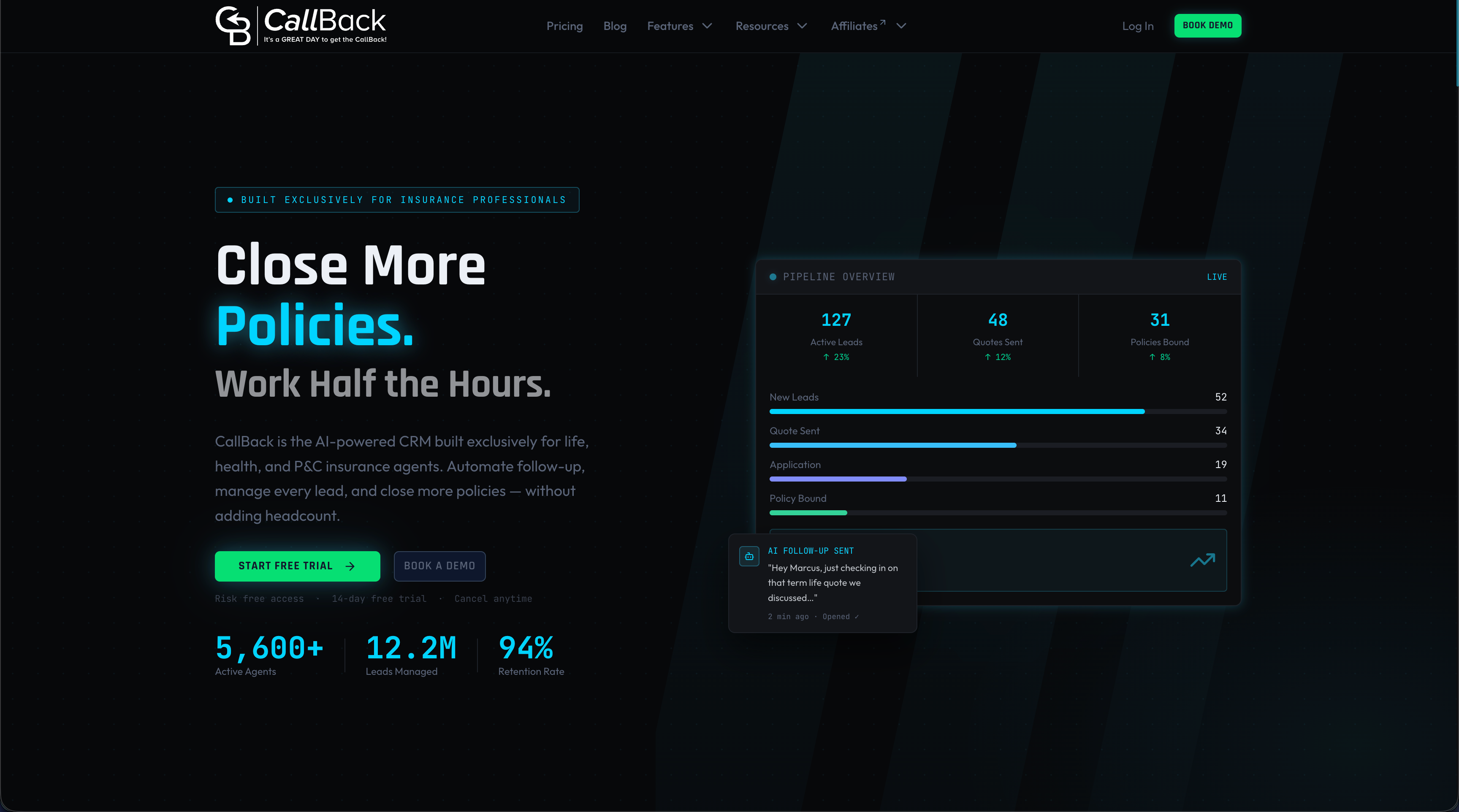
Agents using Callbackcrm can deploy AI-driven follow-up sequences, qualify leads automatically, and route high-value prospects to the right agent without manual sorting. The full feature suite covers everything from chatbot-style AI assistants to proposal tools and reputation management. If you are ready to put AI to work across your agency’s customer interactions, Callbackcrm gives you the infrastructure to do it without a lengthy IT project.
FAQ
What is an AI chatbot in insurance?
An AI chatbot in insurance is software that automates policyholder interactions using natural language processing and machine learning. Advanced versions, called agentic AI, can authenticate users, query policy data, and process claims without human involvement.
How do AI chatbots reduce costs for insurance companies?
AI chatbots resolve routine queries for $0.50–$0.70 per interaction compared to $8–$15 for human agents. Since routine queries represent roughly 90% of inbound insurance contacts, the savings compound quickly at scale.
Are AI chatbots in insurance compliant with regulations?
NAIC guidance requires that AI augment rather than replace human judgment, with explainability and audit trails for every decision. Insurers remain legally liable for all AI-driven outcomes, so any chatbot system must include human oversight and full logging.
How long does it take to deploy an insurance AI chatbot?
Modern agentic platforms can integrate with existing CRM and contact center systems with workflows live in under two days. Smaller agencies benefit most from this speed because it removes the need for large IT migrations.
What is the difference between a rule-based chatbot and conversational AI?
A rule-based chatbot follows a fixed script and cannot handle questions outside its programmed decision tree. Conversational AI uses NLP and machine learning to understand intent, maintain context, and respond dynamically to how a policyholder actually phrases their question.