

TL;DR:
- Predictive analytics forecasts future outcomes using historical data, enabling organizations to act proactively.
- Most failures occur due to poor integration of predictions into decision workflows, not the models themselves.
Most organizations are drowning in data while still making gut-feel decisions. The gap isn’t data volume. It’s the type of analytics in use. Understanding why predictive analytics matter goes beyond appreciating a technical upgrade. It means recognizing that forecasting probable future outcomes rather than just explaining the past changes every decision your organization makes, from which customers to prioritize to how much inventory to hold next quarter. This article cuts through the theory and shows you exactly what predictive analytics delivers and how to make it work.
Table of Contents
- Key takeaways
- Why predictive analytics matter: the core concepts
- How predictive analytics improves business performance
- Operationalizing predictive analytics: from model to action
- Common use cases that show why predictive analytics matters
- My honest take on where organizations go wrong
- How Callbackcrm puts predictive analytics to work for you
- FAQ
Key takeaways
| Point | Details |
|---|---|
| Predictive beats descriptive | Predictive analytics tells you what will likely happen next, not just what already happened. |
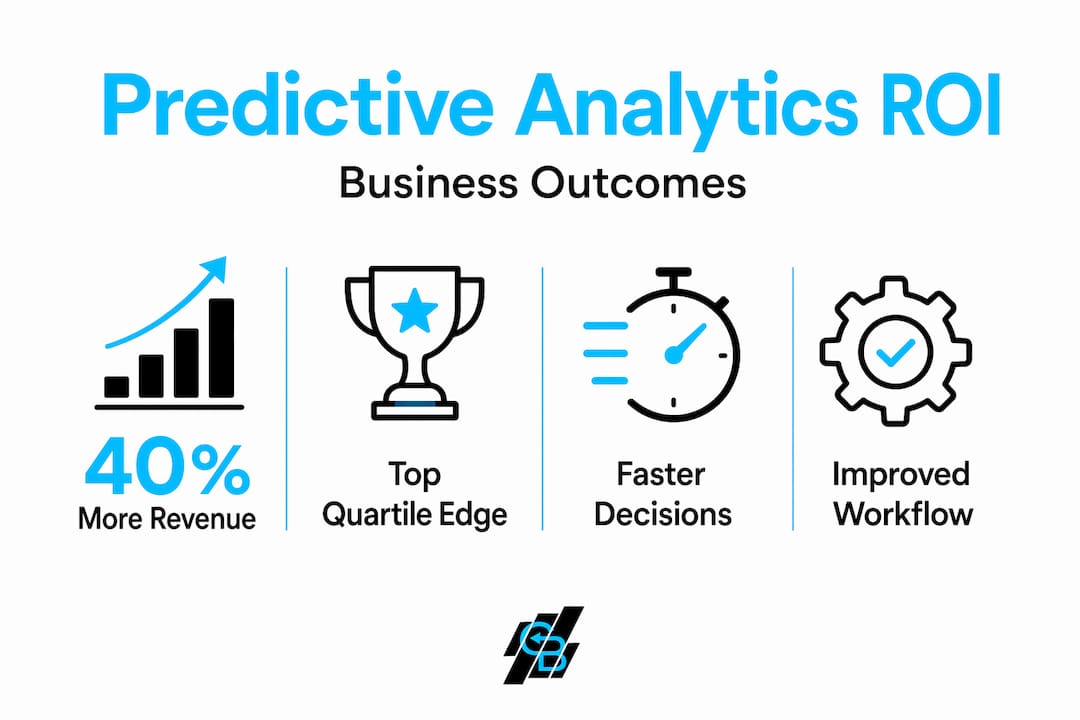
| Measurable financial impact | Companies using predictive personalization report up to 40% more revenue compared to peers who don’t. |
| Action loops are non-negotiable | Predictions without connected workflows produce reports, not results. |
| Model drift silently kills ROI | Production models degrade over time without continuous monitoring and lifecycle governance. |
| Real-time readiness multiplies value | Organizations with real-time decision capabilities achieve over 50% higher revenue growth than those without. |
Why predictive analytics matter: the core concepts
Predictive analytics uses historical data, statistical algorithms, and machine learning to produce probability-based forecasts about future events. It doesn’t tell you what will happen with certainty. It tells you what is most likely to happen and with what confidence, which is a fundamentally different kind of knowledge than a dashboard showing last month’s numbers.
The workflow follows a clear sequence:
- Data collection: Gather structured and unstructured data from CRM systems, transactional records, behavioral signals, and external sources.
- Feature engineering: Select and transform variables that carry predictive power relevant to the outcome you’re modeling.
- Model training: Apply algorithms (regression, decision trees, gradient boosting, neural networks) to learn patterns from historical data.
- Prediction generation: Score new observations against the trained model to produce forward-looking probability estimates.
- Validation and monitoring: Test model accuracy on holdout data, then monitor production performance continuously.
One concept most articles skip is the difference between predictive and prescriptive analytics. Predictive analytics tells you a customer has a 74% probability of churning in the next 30 days. Prescriptive analytics goes one step further and recommends the specific retention offer to send that customer based on their profile. Both matter, but you need functioning predictive outputs before prescriptive recommendations carry any weight.
The other concept worth knowing upfront is model drift. After deployment, the real world changes. Customer behavior shifts, economic conditions move, product lines evolve. A model trained on last year’s data starts making predictions based on patterns that no longer hold. Silent model degradation is one of the most expensive problems in production analytics because accuracy drops before anyone notices.
Pro Tip: Set up automated drift detection from day one, not after you notice prediction quality slipping. Catching drift early costs a fraction of what remediation costs after a model has been making bad recommendations for three months.
How predictive analytics improves business performance
Here is where the importance of predictive analytics becomes undeniable. The shift from reactive to proactive decision-making produces measurable financial returns, faster responses to market changes, and better resource allocation across every function.
Consider four tangible ways this plays out in practice:
-
Decision speed and quality improve simultaneously. Teams stop debating opinions and start acting on probability scores. A sales team that knows which leads score highest for conversion doesn’t need a consensus meeting. They work the list.
-
Risk gets priced before it materializes. Credit teams, insurers, and operations managers who use predictive risk scoring catch problems before they become write-offs. This is the core proactive advantage that descriptive analytics simply cannot offer.
-
Marketing ROI compounds. Predictive personalization drives 40% more revenue compared to generic outreach. When your system identifies which segment is ready to buy and what message converts them, you stop wasting budget on cold audiences. You can see how this applies directly to data-driven insurance marketing where margin on each converted lead is high.
-
Cross-functional alignment becomes data-led. When every team draws from the same predictive model outputs, strategic alignment stops being a leadership problem and becomes a system feature. Finance, sales, and operations are planning against the same forecast.
The financial evidence is hard to argue with. Companies in the top quartile for real-time decision capabilities, which depend directly on predictive analytics infrastructure, report over 50% higher revenue growth and margins than peers. And profit increases up to 73% have been reported by organizations that committed to systematic predictive analytics adoption. These aren’t incremental gains. They reflect a structural competitive advantage.
Beyond the numbers, there’s an organizational psychology benefit worth naming. When your decisions are grounded in model outputs with documented accuracy rates, internal buy-in for strategy shifts becomes far easier to achieve. You’re not selling a gut feeling. You’re presenting a probability and a confidence interval.

Operationalizing predictive analytics: from model to action
This is where most implementations fail. You can have a model with 90% accuracy sitting in a data science notebook, and it delivers exactly zero business value until it connects to a decision workflow with clear ownership.
The role of predictive analytics in business only activates when predictions trigger interventions. A complete predictive analytics solution includes a clear chain from prediction scores to decision policies, to human or automated responses, with comprehensive logging for ongoing calibration. Without that chain, you have a reporting layer dressed up as analytics.
The comparison below captures the operational gap most teams fall into:
| Capability | Reporting mode | Operationalized mode |
|---|---|---|
| Output | Static score or chart | Live score fed into workflow trigger |
| Ownership | Data science team | Business unit with defined action protocol |
| Feedback loop | None | Logged outcomes inform retraining |
| Drift management | Reactive (after complaints) | Automated monitoring with alert thresholds |
| Business impact | Insight sitting in a dashboard | Intervention before outcome locks in |
Sustainable ROI from predictive analytics depends on MLOps disciplines including version control, continuous retraining, and model explainability. These aren’t data science luxuries. They’re the operational infrastructure that keeps production models trustworthy over time. Most organizations dramatically underestimate the gap between a prototype model and a production-ready predictive analytics solution.
The intervention loop design matters just as much as model quality. Who receives the prediction score? What action are they authorized to take? What happens if they don’t act within the defined window? These questions must be answered before deployment, not after.
Pro Tip: Treat every predictive model deployment as a process change, not a technology launch. The model is 20% of the work. The intervention design, training, and feedback loop are the other 80%.
Common use cases that show why predictive analytics matters
Understanding predictive analytics is most useful when you can see it applied across real business functions. The applications span every major sector, including marketing, operations, finance, HR, and risk management.
- Customer churn prediction: Subscription businesses and insurers score customers monthly on churn probability. High-risk accounts trigger retention offers before the cancellation decision is made, not after. This is predictive lead generation working at the retention end of the funnel.
- Supply chain optimization: Retailers and manufacturers forecast demand at the SKU level weeks out. The result is fewer stockouts, lower safety stock costs, and better supplier scheduling. During COVID-19, organizations with demand forecasting models recovered inventory positioning significantly faster than those relying on historical averages.
- Fraud and risk detection: Banks and insurers run transaction-level fraud scoring in real time. A claim or transaction that matches high-risk patterns gets flagged before processing. The cost savings here are immediate and directly measurable.
- HR and workforce planning: HR teams use predictive models to identify employees with elevated flight risk, estimate future hiring needs by role, and optimize team composition for project outcomes. The analytics benefits here often surprise executives who see HR as a qualitative function.
- Personalized marketing at scale: Predictive models score audiences by conversion probability, then feed those scores into automated campaign triggers. The result is that your budget concentrates on the people most likely to act, which is exactly why analytics drives better marketing ROI compared to broad-based campaigns.
The unifying thread across all of these is that predictive analytics enables intervention before outcomes lock in. Descriptive analytics tells you the customer already churned. Predictive analytics gives you a 30-day window to do something about it.
My honest take on where organizations go wrong
I’ve watched teams invest heavily in model development and then struggle for 18 months to generate any measurable business impact. The problem almost never sits in the data science. It sits in the gap between a prediction and an action.
In my experience, the organizations that extract real value from predictive analytics treat it as decision support infrastructure, not a reporting enhancement. Predictive analytics is best understood as a tool that empowers experts to make better decisions, not as something that replaces human judgment. The teams that get this right integrate model scores directly into the tools their people already use. The score appears in the CRM record, the workflow, the daily queue. It doesn’t live in a separate analytics portal that requires a login and a query.
What frustrates me most is seeing organizations treat model deployment as the finish line. Deployment is the starting line. From that point, you need drift monitoring, outcome logging, retraining schedules, and governance. Ignore that discipline, and your model quietly becomes unreliable in production without anyone noticing until the business results stop coming.
My advice is direct: before you build another model, map out exactly what decision it will inform, who will receive the output, and what action they will take within what timeframe. If you can’t answer those questions precisely, your model will produce insights that no one acts on.
— Kyle
How Callbackcrm puts predictive analytics to work for you
If you work in insurance sales or agency management and you’ve been reading this thinking “we need this but don’t have the data science team to build it,” Callbackcrm was built for exactly that situation.
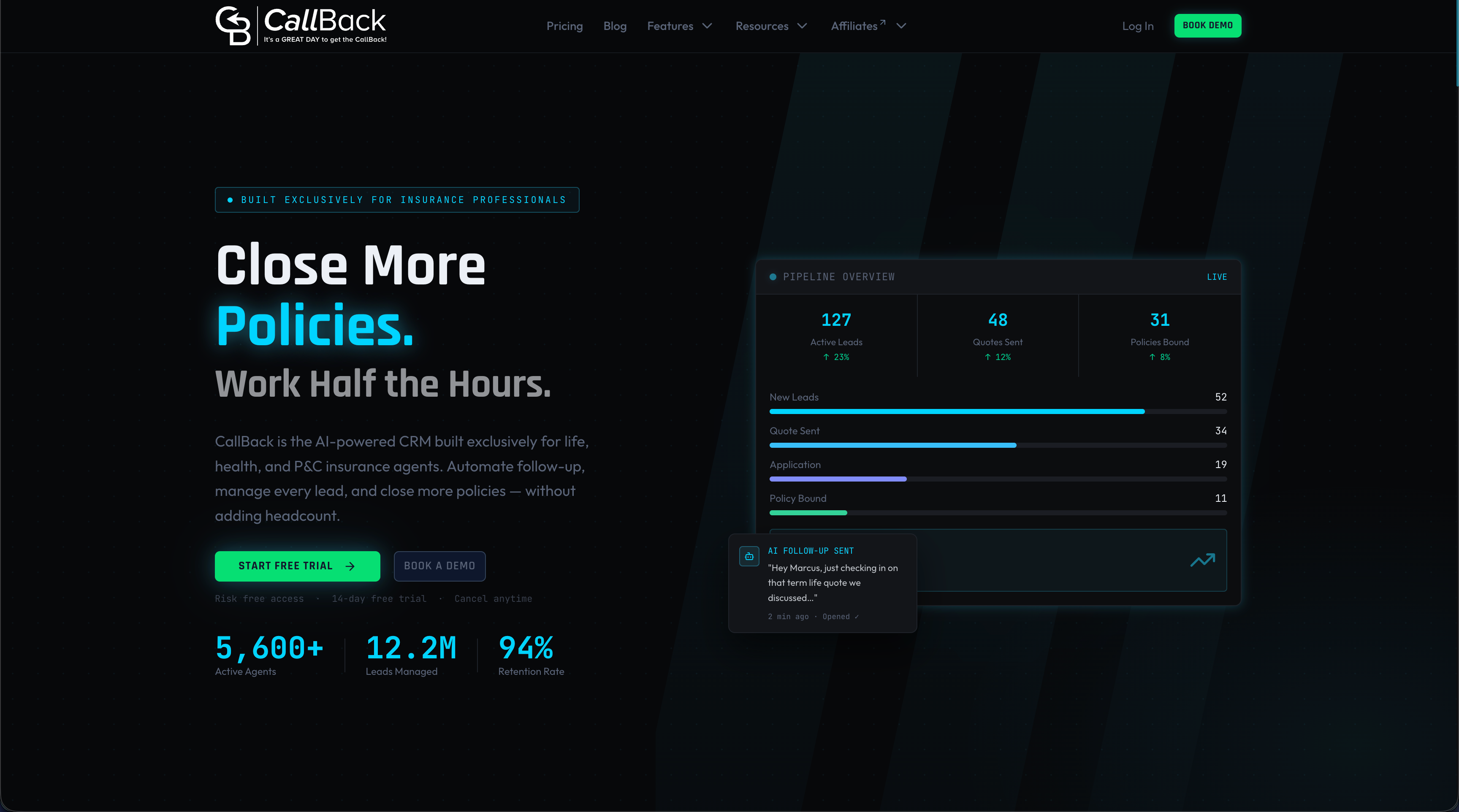
Callbackcrm’s AI-powered platform gives insurance agents and IMOs access to predictive and automation features that identify high-value leads, score prospect behavior, and trigger personalized outreach automatically. The platform connects prediction to action inside a single workflow. Lead scoring feeds directly into SMS marketing campaigns and follow-up sequences so that your highest-probability prospects get the right message without manual sorting. You also get the MLOps side handled. Model outputs update continuously as new behavioral data comes in, so your lead prioritization stays current. Explore the full platform and see how AI-driven decision support works inside an all-in-one sales tool built for insurance professionals.
FAQ
What is predictive analytics in simple terms?
Predictive analytics uses historical data and statistical models to forecast the probability of future events, such as whether a customer will churn, convert, or default, so organizations can act before those outcomes occur.
Why use predictive analytics over standard reporting?
Standard reporting explains what happened. Predictive analytics forecasts what is likely to happen next, which gives decision-makers time to intervene and change outcomes rather than simply document them.
How does predictive analytics help with revenue growth?
Companies using predictive personalization and lead scoring report up to 40% more revenue compared to organizations using only descriptive analytics, primarily because budget and effort concentrate on the highest-probability opportunities.
What is model drift and why does it matter?
Model drift occurs when real-world conditions change enough that a trained model’s predictions become less accurate. Continuous drift monitoring is necessary to catch performance drops before they visibly affect business results.
What is the biggest mistake organizations make with predictive analytics?
Deploying a model without designing the intervention loop. Predictions that don’t connect to defined workflows with clear ownership produce dashboards, not outcomes.