

TL;DR:
- CRM use reduces policy lapses by 25% and increases client retention and assets under management.
- Proper automation and segmentation improve response times, cross-selling, compliance, and client experience.
- Treating CRM as a systematic client relationship platform transforms practices and drives significant growth.
Insurance agents and retirement planners who view CRM platforms as simple contact databases are leaving serious money on the table. CRM adoption leads to a 25% drop in policy lapse rates and a 47% positive effect on client retention, yet most professionals use only a fraction of what these tools can deliver. The gap between average practitioners and top performers often comes down to how deeply they integrate CRM into every part of their client relationship, not just the sales cycle. This article walks you through the core benefits, practical workflows, and proven strategies that turn CRM into a genuine competitive advantage for retirement planning professionals.
Table of Contents
- The evolving landscape of retirement planning
- Core CRM benefits for insurance agents and retirement planners
- Automating processes and improving client outcomes
- Personalization and marketing: Using CRM to build trust
- The hidden value: Why most agents underutilize CRM
- Take your retirement planning CRM to the next level
- Frequently asked questions
Key Takeaways
| Point | Details |
|---|---|
| CRM boosts retention | Automated workflows and reminders significantly reduce client churn and increase long-term value. |
| Automation saves time | Streamlined processes let agents focus on client relationships and strategic planning. |
| Personalization builds trust | Targeted communication enabled by CRM enhances engagement and encourages referrals. |
| ROI is proven | Insurers and advisors leveraging CRM consistently report returns of 3:1 or greater on their investment. |
The evolving landscape of retirement planning
Retirement planning has never been more complex, and client expectations have never been higher. Decades ago, a retiree would meet with an advisor once a year, review a simple portfolio, and call it done. Today, clients expect personalized service, real-time communication, and advice that accounts for Social Security timing, tax-efficient withdrawal strategies, Medicare decisions, long-term care costs, and inflation risk, all at once. If your process can’t keep up with that level of complexity, clients will find someone whose process can.
The regulatory environment adds another layer of pressure. Compliance requirements around fiduciary standards, suitability reviews, and documentation have increased significantly. One missed renewal notice or a poorly timed lapse in communication doesn’t just frustrate a client. It can trigger a complaint, a compliance review, or a lost book of business.
Here’s what’s driving this shift in client expectations:
- Clients now compare their advisor experience to consumer apps like Amazon and Netflix, expecting proactive personalization rather than reactive responses.
- Aging baby boomers are transferring wealth to a generation of beneficiaries who are digitally savvy and willing to switch advisors if communication feels generic.
- Interest rate volatility and longer life expectancies mean retirement plans need more frequent reviews and updates than ever before.
- Online portals and competitor platforms have conditioned clients to expect instant, accurate answers rather than callbacks days later.
This is where relationship management frameworks come into play. There’s a growing movement toward what advisors call the Centralised Retirement Proposition (CRP), a structured, consistent playbook for delivering retirement advice. Consistency in advice is central to both CRP and CRM approaches in retirement planning, ensuring every client gets the same quality of structured guidance regardless of who handles them.
“A CRM isn’t just where you store contacts. It’s the engine behind every consistent client experience you deliver, from the first meeting to the final beneficiary payout.”
The agents who thrive in this environment are the ones who recognize that the client relationship is a system, not a series of one-off interactions. CRM gives you the infrastructure to build and manage that system at scale, without dropping the personal touch that clients actually value.
Core CRM benefits for insurance agents and retirement planners
With rising complexity as the backdrop, the right CRM platform delivers measurable structure and proven financial upside. Let’s get specific about what that looks like in practice.

The numbers are hard to ignore. CRM systems produce a 3:1 to 3.5x ROI, 45% faster client response times, and a 20% increase in assets under management (AUM). For a mid-sized retirement planning practice managing $30 million in AUM, a 20% increase represents $6 million in additional managed assets. That’s not a marginal gain. That’s a practice transformation.
Here’s a quick comparison of how practices operate with and without an active CRM strategy:
| Practice area | Without CRM | With CRM |
|---|---|---|
| Client follow-up | Manual, inconsistent | Automated, scheduled |
| Policy lapse rate | Industry average or higher | Up to 25% lower |
| Response time | Hours to days | Up to 45% faster |
| Cross-sell identification | Ad hoc and reactive | Data-driven and proactive |
| AUM growth | Flat or slow | Up to 20% increase |
| Compliance documentation | Spreadsheets, emails | Centralized, audit-ready |
So how do you actually get these results? The process starts with these foundational steps:
- Centralize all client data. Every policy, beneficiary, contact preference, life event, and communication history should live in one place. This eliminates the “I thought someone else called them” problem and gives you a 360-degree view of each client.
- Segment your book. Group clients by life stage, product type, renewal date, or risk profile. A 58-year-old pre-retiree needs different messaging than a 72-year-old in distribution mode.
- Set automated milestone triggers. Birthday messages, anniversary reviews, and annual policy check-ins should fire automatically without you having to think about them.
- Track all touchpoints. Every email, call, and meeting gets logged. When a client calls with a concern, your team can see the full history instantly rather than starting from scratch.
- Use analytics to find opportunities. Good CRM platforms surface clients who are due for a review, have products that could be upgraded, or haven’t been contacted recently enough.
Pro Tip: Start by building three core segments in your CRM: pre-retirement clients (ages 55 to 64), active retirees (65 and older), and estate planning clients. Each group needs different content, different check-in frequencies, and different product conversations. Segmenting early makes every downstream communication exponentially more relevant.
The cloud CRM retention results for agents who fully adopt these practices are consistently stronger than those who only use CRM for contact storage. And for agencies looking to boost sales with CRM, the data consistently shows that relationship-centered automation outperforms cold outreach every time.
Automating processes and improving client outcomes
Modern CRM platforms do more than organize data. They remove the manual work that slows down your practice and creates gaps where clients fall through the cracks. Automation is where CRM moves from useful to genuinely transformative.
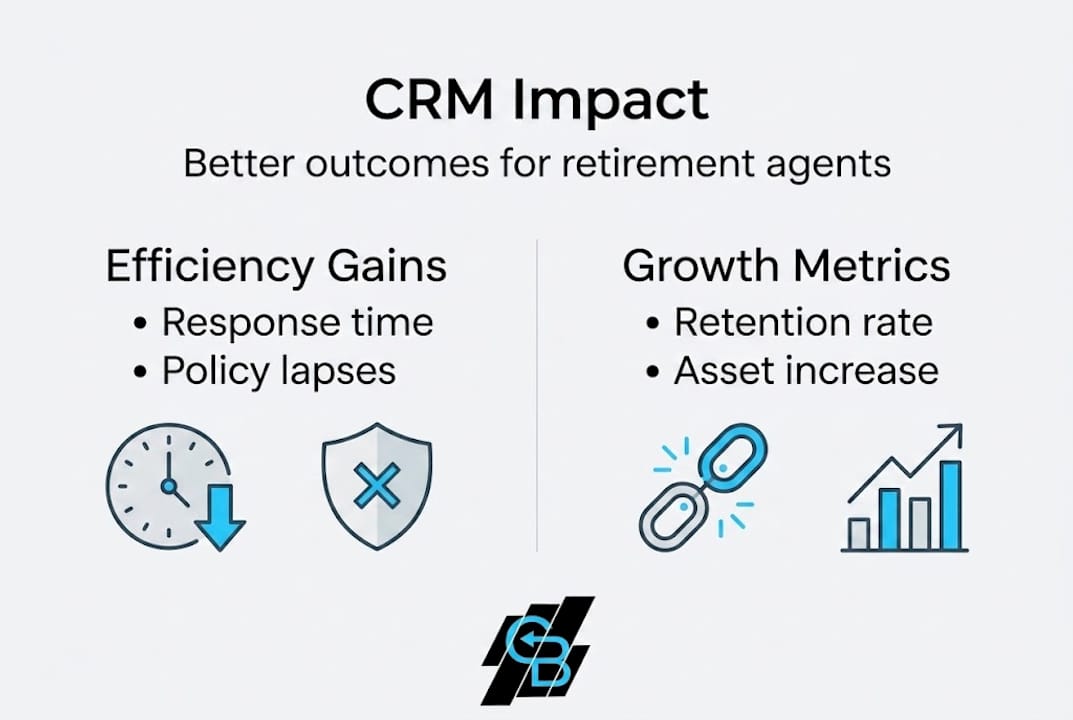
CRM automation leads to a 25% drop in policy lapse rates and 45% faster client responses, two metrics that directly affect your revenue and your clients’ outcomes. Think about what a policy lapse means for a retiring client. It’s not just an administrative headache. It can mean losing life insurance coverage at the exact moment they need it most, or facing surrender charges that disrupt their retirement income plan.
Here are the key workflows every retirement-focused insurance practice should automate:
| Workflow | Trigger | Action | Frequency |
|---|---|---|---|
| Policy renewal | 90, 60, 30 days out | Email and SMS to client | Per renewal |
| Annual review | Client anniversary date | Schedule call, send agenda | Yearly |
| Onboarding sequence | New client signed | Welcome email series | First 30 days |
| Compliance reminder | Regulatory calendar | Internal task to advisor | As required |
| Life event follow-up | Birthday, retirement date | Personalized outreach | Per event |
Each of these workflows removes a decision point from your daily to-do list and replaces it with a system that runs consistently, regardless of how busy your week gets.
Onboarding is particularly critical and often underestimated. When a new client joins your practice, the first 30 days set the tone for the entire relationship. A well-designed onboarding sequence might include a welcome email with their advisor’s direct contact, a second message explaining the review process, a third with educational content about their specific retirement stage, and a calendar invite for their 30-day check-in call. All of this can run automatically the moment a client’s record is created in your CRM.
- Automated renewal reminders reduce the risk of lapsed coverage and the awkward conversation that follows.
- Compliance reminders protect your practice from missed documentation deadlines.
- Review cycle triggers ensure every client gets an annual conversation, even during your busiest enrollment seasons.
- Life event tracking lets you reach out proactively when something changes, positioning you as attentive rather than reactive.
Pro Tip: Build a “dormant client” automation that flags any client who hasn’t had a logged touchpoint in 90 days. Send them a brief check-in message from your CRM automatically. You’ll be surprised how often this reactivates a client conversation or surfaces a referral opportunity that would have been missed otherwise.
Explore insurance CRM workflow examples to see how other agents have structured these automations, and learn more about empowering agents with CRM to handle higher client volumes without adding staff.
Personalization and marketing: Using CRM to build trust
Automation handles the timing. Personalization handles the message. Together, they create the kind of client experience that generates referrals, extends relationships across generations, and makes clients resistant to competitor outreach.
CRM adoption significantly enhances customer retention through personalized engagement, and the mechanics of this are more practical than most agents realize. Personalization doesn’t mean writing custom emails by hand for every client. It means using the data in your CRM to make automated messages feel relevant, timely, and specific to each person’s situation.
Segmented client lists are the foundation. Instead of sending one generic newsletter to your entire book, you create targeted campaigns for each audience:
- Pre-retirees aged 55 to 64: Content about Social Security optimization, Roth conversion strategies, and Medicare enrollment timelines.
- New retirees aged 65 to 72: Income distribution strategies, required minimum distribution (RMD) planning, and long-term care options.
- Legacy planning clients: Beneficiary review prompts, estate planning checklists, and trust and life insurance conversations.
- Business owner clients: Key person insurance reviews, buy-sell agreement funding, and succession planning content.
Each group receives content that speaks directly to where they are in life. That specificity builds credibility. When a client reads something from you that addresses exactly what they’re thinking about, they don’t see you as a salesperson. They see you as an advisor who actually knows them.
Regular communication is equally important. Advisors who check in consistently, even with a brief quarterly update or a market commentary, maintain top-of-mind awareness that protects against attrition. When a competitor calls a client who hasn’t heard from their current advisor in six months, they’re receptive. When a competitor calls a client who got a birthday message, a market update, and a policy review invitation from you in the last quarter, they’re not.
CRM platforms also give you campaign analytics so you can measure what’s working. Open rates, click rates, and response rates tell you which messages resonate with which segments. If your Medicare content gets high engagement from your pre-retiree segment, you know to create more of it. If your estate planning emails go unopened, you might need to rethink the subject line or the timing.
Pro Tip: Use your CRM’s merge fields to personalize subject lines with the client’s first name and a reference to a recent life event or policy milestone. Something as simple as “John, your policy anniversary is coming up” outperforms generic subject lines by a wide margin and takes zero extra time once your templates are built.
For agents ready to take this further, CRM-powered email marketing walks through the practical setup of campaigns designed specifically for insurance and retirement clients.
The hidden value: Why most agents underutilize CRM
Here’s the uncomfortable truth most CRM vendors won’t tell you: the majority of insurance agents use their CRM as an expensive digital Rolodex. They log contacts, store a few notes, and occasionally run a birthday report. That’s it. They’re paying for a Ferrari and using it to go to the grocery store.
The real transformation happens when you stop thinking of CRM as a record-keeping tool and start thinking of it as the architecture of your client experience. Every touchpoint a client has with your practice, from the first website visit to the 20th annual review, should be shaped and tracked by your CRM. Not just recorded after the fact.
What separates the top 10% of retirement planners from everyone else isn’t talent or product knowledge. It’s systematization. They’ve built onboarding sequences that make new clients feel immediately valued. They’ve automated review cycles so no one falls through the cracks during busy seasons. They’ve integrated their CRM with their marketing so that every email campaign feeds data back into the client record.
Agents who treat CRM as an afterthought will always be running their practice reactively, calling people because they remembered to, sending updates when things are slow, and hoping clients don’t leave. Agents who invest in integrating CRM and marketing into a unified system build practices that grow on autopilot, where the relationship management process runs whether they’re at their desk or on vacation.
The compounding effect of good CRM habits is real. Better onboarding leads to stronger early relationships. Stronger relationships lead to referrals. Automated reviews lead to cross-sell opportunities. Better marketing analytics lead to smarter campaigns. Each improvement builds on the last, and over three to five years, the gap between the systematized practice and the unsystematized one becomes enormous.
Take your retirement planning CRM to the next level
Ready to put everything covered here into action? The strategies above are proven, but implementing them efficiently requires a platform built specifically for insurance and retirement planning workflows.
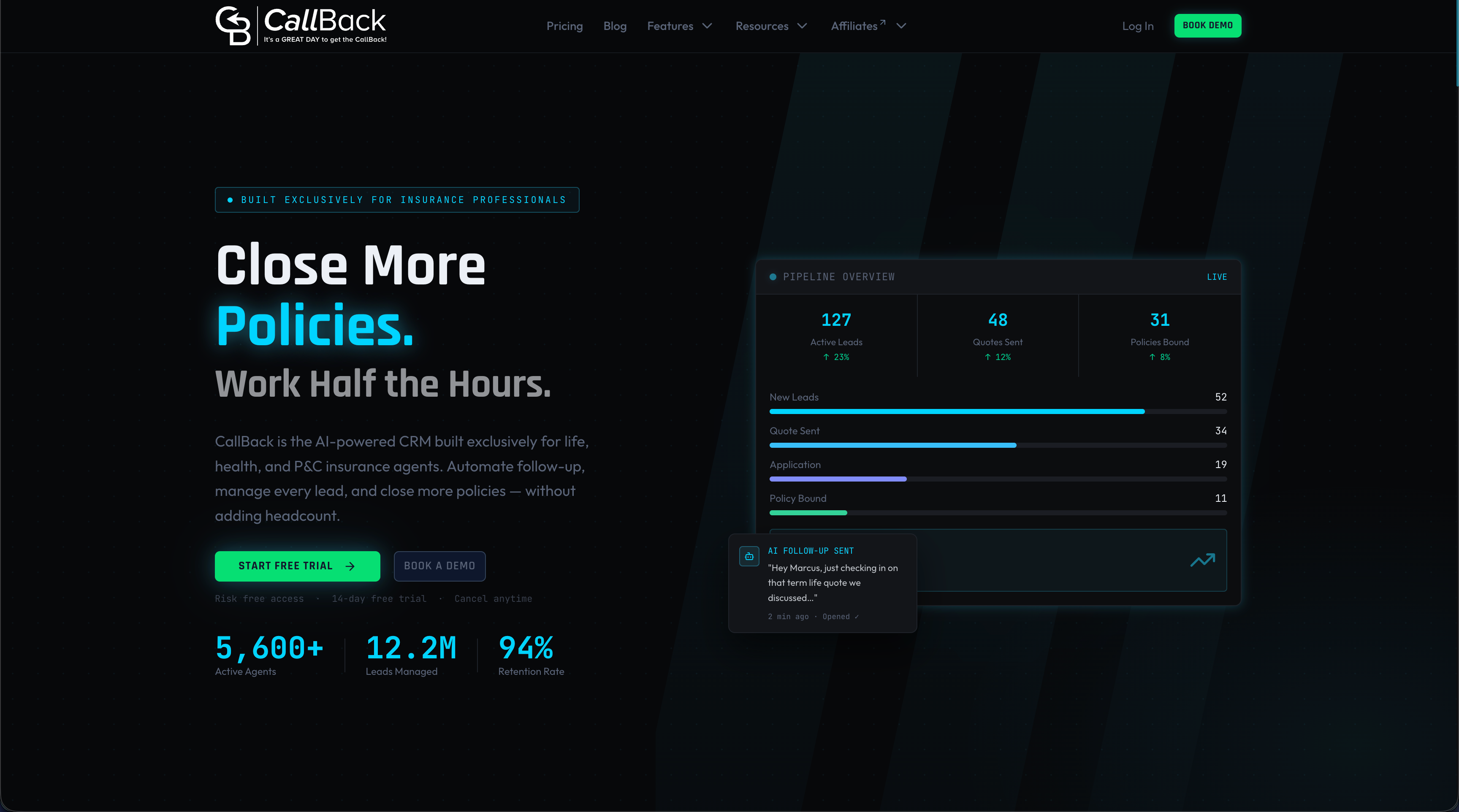
CallBack CRM brings together CRM features for retirement planners, including automated workflows, segmented email and SMS campaigns, compliance tracking, AI-powered lead scoring, and detailed analytics, inside one platform designed for agents and IMOs. You don’t need to stitch together five different tools or manually maintain spreadsheets alongside a generic CRM. The website and funnel tools also help you capture and nurture leads directly into your CRM pipeline. From onboarding automation to personalized marketing campaigns, CallBack CRM gives retirement professionals the infrastructure to grow their book of business without adding complexity.
Frequently asked questions
How does CRM reduce policy lapse rates in retirement planning?
Automated reminders and workflow management ensure clients receive timely renewal communications, and CRM adoption drives a 25% reduction in policy lapse rates by removing the manual gaps that cause policies to fall through the cracks.
Can CRM help increase assets under management (AUM) for advisors?
Yes. CRM is linked to up to a 20% increase in AUM by enabling better client relationships, proactive cross-selling, and more frequent touchpoints that keep clients engaged and invested in your practice.
What role does CRM play in ensuring consistency of retirement advice?
CRM provides a repeatable structure for client communication and documentation, aligning directly with CRP consistency principles that treat every client to the same standard of organized, personalized guidance regardless of who on your team handles them.
Are ROI improvements with CRM measurable in retirement planning?
Absolutely. CRM investments return between 3:1 and 3.5x ROI for insurance and retirement planning practices, making it one of the highest-return investments an agent or planner can make in their business infrastructure.