

TL;DR:
- Operational performance, especially claims outcomes, is the primary driver of insurance reputation and broker loyalty.
- AI tools enable real-time monitoring, automated responses, and lead scoring to enhance reputation management.
- Proper governance and operational follow-through are crucial; technology alone cannot fix poor customer experiences.
Reputation in insurance is not a brand exercise. It’s a measurable business driver that directly controls where brokers place their business, how many leads walk through your door, and whether clients renew or walk away. The evidence is stark: claims dissatisfaction can collapse broker loyalty almost entirely, while a positive experience locks in future placements at rates most marketers only dream about. AI tools now give insurance agencies the ability to monitor, manage, and strengthen their reputation at a scale and speed that was impossible five years ago.
Table of Contents
- Why reputation management matters for insurance agencies
- How AI tools transform reputation management in insurance
- Strategies for insurance agencies to improve reputation and lead generation
- Common challenges and pitfalls in reputation management with AI
- The uncomfortable truth about reputation management in insurance
- Connect your agency’s reputation strategy with AI-driven solutions
- Frequently asked questions
Key Takeaways
| Point | Details |
|---|---|
| Claims outcome drives loyalty | Positive claims experiences make brokers 9 times more likely to place business with an insurer. |
| AI tools minimize errors | Workflow-focused AI platforms help agencies avoid coverage fact mistakes and boost reputation safely. |
| Strategic reputation tactics | Combine real customer engagement, automated feedback, and strong governance for sustainable results. |
| Reputation risk is measurable | Insurance firms now quantify reputation exposure by tracking engagement and privacy controls. |
Why reputation management matters for insurance agencies
Reputation is not built in a marketing meeting. It’s built in the claims department, on hold with a service rep, and in the follow-up email after a policy renewal. For insurance agencies, operational performance is the real reputation engine, and brokers know it.
The numbers make this uncomfortably clear. Brokers with good claims outcomes are 95% likely to return business to the same insurer within 12 months, while brokers who experienced a poor claims outcome drop to just 10%. That is not a marginal difference. That is a business-defining gap that no advertising budget can close.
“Claims performance is now a primary filter for broker placement decisions. Agencies that treat it as an afterthought are effectively giving their competitors a 9-to-1 advantage in broker retention.”
Think about what this means practically. If your agency handles 100 broker relationships and half have mediocre claims experiences, you are potentially trading away 42 placements that a competitor with better operational outcomes would keep. Multiply that across a year, and you are looking at a significant revenue leak that no amount of Google ads will plug.
Customer reviews and agent narratives add another layer. Online reviews on Google, insurance-specific platforms, and social media now surface directly in prospect searches. Agencies that understand insurance reputation management basics know that response speed, tone, and consistency across review platforms are as important as the rating itself. A 4.2-star agency that responds thoughtfully to every review often outperforms a 4.6-star agency that ignores feedback entirely.
Here is a quick comparison of reputation signals and their impact on agency performance:
| Reputation signal | Impact on broker loyalty | Impact on direct leads | Manageable with AI |
|---|---|---|---|
| Claims handling speed | Very high | Moderate | Partially |
| Response to reviews | Moderate | High | Yes |
| Communication consistency | High | High | Yes |
| Policy error rate | High | Moderate | Yes |
| Social proof and testimonials | Low | High | Yes |
The table reveals something important: AI tools are most effective at managing the signals that directly influence direct leads, while the hardest factor (claims speed) requires operational investment. Reputation management is a two-track effort: fix the operation, then amplify the results with technology.
How AI tools transform reputation management in insurance
AI has moved from a buzzword to a practical toolkit for agencies that want to stay competitive. But not all AI is created equal, and in insurance, that distinction carries real risk.

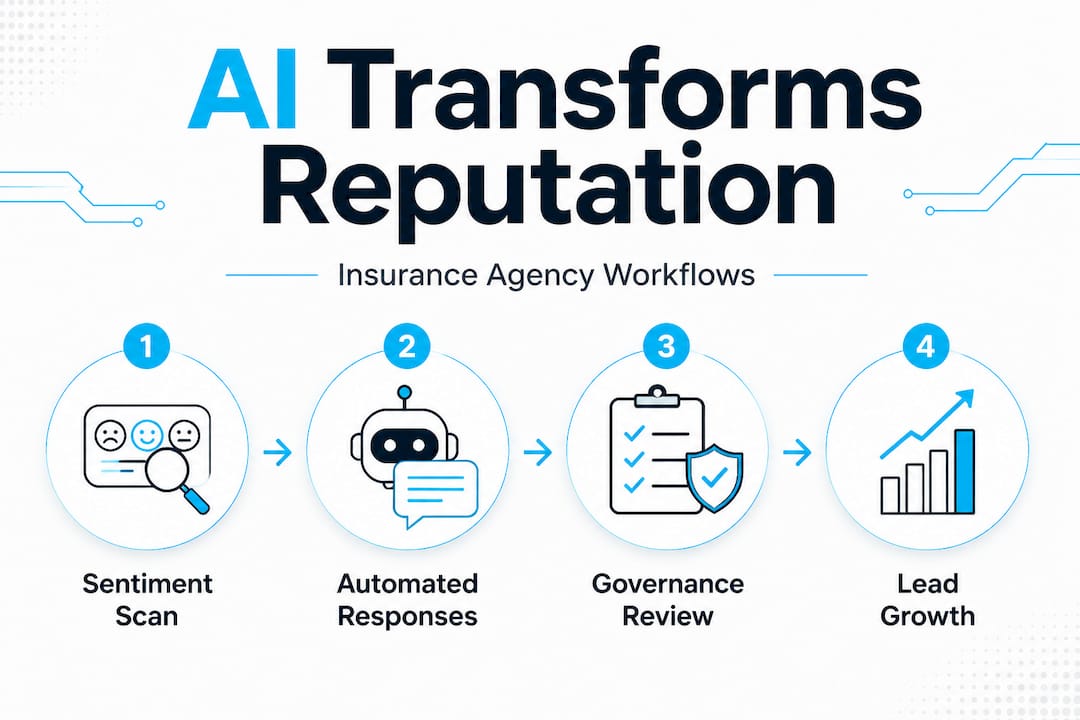
The most effective AI applications for reputation management fall into three categories: sentiment monitoring, automated response workflows, and lead scoring based on engagement data. The best AI tools for insurance combine these into connected systems rather than isolated point solutions.
Sentiment monitoring tools scan review platforms, social media, and even call transcripts to flag negative signals before they become public crises. If a client posts a frustrated comment about a delayed claim, an AI-monitored workflow can alert your team within minutes, trigger a personalized outreach sequence, and log the interaction in your CRM automatically. Compare that to the traditional model of a staff member manually checking Google reviews twice a week.
Automated response management is where AI marketing to boost leads becomes tangible. Agencies can configure AI workflows to draft review responses, route complex complaints to senior agents, and send follow-up satisfaction surveys after claim closures. The speed alone changes the customer experience. A client who receives a personal response within two hours of posting a review has a dramatically different perception of your agency than one who waits three days.
Here is how AI-assisted reputation tasks compare to manual processes:
| Task | Manual process time | AI-assisted time | Error risk |
|---|---|---|---|
| Review monitoring | Daily check (15 min) | Real-time | Lower |
| Response drafting | 10 to 20 min per review | 2 to 3 min with review | Lower with governance |
| Sentiment analysis | Weekly report | Continuous | Significantly lower |
| Client follow-up after claim | Manual scheduling | Automated triggers | Lower |
| Lead scoring from engagement | Not practical manually | Automated | Lower |
The governance point is critical. AI governance in insurance is not optional. Reputation management in insurance involves policy details, coverage claims, and client-specific information. A generative AI system that “hallucinates” (produces confident but incorrect information) can create errors and omissions (E&O) exposure for your agency.
Pro Tip: Before deploying any AI tool for client-facing communications, test it with 20 real-world scenarios from your agency’s case history. If it produces even one factually incorrect policy statement, your governance controls are not tight enough.
Key capabilities to look for in AI reputation tools for insurance:
- Deterministic response engines that pull from verified policy data rather than generating open-ended answers
- Workflow automation with human approval steps for sensitive communications
- CRM integration that logs every reputation touchpoint for audit purposes
- Sentiment scoring with configurable alert thresholds
- Review platform connectors for Google, Yelp, and insurance-specific directories
Strategies for insurance agencies to improve reputation and lead generation
Understanding the technology is one thing. Deploying it strategically is another. Here is a practical framework agencies can implement to build reputation and generate leads simultaneously.
Reputation risk is increasingly quantifiable. A Willis survey on reputational risk found that corporate-level reputation risk is now treated as a structured risk-control topic, not just a PR concern. That shift matters for insurance agencies because it means boards and senior teams are expecting measurable metrics, not anecdotes.
Here is a numbered action framework for agencies ready to take reputation management seriously:
-
Audit your current reputation footprint. Pull your last 12 months of reviews, complaint logs, and NPS scores. Look for patterns, not outliers. Are slow claim communications showing up repeatedly? That is a process problem, not a bad luck problem.
-
Integrate AI sentiment monitoring into your CRM. Your AI customer engagement strategies should include real-time alerts for negative sentiment across every channel where clients interact with your brand.
-
Automate post-claim outreach. Build a workflow that triggers a satisfaction check within 48 hours of a claim closing. This single step has been shown to improve client retention and surface positive review opportunities before clients disengage.
-
Standardize review response protocols. Draft templates for common response scenarios (delayed claim, billing dispute, policy confusion), then use AI to personalize them at scale. Human review before posting protects against E&O exposure.
-
Connect reputation signals to your lead pipeline. Use AI-powered lead generation tools to score inbound prospects based on how they found you. A lead who found you through a five-star review or a referral is warmer than a cold ad click and should be prioritized accordingly.
-
Build privacy and cyber controls into your communication stack. Clients in 2026 are acutely aware of data privacy. Agencies that visibly protect client information and communicate their security practices build a layer of trust that feeds reputation over time.
-
Automate renewal touchpoints. Insurance sales automation workflows that send personalized renewal reminders, coverage review invitations, and policy update notifications show clients you are proactive. Proactivity is a major reputation driver.
Key statistic: According to the Willis survey, organizations that treat reputation risk as a quantifiable variable are better positioned to respond quickly when negative events occur because they already have monitoring and escalation systems in place. Agencies without those systems often react too slowly, which compounds reputational damage.
Pro Tip: Ask every new client during onboarding how they heard about your agency. Track this data in your CRM. Over six months, you will see which reputation signals (reviews, referrals, social content) generate the most valuable leads, and you can invest accordingly.
Common challenges and pitfalls in reputation management with AI
Technology does not eliminate risk. It redistributes it. Agencies that deploy AI for reputation management without proper safeguards can create new problems faster than they solve old ones.
The biggest risk is generative AI producing incorrect policy information. A chatbot that tells a prospect “your policy covers flood damage” when it does not is not just embarrassing. It is a potential E&O claim. AI tools for insurance that favor deterministic or workflow-constrained approaches over free-form generation dramatically reduce this risk because every response is pulled from verified, structured data rather than synthesized from patterns.
Common pitfalls to watch for:
- Overpromising in automated responses. AI-drafted responses that sound authoritative but contain coverage details not specific to the client’s policy.
- No human review checkpoint. Fully automated response systems that post directly to public review platforms without agent approval.
- Inconsistent messaging. When AI tools are not connected to a central CRM, different channels produce different answers to the same client question.
- Ignoring negative sentiment escalations. AI alerts are only useful if someone acts on them. Build escalation paths with clear ownership.
- Neglecting data hygiene. AI tools trained on outdated or incomplete policy data will produce outdated or incomplete responses.
“The agencies that struggle most with AI-driven reputation management are not the ones using the wrong tools. They are the ones using good tools without governance frameworks to contain the output.”
For data-driven insurance marketing to work without creating liability, every automated touchpoint that references coverage, pricing, or claims must pass through a verification layer. Think of it as a spell-check for factual accuracy, not just grammar. Agencies using AI marketing tools for insurance leads should document their governance process so they can demonstrate compliance if a dispute arises.
The uncomfortable truth about reputation management in insurance
Here is something most articles in this space will not tell you: no AI platform, no matter how sophisticated, can fix a genuinely poor customer experience. Technology is an amplifier. It makes great operations look outstanding, and it makes poor operations fail faster and more publicly.
The agencies we see struggling most with reputation are not short on technology. They are short on follow-through. They have CRMs loaded with automation workflows but claim handlers who still take two weeks to return calls. They have five-star review request campaigns running alongside complaint queues that nobody is monitoring.
Reputation is a strategic asset only if it reflects operational reality. When it does not, the gap becomes visible quickly in the review stream, in broker attrition, and eventually in renewal rates. The insurance reputation management basics that genuinely move the needle are not about which platform you use. They are about whether your agency actually delivers what it promises.
AI tools matter enormously, but they matter most when they are surfacing real operational strengths, automating genuine follow-through, and giving agents time to focus on relationship quality rather than administrative tasks. The agencies winning in 2026 are the ones where AI handles the repetitive and the operational handles the exceptional.
Connect your agency’s reputation strategy with AI-driven solutions
If the strategies above resonate with where you want to take your agency, the next step is finding a platform that handles monitoring, automation, and client communication without requiring a separate tool for each function.
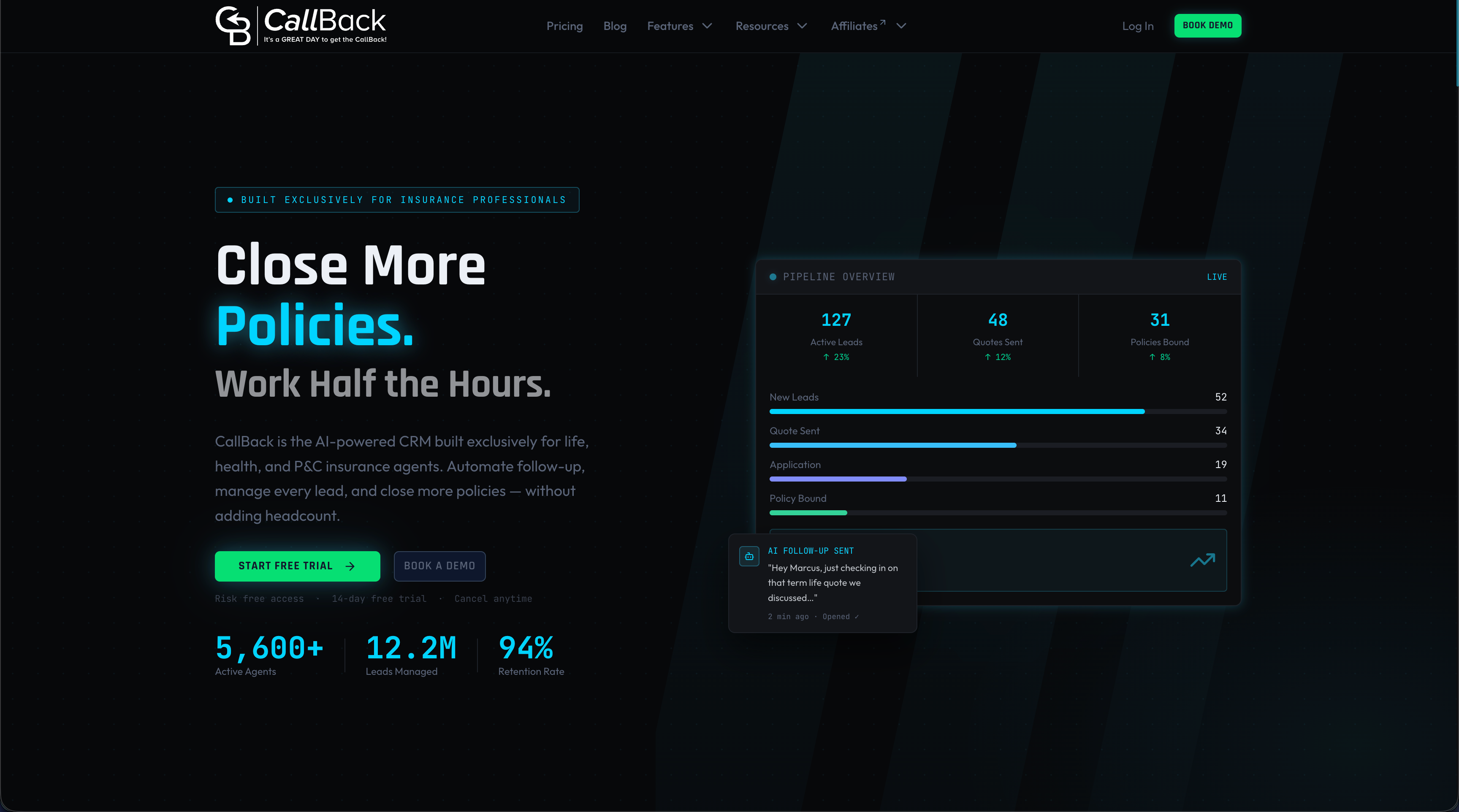
CallBack CRM is built specifically for insurance agents and agencies who want to centralize their reputation management, lead generation, and customer engagement in one place. The platform’s AI insurance tools features include automated workflow builders, CRM-integrated sentiment monitoring, and review response management that keeps human approval in the loop. For agencies that want to move fast on client follow-up, the SMS marketing for insurance tools enable real-time outreach after claim events or policy milestones. And for teams ready to reduce manual overhead across every touchpoint, the insurance automation tools make it straightforward to build compliant, governance-ready workflows.
Frequently asked questions
How does reputation management impact lead generation for insurance agents?
A strong reputation, particularly around claims outcomes, directly controls broker placement decisions. With 95% of satisfied brokers likely to return business within 12 months, reputation is one of the highest-leverage lead generation factors available.
What types of AI tools are safest for insurance agencies regarding reputation management?
Deterministic and workflow-constrained AI tools that pull from verified data and predefined logic are the safest choice. AI platforms with governance controls minimize hallucination risk and reduce the chance of producing incorrect policy information in client-facing communications.
How can agencies prevent errors in automated customer communications?
Agencies should deploy AI platforms with built-in governance layers and require human review for any communication that references specific policy details or coverage facts. AI governance requirements in insurance are not optional when automated systems interact with clients on factual matters.
Is reputation risk quantifiable for insurance agencies?
Yes. The Willis reputational risk survey confirms that corporate reputation risk is now treated as a structured, measurable control topic. Agencies can track reputation risk through engagement metrics, complaint volume, sentiment scores, and renewal rate trends over time.