
Managed Agents let you create AI-powered assistants by describing the work you want them to perform in plain language. You can connect Knowledge Bases, configure CRM actions and event triggers, and test an agent before publishing it. Supported agents can also generate images, audio, and video or use Computer for browser-based tasks. This guide explains how to create, configure, test, publish, and manage Managed Agents.
TABLE OF CONTENTS
- What Is the Managed Agents Builder?
- Key Benefits of Managed Agents
- Prerequisites and Limitations
- Build Agents Using Natural Language
- Intelligent CRM Agents
- Computer for Managed Agents
- Event-Driven Automation
- Managed Agents Unified Workspace
- How to Set Up Managed Agents
- Frequently Asked Questions
- Related Articles
- Need Help?
What Is the Managed Agents Builder?
The Managed Agents builder, formerly called Super Agents, creates AI agents from conversational instructions instead of requiring you to configure every step using a visual flowchart.
Managed Agents can answer questions, retrieve information from connected Knowledge Bases, perform supported CRM actions, respond to configured events, and use available tools to complete tasks.
Each agent follows a Draft, Test, and Publish lifecycle. You describe the agent's role, review its generated configuration, refine its behavior, and test it before enabling live activity.
Managed Agents also offers a Unified Workspace that combines agent discovery, conversations, testing, activity, and configuration into one interface. The Unified Workspace is available through its supported Labs feature. When that feature is not enabled, the existing Managed Agents interface remains available.
Key Benefits of Managed Agents
Managed Agents combine natural-language instructions, approved business information, and supported automation tools. This lets you automate repeatable work while retaining control over the agent's responsibilities, connected resources, and actions.
- Natural-Language Setup: Describe the agent's role, responsibilities, and behavior instead of manually connecting workflow nodes.
- CRM Automation: Use permitted actions to update contact records, manage tags, trigger workflows, and complete supported tasks.
- Knowledge-Based Responses: Connect approved Knowledge Bases so the agent can retrieve relevant business information when answering questions.
- Concurrent Browser Work: Use Computer to perform supported browser tasks through independent environments and parallel conversations.
- Secure Website Authentication: Use supported credential storage when browser tasks require access to authenticated websites.
- Testing Before Publishing: Review responses, actions, and configured behavior before allowing an agent to process live events.
- Centralized Agent Management: Find, test, monitor, configure, and publish agents from the available Managed Agents workspace.
Prerequisites and Limitations
Before building a Managed Agent, confirm that you can access the builder and that the resources required for its tasks are available. Connected tools, integrations, and permissions determine which actions the agent can perform.
Prerequisites
Prepare the necessary access, knowledge, and connections before configuring the agent.
- Managed Agents Access: You must have permission to access and manage Managed Agents.
- Knowledge and Tools: Prepare any Knowledge Bases, workflows, or calendars that the agent needs.
- Connected Integrations: Configure the supported connections required for external services or communication channels.
- Facebook Lead Forms: Connect the applicable Facebook Page for lead synchronization. A Page administrator must accept Meta's Lead Ads Terms of Service.
- Testing: Review the agent's instructions, connected resources, and available actions before publishing.
Limitations
Managed Agents support a range of capabilities, but their availability depends on the current configuration and supported integrations.
- Available triggers and communication channels depend on the configured integrations and supported agent capabilities.
- The Unified Workspace requires its supported Labs feature. The existing interface remains available when Unified Workspace is not enabled.
- Computer-based tasks require access to the appropriate browser tools and any websites involved.
- Secure website authentication requires the necessary credentials and permissions.
- Media-generation capabilities must be enabled before the agent can use them.
- Generated configurations should be reviewed and tested before they perform live CRM actions or communications.
Build Agents Using Natural Language
The Managed Agents builder turns a plain-language description into an initial agent configuration. Clear instructions help the builder understand the work the agent should perform, the information it needs, and the boundaries it must follow.
When describing an agent, include:
- Role: The work the agent is responsible for, such as customer support, lead follow-up, or social media assistance.
- Supported Channels: Where the agent should interact, such as supported chat, email, or event-based experiences.
- Knowledge Bases: Which approved business information the agent should use.
- Permitted CRM Actions: Which supported record updates, workflow actions, or other operations the agent may perform.
- Behavior: Its tone, response style, task boundaries, and expected results.
Example Agent Prompt
A detailed prompt helps the builder create a draft that matches the intended use case.
Create a Social Media Assistant that writes and schedules on-brand posts for Facebook, Instagram, and LinkedIn. Use our Marketing Knowledge Base for product information and follow our brand voice.
After you submit the description, the builder generates a draft with proposed behavior, triggers, and actions. You can refine it with follow-up instructions.
For example:
- "Make the tone more formal."
- "Limit posts to three per week per platform."
- "Use our support Knowledge Base when answering product questions."
You can also describe Facebook lead form or survey triggers in natural language. The builder can then use the available Pages, Lead Forms, and surveys without requiring you to enter their IDs manually.
Describe the work you want the agent to perform to generate its initial configuration.
Intelligent CRM Agents
Managed Agents combine AI reasoning with connected business information and supported CRM tools. They can answer questions and perform configured tasks rather than only generating conversational responses.
Knowledge Base Answers
Connect approved Knowledge Bases to help agents retrieve relevant information when responding to requests.
Supported knowledge content can include:
- Documents.
- Rich-text content.
- Tables and CSV files.
- Crawled website content.
Agents can use connected knowledge sources when their instructions and available tools call for that information.
CRM Actions and Automation
Agents can use configured CRM capabilities to complete supported business tasks. Review the available tools and permissions before enabling automated changes.
Supported actions can include:
- Updating contact fields and tags.
- Triggering supported workflows.
- Creating tasks and notes.
- Creating appointments through available tools.
- Using supported external API actions and connected tools.
Media Generation and Editing
Managed Agents can generate supported images, audio, and video. They can also edit existing PNG images and continue refining generated content through follow-up requests.
Generated media can be saved to Media Storage for reuse.
Common Use Cases
Managed Agents can assist with several business processes when the necessary capabilities and integrations are configured.
- Social media assistance and content preparation.
- Knowledge Base support and question answering.
- Community moderation tasks.
- Email campaign assistance.
- Routine CRM record-management tasks.
- Supported external API interactions.
Available capabilities depend on the configured Managed Agent and its connected tools.
Computer for Managed Agents
Computer allows supported Managed Agents to interact with websites and perform browser-based tasks. Dedicated environments, parallel execution, secure authentication, and browser controls help agents complete online work while keeping tasks organized.
Dedicated Computer Environments
Each Managed Agent uses its own computer environment. Separate environments allow multiple agents to perform browser tasks independently without interfering with each other's work.
This is useful when different agents handle unrelated website tasks or when one agent is processing several independent requests.
Parallel Browser Conversations
A Managed Agent can run multiple browser conversations in parallel, with support for up to 10 concurrent conversations in the documented experience.
Each conversation uses its own browser context so independent tasks can progress without requiring another conversation to finish first.
Secure Website Authentication
Supported credential storage allows agents to authenticate with websites without placing sensitive login details directly into agent instructions.
This supports browser tasks that require access to authenticated websites when the appropriate credentials and permissions are configured.
Important: Do not place passwords, authentication tokens, or other private login information directly into agent instructions.
Improved Browser Controls and Take Control
The Computer interface provides visibility into ongoing browser activity. The Take Control experience supports transitions between agent-controlled and user-controlled browser interactions.
These controls are useful when a browser task requires direct user involvement before automated work can continue.
Event-Driven Automation
Triggers start a Managed Agent when a configured event occurs. This allows agents to respond to supported CRM activities without requiring a user to start every task manually.
When media generation and the appropriate triggers are enabled, supported triggered runs can also create media without an active chat conversation.
Available Trigger Types
Choose a trigger that matches the business event the agent should respond to.
- Tag Changed: Start an agent when a contact gains or loses a specified tag.
- Form Submitted: Start an agent after a selected form is submitted.
- Chat Interface: Begin agent interactions through supported chat channels.
- Facebook Lead Form: Start an agent when a lead form is submitted from a selected Facebook Page. The agent receives the contact and submitted answers as context.
- Survey Submitted: Start an agent when a selected survey receives a response. The agent receives the survey name and submitted answers.
Other supported events can include schedules, appointments, and contact or opportunity events.
When a configured form includes a file-upload field, a submitted PNG image can also be provided to the agent as trigger context. The agent can use that image according to its instructions and enabled capabilities.
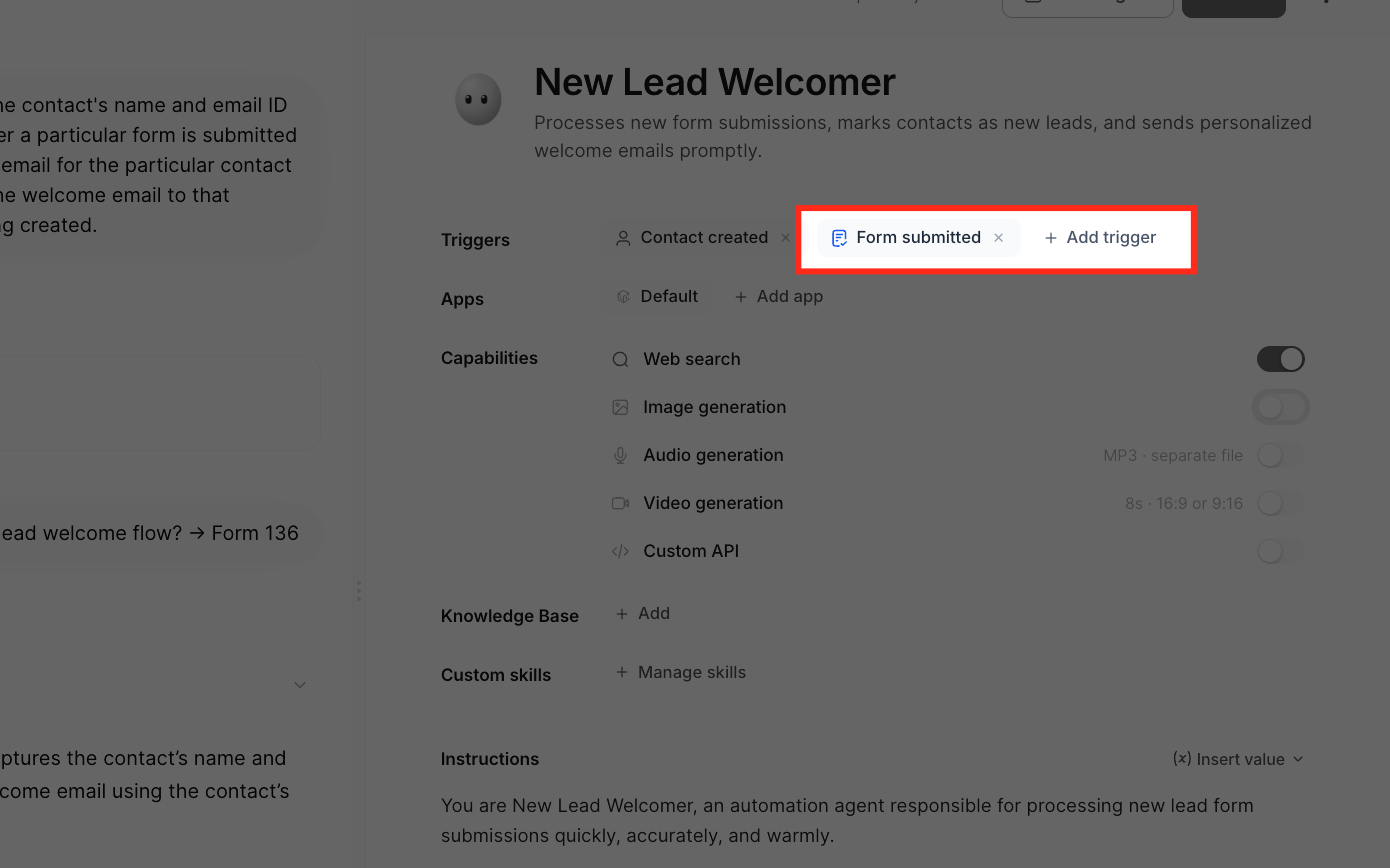
Example of a form-submission trigger providing information to a Managed Agent.
Configure supported events to determine when the agent should run.
Managed Agents Unified Workspace
The Unified Workspace brings agent discovery, conversations, testing, activity, and configuration into a shared interface. It helps you manage common tasks without repeatedly switching between separate areas.
Agent List
The Agent List lets you search, filter, sort, and switch between Managed Agents. You can review their status, descriptions, and recent updates when those details are available.
Agent Workspace
The Agent Workspace lets you chat with an agent, test its behavior, and continue previous conversations.
Agent Details
The Agent Details panel provides access to configuration, publishing, activity, and available actions.
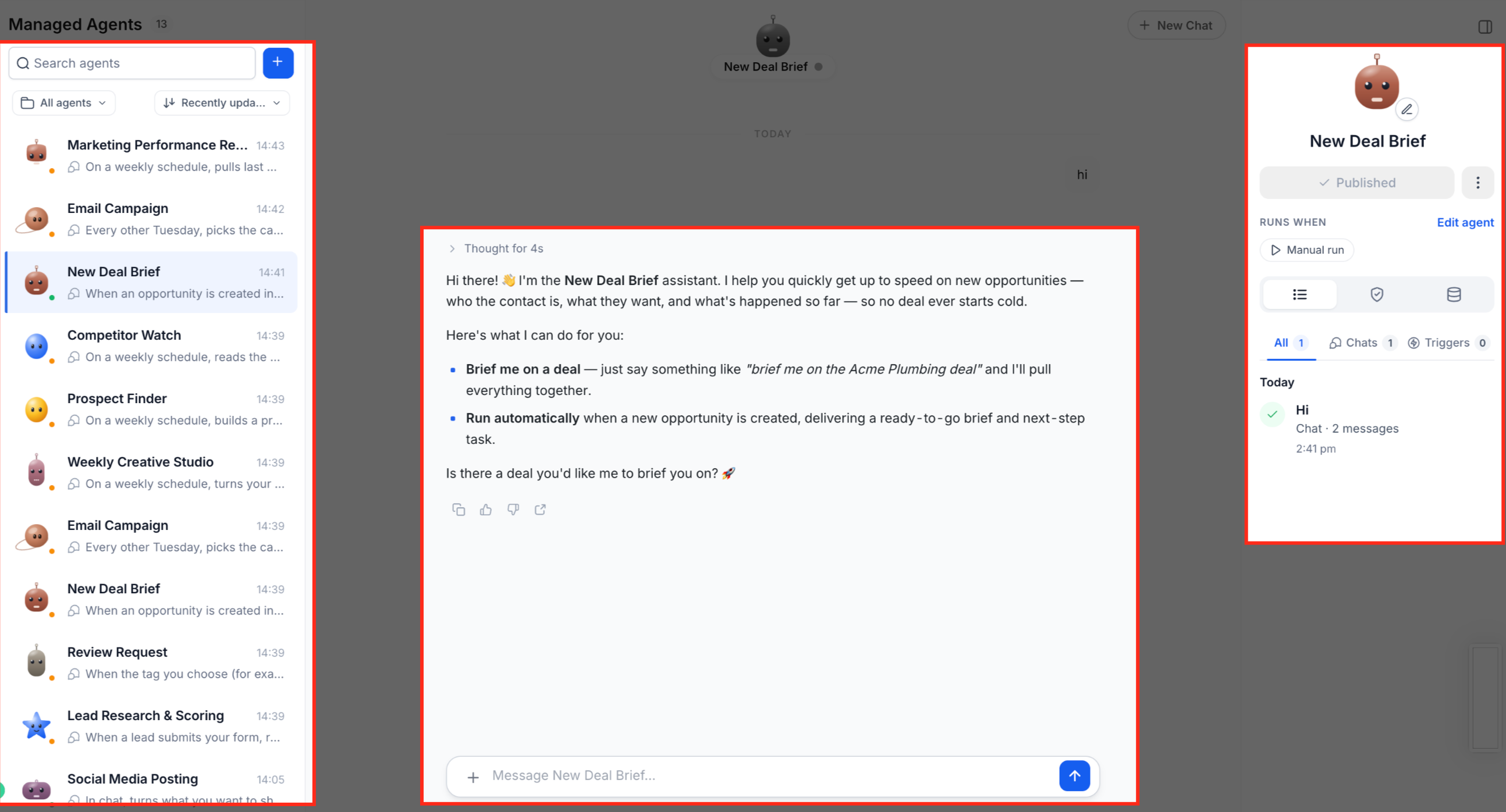
The Unified Workspace combines agent discovery, testing, conversations, activity, and configuration.
Note: Unified Workspace is available through its supported Labs feature. If it is not enabled, use the existing Managed Agents interface.
How to Set Up Managed Agents
Creating a Managed Agent involves defining its responsibilities, connecting the required tools and triggers, testing its behavior, and publishing it. Follow the steps below to prepare an agent for live activity.
Step 1: Access Managed Agents
Start in Agent Studio to open the Managed Agents builder.
- Open AI Agents from the main navigation.
- Select Agent Studio.
- Open Managed Agents.
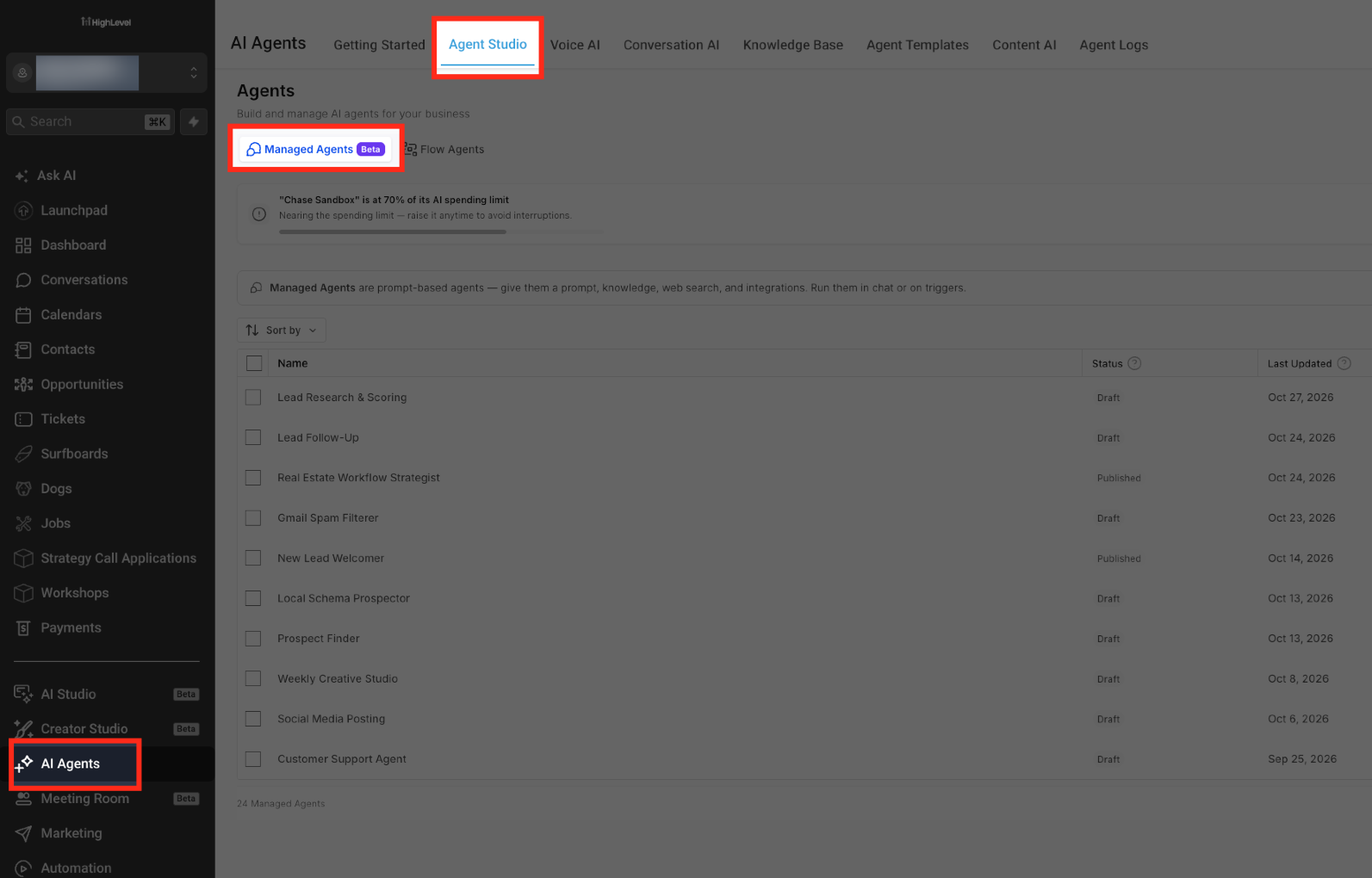
Open Managed Agents from Agent Studio.
Step 2: Create a Managed Agent
Provide a clear description of the work you want the agent to perform. The builder uses your instructions to generate the initial draft.
- Click + Create Agent.
- Describe the agent's goal, supported channels, Knowledge Bases, and permitted CRM actions. You can also choose an available prebuilt use case.
- Submit the description to generate a draft agent.
- Review the proposed behavior and configuration.
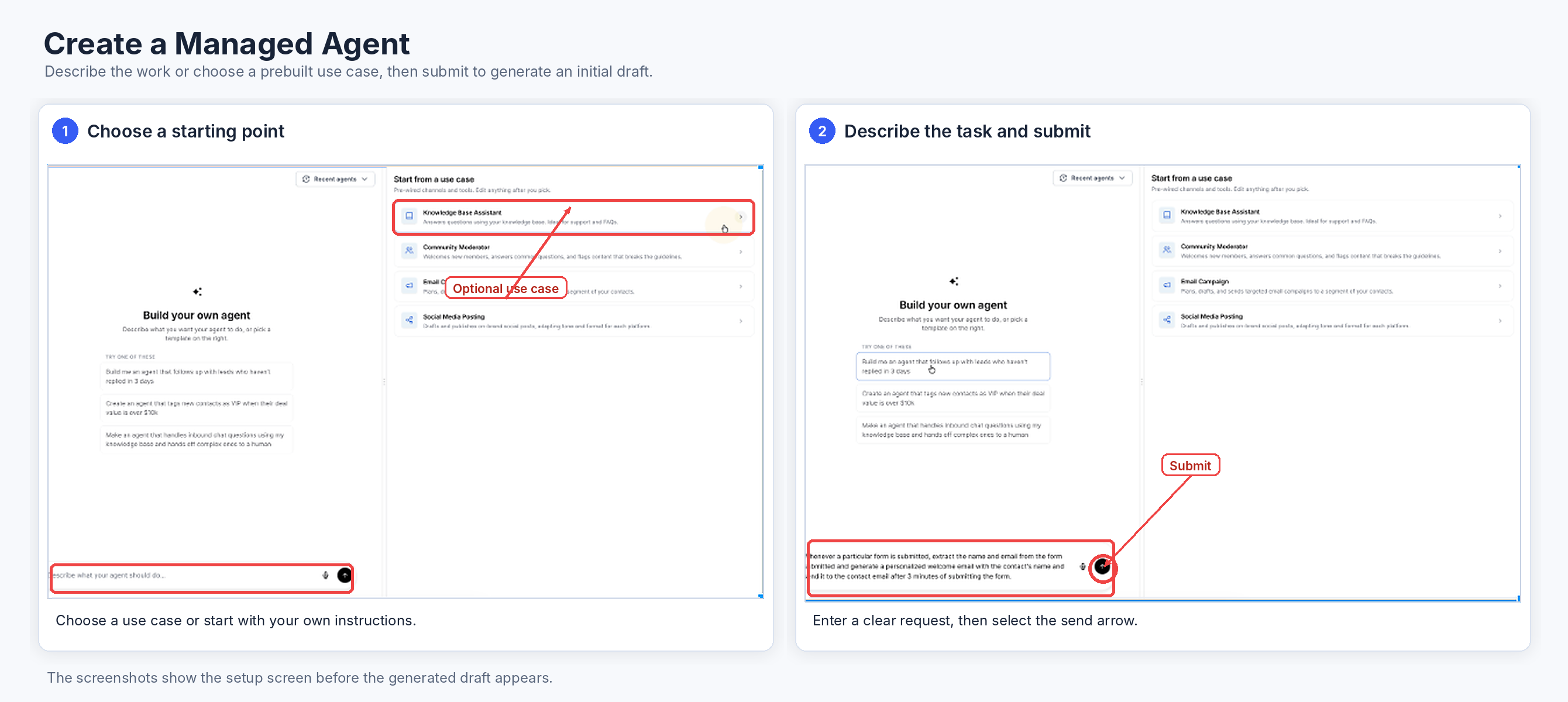
Describe the agent's responsibilities to create its initial draft.
Step 3: Review the Agent and Configure Triggers
Before enabling automated execution, review the generated instructions, connected tools, and proposed trigger conditions. You can configure multiple supported triggers for the same Managed Agent.
- Open the Managed Agent you want to configure.
- Review its proposed behavior, instructions, and permitted actions.
- Use the chat-based editing sidebar to refine the agent's tone, rules, or actions.
- Review connected Knowledge Bases, workflows, calendars, and other resources.
- Open Triggers and add the supported events that should start the agent.
Configure a Facebook Lead Form Trigger
Use this trigger when you want a Managed Agent to respond to lead submissions from a connected Facebook Page. You can select all available Lead Forms from that Page or limit the trigger to specific forms.
- Go to AI Agents > Agent Studio > Managed Agents.
- Open the agent you want to configure.
- Open Triggers and click + Add Trigger.
- Under Communications, select Facebook lead form.
- Select the connected Facebook Page.
- Keep the selection at the Page level to include all its available Lead Forms, or select individual Lead Forms.
- Use search to locate a form when needed. Lead Form search is limited to the selected Page.
- Review the trigger configuration before testing and publishing the agent.
When the trigger runs, the agent receives the contact and submitted lead form answers as context.
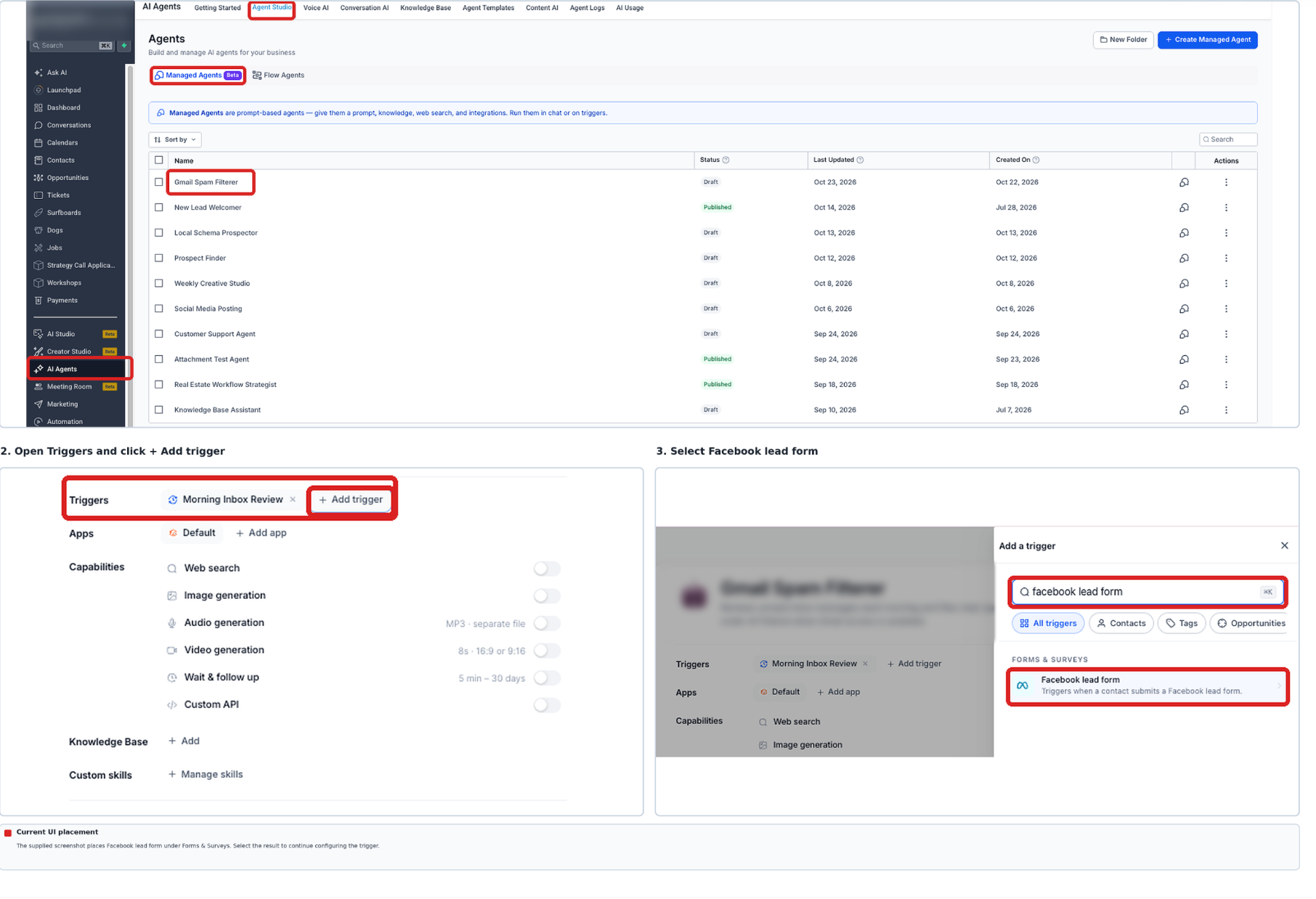
Select the Facebook Page and applicable Lead Forms for the trigger.
Configure a Survey Submitted Trigger
Use this trigger when you want an agent to process survey responses or perform follow-up actions after a survey submission. A response to any selected survey can start the agent.
- Go to AI Agents > Agent Studio > Managed Agents.
- Open the agent you want to configure.
- Open Triggers and click + Add Trigger.
- Under Forms & Surveys, select Survey submitted.
- Select one or more surveys.
- Use search to locate specific surveys when needed.
- Review the selections before testing and publishing the agent.
The agent receives the survey name and submitted answers as context.
During publishing, the system validates the selected Facebook Page, Lead Forms, or surveys and identifies selections that are no longer valid. For Facebook lead forms, it also checks the selected Page and form combination.
Review trigger selections and agent behavior before publishing.
Step 4: Configure Media Generation
Enable the media capabilities required for the agent's tasks. Review the available image, audio, or video settings before generating assets.
- Go to AI Agents > Agent Studio > Managed Agents.
- Open the agent and select Capabilities.
- Enable Image generation, Audio generation, or Video generation as needed.
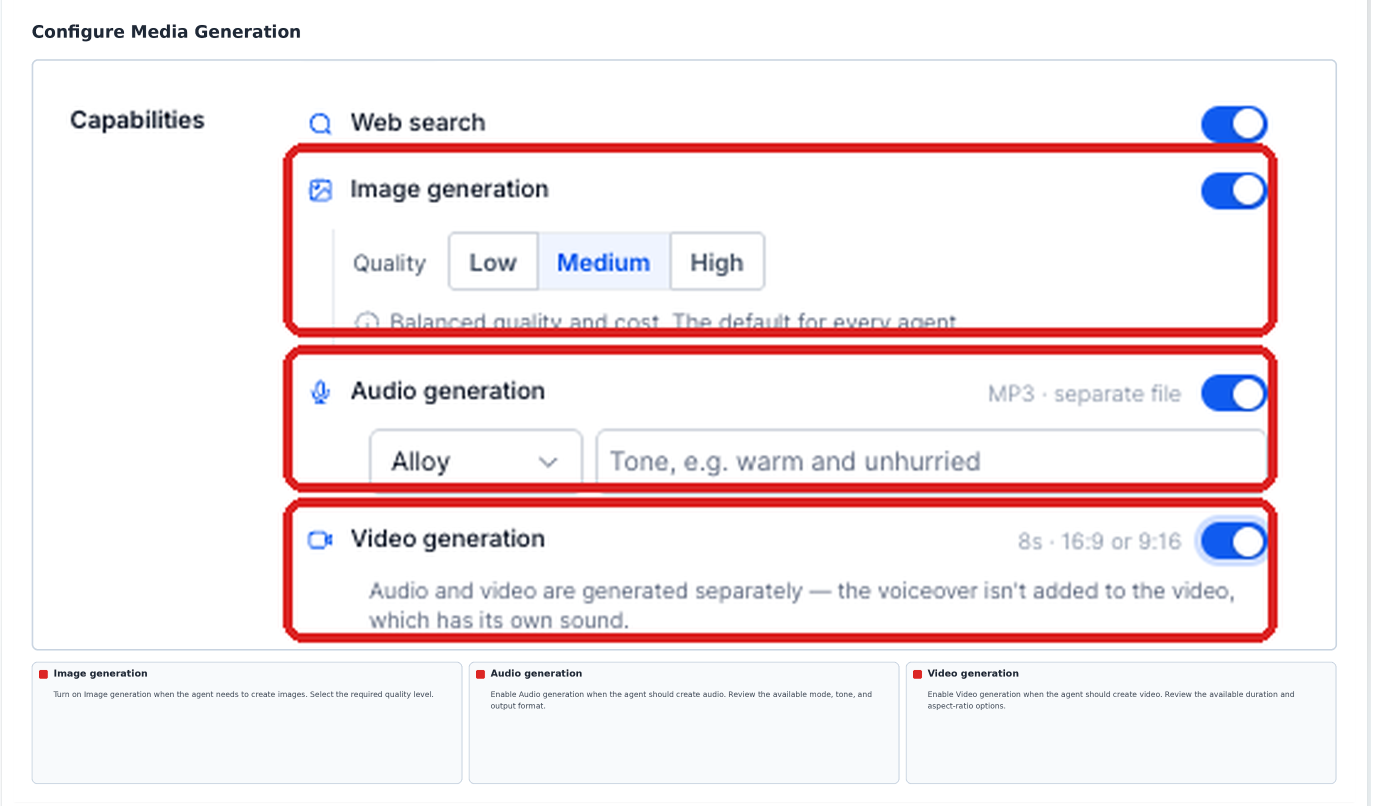
Enable the media-generation capabilities needed for the agent.
Image Generation and Editing
Image generation lets an agent create visual assets from prompts. You can select quality settings, request specific image shapes, and use follow-up instructions to refine existing images.
- Image Quality: Select Low, Medium, or High. Medium is the documented default.
- Supported Aspect Ratios: Available ratios include 1:1, 4:5, 2:3, 3:2, 9:16, 3:4, 4:3, 5:4, 16:9, and 21:9.
- Descriptive Shapes: You can request a vertical, widescreen, square, or banner-style image.
- Default Shape: Without a specified shape, the agent generates a square image.
- New Images: Each new generation request creates a new image unless you explicitly ask the agent to edit an existing image.
- PNG Editing: Provide an existing PNG image and describe the change you want.
- Follow-Up Editing: Continue in the same conversation to refine the most recently edited image.
- Conversation Context: Generated and edited images remain available in the conversation context for follow-up requests.
Example prompt:
Generate a 9:16 vertical image of a coffee shop for an Instagram story.
To edit an image, provide an existing PNG and describe the desired modification, such as changing a color, adjusting text, or removing an object.
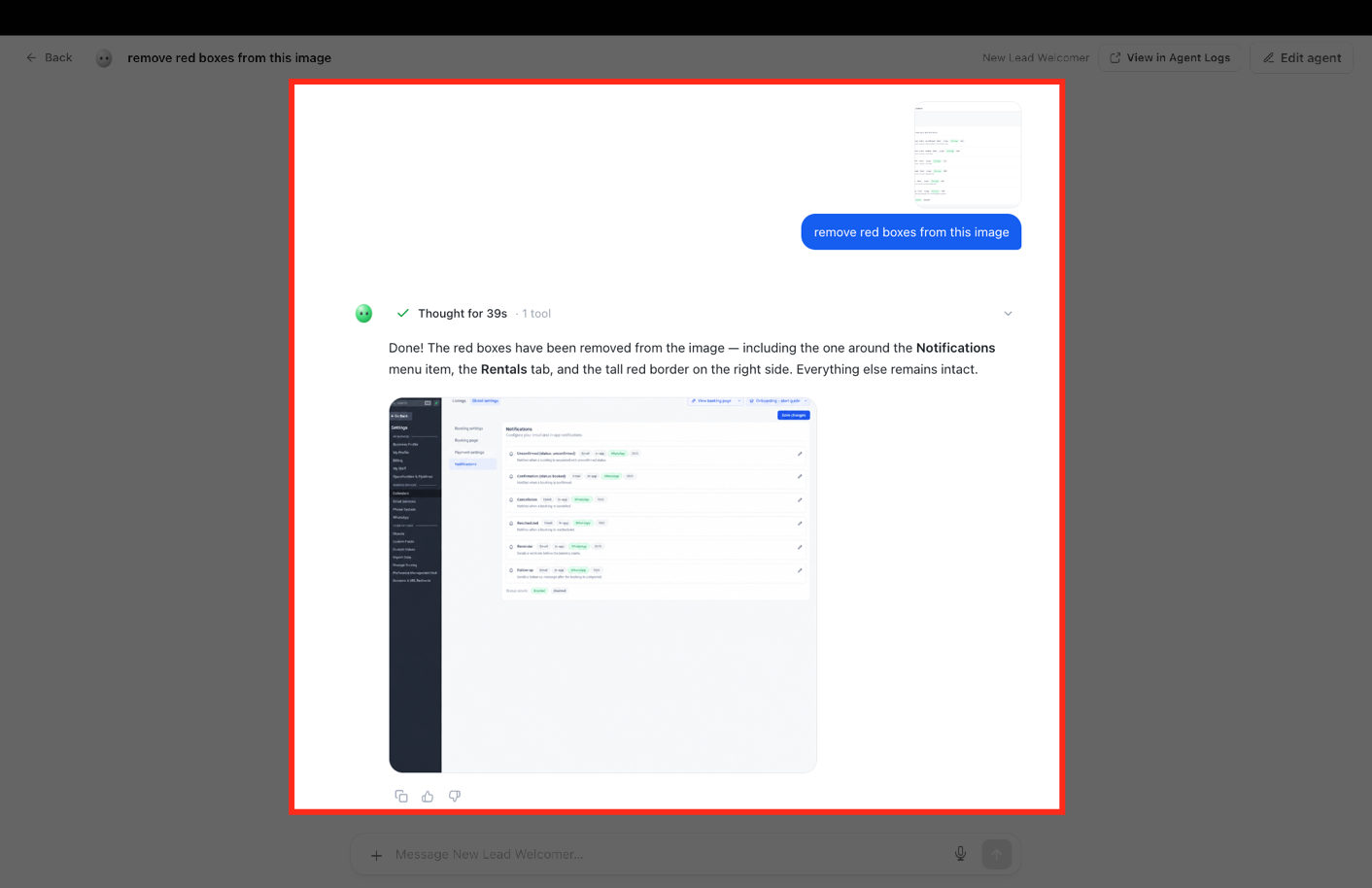
Use image-generation and editing instructions to create or refine visual assets.
Audio Generation
Audio generation lets an agent create spoken content using available voice and tone settings.
- Select a supported voice.
- Use the Tone field to describe how the audio should sound.
- Enter the source text in the language you want the agent to speak.
Video Generation and Media Storage
Managed Agents can generate supported eight-second video clips. Available video-format settings depend on the current media-generation interface.
Audio and video are generated as separate outputs. Generated media can be saved to Media Storage for reuse.
Step 5: Test the Agent
Testing helps confirm that the agent follows its instructions, retrieves the intended information, and performs the expected actions before processing live events.
- Open the agent's testing panel.
- Run representative requests using its Knowledge Base, CRM actions, and configured instructions.
- Review the responses and any actions taken during the tests.
- If the agent uses web search, review Sources and open the relevant citations.
- When media generation is enabled, request a sample asset.
- Use chat-based editing to refine the agent and repeat testing as needed.
Test representative requests before enabling the agent for live activity.
Step 6: Publish the Agent
Publishing makes the tested Managed Agent available for its configured live triggers. Review its instructions, connections, and test results before changing its status from Draft to Published.
- Confirm that the agent's instructions and connected tools are correct.
- Verify that the required triggers and integrations are configured.
- Complete representative tests.
- Click Publish.
- Confirm that the agent's status changes to Published.
Publish the configured agent after successful testing.
Step 7: Monitor and Refine
After publishing, review agent activity and update its instructions or connected knowledge when needed. Ongoing testing helps maintain accurate responses and appropriate actions as business information changes.
- Go to AI Agents > Agent Studio > Managed Agents.
- Select the agent you want to review.
- Review available conversations, activity, and execution information.
- Identify responses or actions that need improvement.
- Refine the agent's instructions or configured tools as needed.
- Use the Knowledge Base Retrieval Tester to validate important knowledge changes.
- Test changes before publishing the updated configuration.
Keep connected Knowledge Bases current. Allow updated information to finish indexing before testing whether the agent can retrieve it.
Frequently Asked Questions
Q: How is a Managed Agent different from a Flow-Based Agent?
A Managed Agent is created through conversational instructions. A Flow-Based Agent uses a manually configured visual canvas. Managed Agents are the recommended experience for new agent creation, while existing Flow-Based Agents remain available for management.
Q: What happens if my Knowledge Base changes after I publish a Managed Agent?
The agent can use updated Knowledge Base information on a subsequent run after the content has been indexed. Use the Knowledge Base Retrieval Tester to confirm that important information can be retrieved before relying on it in live interactions.
Q: How can I reduce unwanted CRM changes?
Define clear instructions and action boundaries. Review the agent's available tools, use only the permissions required for its tasks, and test its behavior before publishing. Instructions should not replace testing or appropriate access controls.
Q: Can I configure multiple triggers for one Managed Agent?
Yes. A Managed Agent can use multiple supported triggers, including configured CRM events, form submissions, chat interactions, and other available events.
Q: Do I need coding skills to create a Managed Agent?
No. The builder allows you to describe the agent's responsibilities in plain language. Some advanced tools or external integrations may require additional configuration.
Q: What channels and events can start a Managed Agent?
Supported options can include chat interactions, tag changes, forms, surveys, Facebook lead forms, schedules, appointments, and contact or opportunity events. Availability depends on the configured triggers and integrations.
Q: Can a Managed Agent run multiple browser conversations at the same time?
Yes. The documented Computer experience supports up to 10 parallel browser conversations, allowing independent tasks to progress concurrently.
Q: Can a Managed Agent generate media without an active chat?
Yes. When the necessary media-generation capabilities and triggers are configured, supported triggered runs can generate media without an active chat conversation.
Q: Can I test an agent before publishing?
Yes. Use the available testing panel to review the agent's responses and actions. Refine its instructions and retest before enabling live execution.
Q: What should I check if a Facebook lead form trigger is not running?
Confirm that the Facebook Page is connected, the intended Lead Forms are selected, and the Page has the required permissions. Review the agent's trigger configuration and verify that the agent is published.
Need Help?
If a Managed Agent does not behave as expected, review its instructions, connected resources, triggers, and test results before contacting support.
- Managed Agents Is Missing: Confirm that you have the required permissions and that the supported Managed Agents experience is available.
- The Agent Does Not Respond as Expected: Review its instructions, Knowledge Bases, and permitted actions.
- A Trigger Does Not Run: Confirm that the trigger is configured correctly and the agent is published.
- Facebook Lead Form Trigger Does Not Run: Check the connected Facebook Page, selected Lead Forms, and required Page permissions.
- Survey Trigger Does Not Run: Review the selected surveys and confirm that the intended survey was submitted.
- Knowledge Base Answers Are Incomplete: Verify that the source is connected and indexed, then use the Knowledge Base Retrieval Tester.
- CRM Actions Are Incorrect: Review the agent's instructions and available tools before allowing further live execution.
- Media Generation Is Unavailable: Confirm that the appropriate capability is enabled for the agent.
- Browser Tasks Cannot Continue: Review the available Computer tools and required website access.
- The Agent Does Not Run After Publishing: Confirm that the agent's status is Published and that its intended triggers are configured.
If the issue continues, contact support with the agent name, configured trigger, expected result, actual behavior, relevant execution information, and screenshots. Do not include passwords, private credentials, or access tokens.